
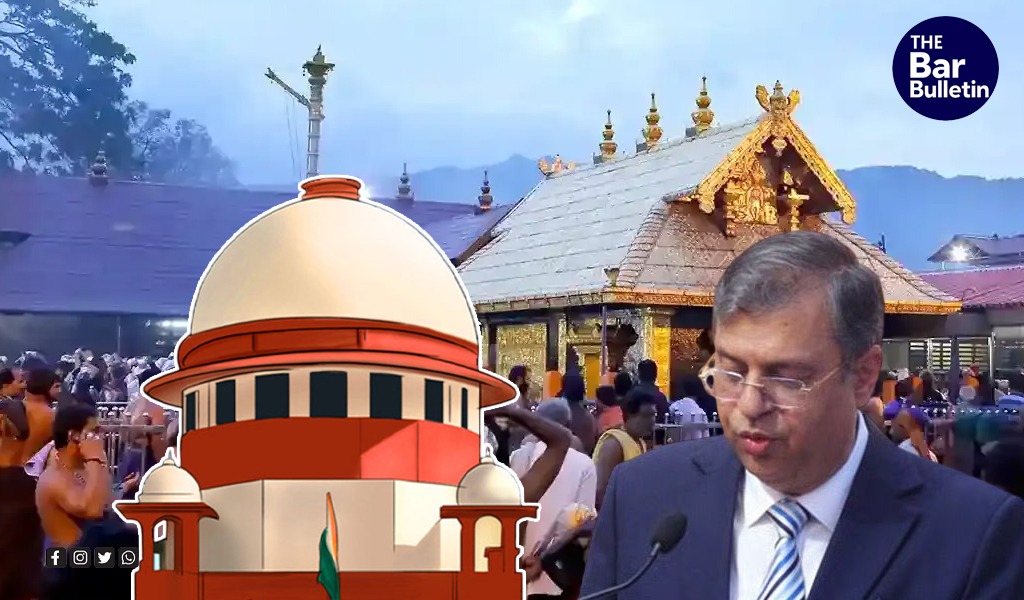

The Supreme Court Constitution Bench on Wednesday heard submissions of Senior Advocate Rakesh Kumar Khanna on the relationship between Articles 25 and 26 of the Constitution, with arguments stressing that religious denominations cannot claim immunity from constitutional scrutiny beyond that available to Parliament or State legislatures.
“When a State Legislature or Parliament formulates laws, they are subject to fundamental rights. The will of a small collective or section cannot be given immunity beyond what is provided to Parliament and the State itself. Any norms formulated by a section of society can only be said to represent the will of that section.”
Making submissions before the nine-judge Bench, he argued that Article 26 confers only an “enabling collective right” upon religious denominations and must remain subject to the larger constitutional framework, including fundamental rights under Part III.
According to the submissions, Article 25 protects the individual dimension of religious freedom, while Article 26 recognises the collective institutional dimension flowing from it.
“Article 25 serves as a constitutional gateway through which persons professing a common faith may organise themselves into a religious collective or institution. It is this collective… that Article 26 recognises.”
Mr Khanna further argued that religious customs, tenets and denominational norms should fall within the broad definition of “law” under Article 13 and therefore remain open to constitutional scrutiny. He argued that Article 13 does not merely cover legislation but also includes customs and usages.
The submissions also relied on Hans Kelsen’s “Pure Theory of Law”, describing the Constitution as the “grundnorm” and denominational rules under Article 26 as subordinate norms that must yield to constitutional guarantees.
The Court, however, observed that a small religious group establishing its own institution with distinct practices cannot later be overridden merely because larger numbers subsequently join or disagree with those principles.
“Just because today the majority wants a reform doesn’t mean that the entity which has itself initiated something… can be overridden,” the Bench remarked.
Mr Khanna clarified that his argument was not about parliamentary supremacy over religion, but only that denominational norms and rules remain subject to judicial review under the Constitution.
On the limits of denominational autonomy under Article 26(b), he submitted that Article 26 protects institutional matters such as doctrine, rituals, and appointment of religious functionaries, but does not confer “plenary authority” over the conscience and personal choices of individual members.
Concluding his submissions, Mr Khanna urged the Court to define the constitutional boundaries between protected denominational autonomy and individual dignity through principles of harmonious construction and essential religious practices.