
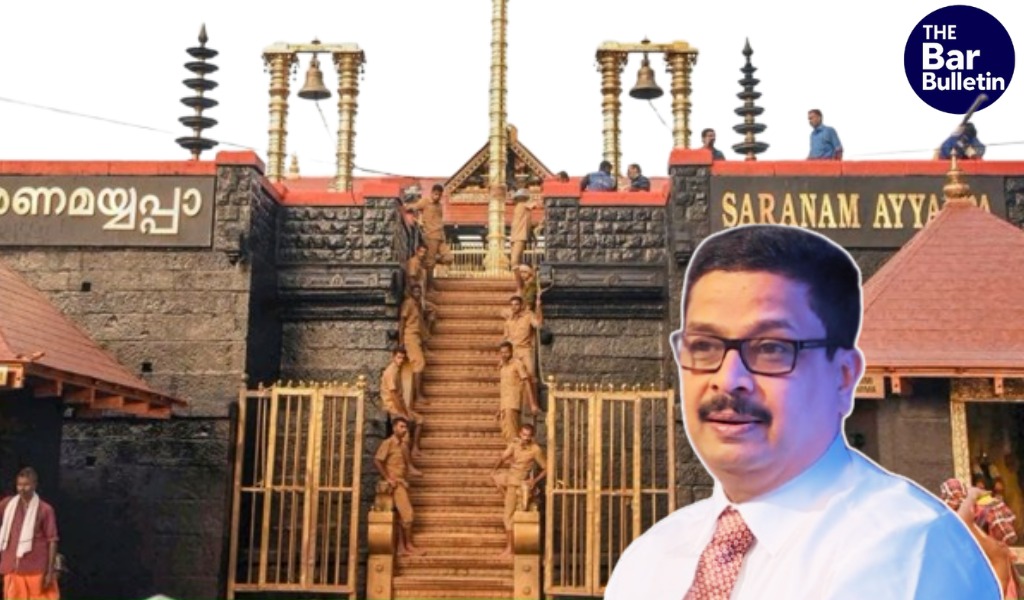
Senior Advocate M.R. Venkatesh, appearing in the Sabarimala review proceedings, argued before the Supreme Court that key constitutional expressions such as “religious practice” under Article 25 and “religious denomination” under Article 26 are inherently indeterminate and incapable of precise definition, cautioning against rigid judicial interpretation.
Opening his submissions, Sr Adv Venkatesh contended that the concept of “denomination” has deep foreign roots, traceable to Christian ecclesiastical structures and later adopted into the Irish Constitution, thereby limiting its contextual suitability in interpreting Indian religious traditions. He submitted that Articles 25(2)(a) and 25(2)(b) are sui generis provisions, uniquely tailored to Indian conditions without any international precedent, and therefore require a careful, context-specific interpretation.
Raising concerns over the classification of temples, he argued that a narrow understanding of denominational temples risks rendering non-denominational temples as mere public spaces “like a bus stand,” stripping them of constitutional protection under Article 26.
On the scope of State intervention, Sr Adv Venkatesh submitted that the controlling test under Article 25(2)(a) must be whether a law is predominantly secular in character with only incidental impact on religion. Any reversal of this approach where religious practices are assessed through a secular lens distorts the constitutional scheme and leads to excessive interference.
He strongly criticised the Essential Religious Practices (ERP) doctrine, arguing that identifying and redefining core religious practices under the guise of regulating secular activities amounts to an impermissible abridgment of religious freedom, violating Article 13(2).
Emphasising constitutional structure, Sr Adv Venkatesh warned that a secular State cannot disproportionately curtail religious freedoms beyond the limits expressly provided under Article 25(1), submitting that excessive intervention would run contrary to the basic structure doctrine.
Referring to Dr. B.R. Ambedkar’s Constituent Assembly speeches, he argued that a crucial distinction between “untouchability” and temporary notions of defilement central to the constitutional scheme was overlooked in the Sabarimala judgment.
On interpretation, Sr Adv Venkatesh submitted that if the Court adopts an expansive reading of the freedom of religion under Article 25(1), the scope for judicial and legislative intervention must correspondingly narrow. He maintained that Article 25(2)(a) permits regulation only of secular activities associated with religion and cannot be used to intrude upon core religious practices.
Concluding, he cautioned against reversing the constitutional balance by reading religious practices through secular frameworks, urging the Court to adopt a restrained, non-invasive approach that preserves the autonomy of religious traditions.