
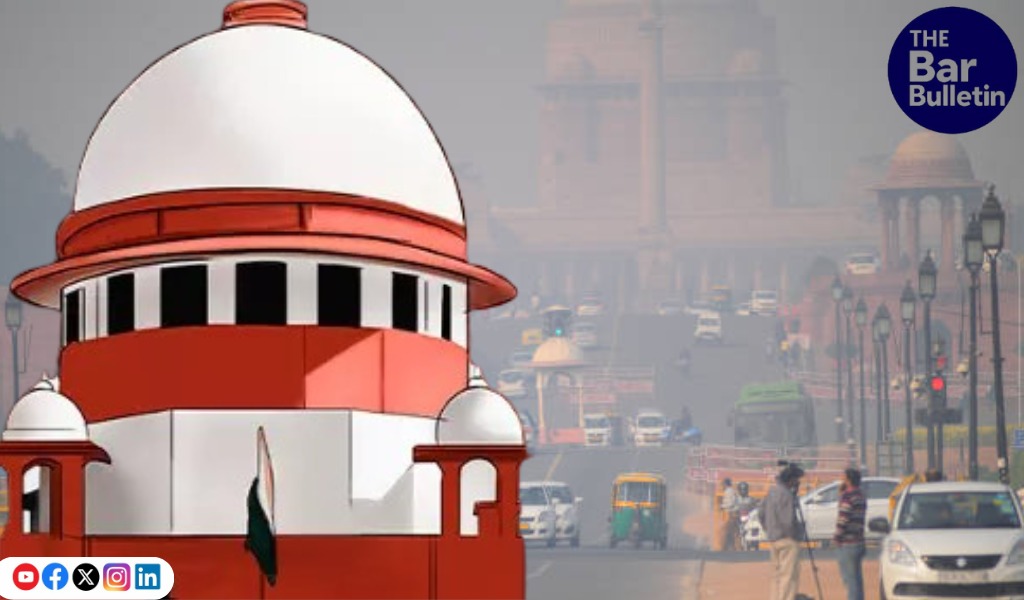

A Bench led by Chief Justice of India Suryakant and Justice Jyotirmayaa Bagchi on Monday reviewed the alarming air-quality situation in Delhi–NCR and called for a comprehensive, data-backed evaluation of all pollution-control measures currently in place. The Court pressed for clarity on what has worked, what has failed, and why.
The Bench emphasised that it must be informed to what extent existing action plans on stubble burning, vehicular emissions, road dust, industrial pollution, waste burning, and construction debris have actually been implemented, and what proportionate improvement (if any) has resulted from past interventions.
The Court remarked that while formal prohibitions exist “on paper,” ground-level compliance is often negligible. It directed:
• All NCR States (Delhi, Haryana, Punjab, Uttar Pradesh, Rajasthan) to file updated Action-Taken Reports (ATRs) under each pollution category.
• The Commission for Air Quality Management (CAQM) to file a consolidated status report detailing specific improvements, lapses, and scientific analysis.
• The Central Pollution Control Board (CPCB) to explain the reported malfunctioning of air-quality monitors, as inaccurate measurements undermine timely enforcement.
CAQM officials informed the Court that although stubble-burning cases have reduced nearly 90% from 2020 levels, the target of “zero stubble burning” remains unmet. The Court, however, highlighted that stubble burning forms only a short-term, periodic contributor and insisted on equal focus on diesel vehicular emissions; construction dust; road dust compounded with toxic particular; emissions from thermal power plants; industrial pollutants and DG sets and biomass burning
The Court also took note of submissions that Delhi has more registered vehicles than several major Indian metros combined.
The Bench questioned the repeated extensions granted since 2015 for emission-norm compliance by coal-based thermal power plants. The Court observed that such deferrals raise serious concerns and sought CAQM’s scientific analysis on the quantum of pollution attributable to non-compliant thermal units.
Reiterating that the issue must remain non-political and grounded in science, the Court said:
“Solutions must come from subject experts. If existing plans are weak or ineffective, they must be revisited. We need feedback backed by data not assumptions.”
The amicus also flagged issue regarding illegal parking choking arterial roads; inadequate enforcement of traffic and parking rules; on-ground implementation of parking and mobility policies.
The Court directed all authorities to file their reports before the next hearing, noting the urgency of the issue:
“We may revisit this twice a month, if required. We need visible, measurable change not just paperwork.”
The matter will be taken up again on 10 December 2025.