

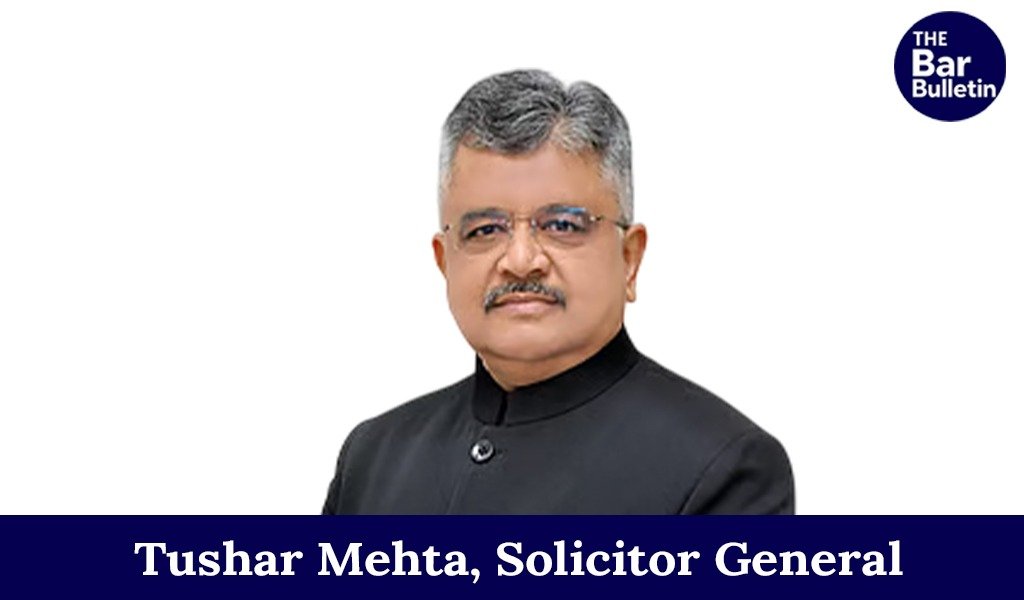
The Supreme Court’s seven-judge Bench on Tuesday began hearing a reference concerning the legislative competence of State legislatures to impose a surcharge or additional tax on sales and purchases, with Solicitor General Tushar Mehta submitting that the issue may have become largely academic after the introduction of the Goods and Services Tax (GST) regime in 2017.
A seven-judge Constitution Bench comprised of Chief Justice Surya Kant and Justices K.V. Viswanathan, S.V.N. Bhatti, Joymalya Bagchi, N.V. Anjaria, Arun Palli and V. Mohana.
The reference arose from conflicting views in the five-judge Bench judgment in S. Kodar v. State of Kerala, 1974 AIR 2272 and the three-judge Bench judgment in Hoechst Pharmaceuticals Ltd. v. State of Bihar, (1983) 4 SCC 45, as well as observations made by the seven-judge Bench in India Cements Ltd. v. State of Tamil Nadu, (1990) 1 SCC 12. The reference asks whether a State legislature can impose a surcharge, additional tax, levy or cess on sale or purchase when it is calculated on the basis of a validly levied sales or purchase tax.
Solicitor General Tushar Mehta submitted that the introduction of GST had substantially changed the position.
“
“After 2017, when there is a regime change, GST has now taken over. These questions may have become academic. There may be some very few and far between cases pending. But they may not be in three digits also.”
Mehta, however, sought to preserve the Centre’s contention concerning India Cements. He submitted that India Cements had subsequently been dealt with by a nine-judge Bench judgment and that the Centre had filed a curative petition. He added that the Centre wished to argue that the Mineral Area Development Authority (MADA) judgment required reconsideration, although not necessarily in the present proceedings.
He further requested that, if the Court proceeded on the basis that the effect of the subsequent nine-judge Bench judgment removed the conflict surrounding Kodar, the Centre’s contention that the overruling of India Cements itself required reconsideration should be left open. The Bench agreed to record the submission.
CJI observed MADA had held that the proposition in India Cements treating royalty as a tax was no longer good law, but that the present reference involved a different question.
The Bench noted that MADA concerned royalty on minerals and that the precise situation concerning an additional surcharge had not arisen there. SG pointed out that India Cements involved two distinct aspects: its treatment of royalty as a tax and its approach to determining legislative competence by examining the legislative power to impose the initial tax. The latter aspect, counsel submitted, could potentially survive.
He clarified that the Centre did not necessarily seek to argue that issue in the present proceedings. He requested that, if the seven-judge Bench proceeded on the basis that the subsequent nine-judge judgment had removed the conflict surrounding Kodar, the Centre should be permitted to raise separately the contention that the overruling of India Cements itself requires reconsideration. The Bench agreed that the submission could be recorded.
On Kodar, counsel for petitioner argued that it had been doubted only in the context of its perceived conflict with India Cements, and not as a general proposition of law. The Bench noted that Kodar had received approval in part, including on the proposition that the nomenclature of a tax and the measure of tax liability are not necessarily the dominant factors in determining the nature of a levy.
Counsel also pointed out that Kodar had been relied upon in Hoechst, submitting that the real conflict was between Kodar and Hoechst, on the one hand, and India Cements, on the other. Relying on Kodar, counsel further submitted that once a legislature possesses the power to impose a tax, it also possesses the power to impose an additional tax. He said: “Once you have the power to tax, you have the power to tax additionally also.”
Counsel acknowledged reservations concerning the proposition but maintained that the issue could not be reopened in the present proceedings unless the relevant principles in MADA were revisited.
Counsel appearing for Odisha informed the Bench that the lead matter arose from Odisha and concerned a sugar mill against which surcharge had been imposed under Section 5A. The matter was pending in an SLP after proceedings before the High Court. The Bench indicated that if the matter was identical to the lead case, it could be disposed of along with it.
Counsel, however, stressed that the present proceedings concerned only the reference on law and that the validity of individual statutes, along with other issues arising in the respective cases, would have to be considered separately.
Counsel for Punjab then raised a separate question concerning the measure of the surcharge. He submitted that, apart from legislative competence to impose an additional tax, the Court would have to consider whether taxable turnover could be used as the basis for the levy.
Relying on Kodar and the Keshav Ram test, counsel argued that the measure of a levy is not by itself the dominant test for determining its nature.
“
“The measure of tax liability, what is the value on which the rate is applied, is not the dominant test to understand what is the nature of tax liability. If you have legislative competence to impose a tax, you have the competence to impose additional tax. Surcharge is only a nomenclature of an additional tax.”
On the practical impact of the reference, SG submitted that the issue had become largely academic in view of GST and the limited number of pending matters.
Counsel also pointed out that, in Punjab, the surcharge could be passed on under the relevant legislation, potentially leaving no recovery dispute to be decided.
On the GST framework, SG Mehta submitted that States now operate within a system where the Centre and States function as federal partners in relation to the same taxable event. He described the GST Council as a constitutionally created body through which the Centre and States determine the taxation framework through discussion, exchange of ideas and give-and-take, with unanimity emerging through the process.
The parties finally sought liberty to raise issues falling outside the present reference in appropriate proceedings. The Bench accordingly de-tagged the Punjab Social Security Act matters.