
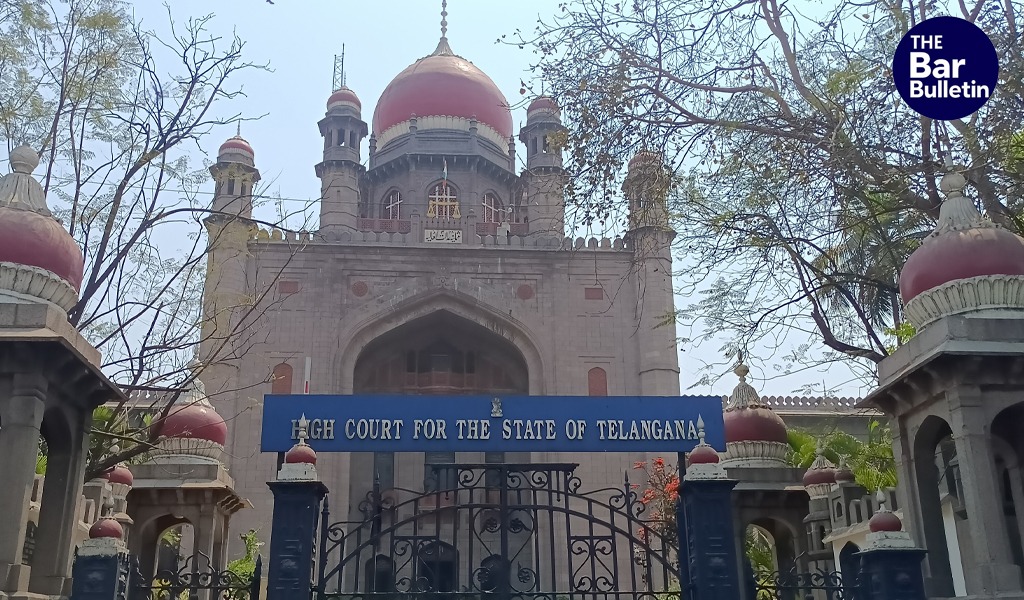

The Telangana High Court at Hyderabad Bench has clarified that where a corporate debtor holding project rights through an Special Purpose Vehicle (SPV) undergoes insolvency resolution under the IBC, and the approved resolution plan under Section 31 contemplates transfer of shareholding and control subject to governmental consent, the State’s grant of such consent in furtherance of the approved plan is not a fresh award of State largesse, but an act undertaken within and bound by the statutory framework of the IBC; by virtue of Sections 31 and 238 of the IBC, the resolution plan is binding on all stakeholders, including shareholders and the State, and any inconsistent claims founded on prior contractual arrangements or other laws must yield to the Code.
The Court held that a shareholder of the corporate debtor cannot assert an independent proprietary or contractual right in respect of project assets or leasehold rights outside the corporate entity, since such rights vest in the company as a distinct juristic person, and upon insolvency resolution the extinguishment or dilution of shareholder interest is merely a commercial consequence of the statutory resolution process, constituting procedure established by law, and does not amount to unconstitutional deprivation of property under Article 300A requiring compensation.
The Court also held that where differential treatment between the erstwhile controlling shareholder and a minority technical/operator entity is based on their distinct legal and functional positions post-CIRP, no violation of Article 14 arises. Further, a resolution applicant selected through the CIRP process cannot be equated with a recipient of State largesse requiring re-tendering, and issues concerning FDI compliance fall for examination by competent regulatory authorities rather than by the writ court in the absence of manifest illegality.
The Division Bench comprising the Chief Justice Aparesh Kumar Singh and Justice G.M. Mohiuddin treated the overriding effect of the IBC and the binding nature of the approved resolution plan as the fulcrum of the dispute. It held that the appellant’s allegation that the State had transferred a public project to respondent No. 4 without public tender ignored the statutory scheme of the IBC. Referring to Section 238, the Bench observed that the IBC is a comprehensive special legislation with an overriding non-obstante clause, and noted that the legal position on primacy of the IBC was no longer res integra.
The Bench observed that once a resolution plan is approved under Section 31, it becomes binding on the corporate debtor and all stakeholders. Since the plan approved by the NCLT on February 07, 2020 specifically contemplated transfer of entire shareholding and control of GJHPL and made implementation conditional upon State consent, the State’s subsequent decision dated September 22, 2025 was held to be an act in furtherance of the approved resolution plan, and not an exercise of fresh power to distribute State largesse.
The Bench specifically observed that the project was implemented through GJHPL, which alone entered into the Lease Deed and DMA with the State, and therefore the rights of consortium members, including the appellant, were mediated exclusively through their shareholding in that corporate entity. The Bench held that the appellant, being merely a shareholder of the corporate debtor, could not assert any independent or superior right over the project outside the corporate entity.
On the plea under Article 300A, the Bench observed that the appellant had no independent or direct right in the leasehold property or the project, and whatever rights it possessed were derivative, flowing solely from its shareholding in GJHPL. The extinguishment or dilution of its interest was held to be a direct consequence of the insolvency of the corporate debtor and implementation of the approved resolution plan, and not a deprivation of property dehors authority of law. The loss suffered by the appellant was characterized as a commercial consequence of insolvency proceedings rather than compulsory acquisition by the State, and therefore compensation under Article 300A was held not to arise.
Briefly, the appeal impugns the order passed by the Single Judge, whereby the writ challenging the decision of the Empowered Committee (Tourism) dated September 22, 2025 was dismissed with costs of Rs. 10 lakhs. The challenged decision had granted a No Objection Certificate in favour of respondent No. 4, the successful resolution applicant under the Insolvency and Bankruptcy Code, 2016, for change in shareholding and control of M/s Golden Jubilee Hotels Private Limited, subject to terms and conditions, to facilitate implementation of the approved resolution plan.
The dispute traces back to a State tourism project conceived by the erstwhile State of Andhra Pradesh for development of a five-star hotel at Madhapur, Hyderabad on a Build-Operate-Transfer basis. Pursuant to an Request for Proposal (RFP) issued in 2005, a consortium comprising My Home Group as lead developer, VBC Group as financial member, and EIH Ltd. as technical member was declared successful, and an Special Purpose Vehicle (SPV), namely M/s Golden Jubilee Hotels Private Limited, was incorporated as the project company. Lease Agreements and a Development and Management Agreement, both dated May 09, 2007, were executed between the State and GJHPL for a tenure of 33 years.
The consortium structure was such that the lead and financial members together held approximately 84% shareholding and EIH Ltd. held the remaining 16%. The project was conceived as a two-tower development, with commercial operations of Trident Hotel, Hyderabad commencing in September 2013 after completion of the first tower, while the second tower was substantially completed thereafter.
Subsequently, disputes arose among consortium members, and according to the appellant, alleged financial mismanagement and diversion of revenues by EIH Ltd. pushed GJHPL into financial distress. The loan account of GJHPL was classified as NPA by the lending consortium led by Bank of Baroda, which initiated proceedings under Section 7 of the IBC before the NCLT, Hyderabad Bench. A material term of the approved plan was that implementation was contingent on obtaining prior written consent of the State Government, including respondent Nos. 1 and 5, for change in shareholding and control of GJHPL, as a condition precedent to the plan becoming effective.
Earlier, the appellant had challenged the prospect of such change in control, which was dismissed holding that the provisions of the IBC would prevail over the TIDE Act to the extent of inconsistency. Thereafter, following delays and revived negotiations among stakeholders, the Empowered Committee (Tourism), in its meeting dated September 22, 2025, accorded conditional consent to implementation of the resolution plan. The conditions included validity of lease only for the balance period till 2041 without extension, upfront payment of Rs.88.23 crores, waiver of arbitral claims against the Government, recalculation of lease rental at Rs.7,500 per square yard from May 2007, completion and operationalization of tower 2 within 24 months, a tripartite arrangement with EIH for continued operation, withdrawal of court cases, and liberty to TGTDC to file claims before the NCLT for unsettled dues.
The appellant challenged that decision in W.P. No. 30461 of 2025, contending that the State had arbitrarily divested its accrued proprietary and contractual rights as lead developer without notice, hearing, or compensation and without following the termination procedure in the Lease Deed and DMA; that the State’s conditions impermissibly modified the approved resolution plan; that the appellant was discriminated against vis-à-vis EIH Ltd.; that the project, being State largesse, could not be effectively transferred without transparent public tender; that the transfer of 100% shareholding to a foreign entity violated the Consolidated FDI Policy; and that the Single Judge erred in treating the matter as re-litigation and imposing exemplary costs.
The respondents opposed the appeal on the basis that Section 238 of the IBC overrides inconsistent laws, the approved resolution plan under Section 31 is binding on all stakeholders, the project rights vested in the SPV and not in its shareholders individually, the State’s consent was in conformity with the plan, the conditions reflected commercial settlement and wisdom, the operator issue was commercially determined, the matter had already been concluded in earlier litigation, and FDI compliance fell within the domain of statutory authorities.
Appearances:
Advocates Suraj Prakash and Vanaparthi Vaishali, for the Appellant
Advocate General A. Sudarshan Reddy and Government Pleader I.V. Siddhivardhana, for the Respondent Nos.1 to 3 and 5
Senior Advocate Dr. Abhishek Manu Singhvi, along with Advocates Gyanendra Kumar Seni and Rajesh Maddy, for the Respondent No.4
Deputy Solicitor General of India N. Bhujanga Rao, for the Respondent No.7
