
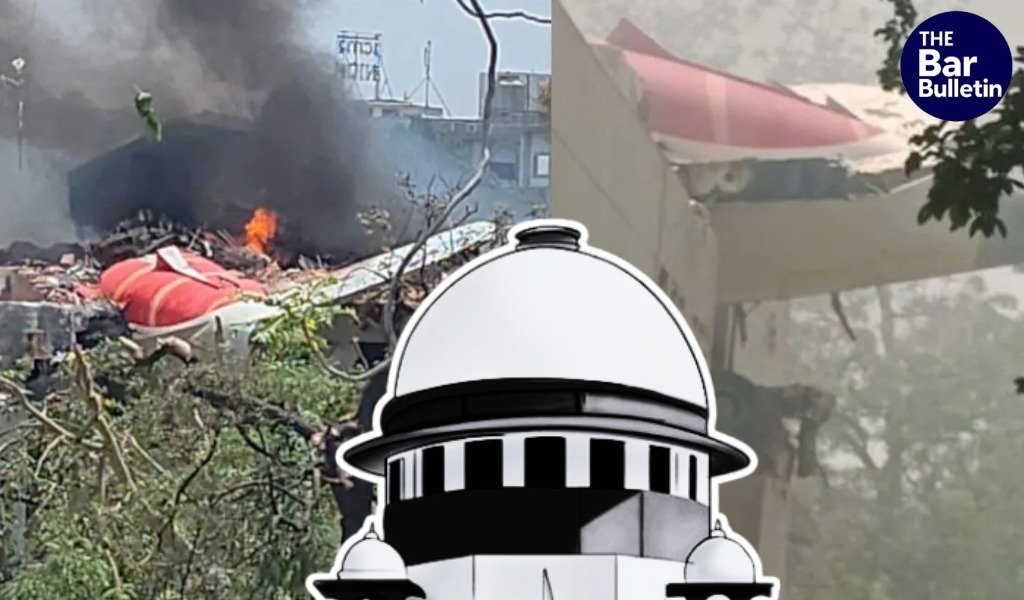

The Supreme Court on Tuesday deferred consideration of pleas seeking an independent probe into the Ahmedabad Air India Flight AI-171 crash, observing that since the Aircraft Accident Investigation Bureau (AAIB) had substantially progressed with its investigation, the Court would first await the final report before deciding whether any further inquiry by an independent body or a Court of Inquiry was warranted.
A Bench of Chief Justice Surya Kant, Justice Joymalya Bagchi and Justice V. Mohana was hearing a batch of petitions filed by, among others, the Federation of Indian Pilots and the father of the deceased pilot.
Appearing for the father of the deceased pilot, Senior Advocate Gopal Sankaranarayanan submitted that a report prepared by a US law firm, based on ten simulator tests, suggested that the aircraft’s Ram Air Turbine (RAT) had deployed even before take-off. According to him, the deployment pointed towards a possible electrical, hydraulic or thrust failure and substantially ruled out pilot intervention at that stage of the flight. He informed the Court that the report, along with representations from the Federation of Indian Pilots, had already been forwarded to the Directorate General of Civil Aviation (DGCA), requesting that the same simulations be carried out during the official investigation.
Mr Sankaranarayanan further contended that under the International Civil Aviation Organization (ICAO) framework, which has been incorporated into Indian law, investigations into major air crashes are required to be independent of governmental agencies. He argued that even if the Court was not inclined to interfere with the ongoing investigation at this stage, the investigating authority should at least be directed to consider all the technical material placed before it.
Responding to the submissions, Solicitor General Tushar Mehta, appearing for the Union of India, informed the Bench that the Director General was present in Court and that multiple simulator tests had already been conducted. He assured the Court that the technical material relied upon by the petitioners would be placed before and considered by the investigating agency.
Recording the assurance, the Bench observed:
“
“That has to be considered… Certainly. It would make its comments on it. As to whether it is reliable, not reliable or if it is reliable, why it is acceptable. The report should be self-speaking.”
The Solicitor General also stated that while the petitioners were pressing for an independent investigation, the AAIB investigation had already substantially progressed. He explained that several aircraft components had been sent to their respective manufacturers abroad in accordance with international protocol and informed the Court that although the report was expected around the middle of September, the Government was seeking time till the end of October as a buffer.
Senior AdvocatePrashant Bhushan, appearing for another petitioner, submitted that the challenge to the composition of the investigation was not merely academic. He argued that three out of the five members of the investigating team belonged to the DGCA despite earlier expert recommendations against such an arrangement owing to a conflict of interest. He urged the Court to direct that the investigation be entrusted to an independent authority in terms of international norms.
The Bench, however, observed that it was not inclined to decide that issue before the final report was available.
“
“The agency has already commenced the investigation and has substantially progressed, we choose not to entertain this debate at this stage. Let us await the result. If the report is satisfactory for all concerned, then we need not go into the history. But if there is a dispute, we will definitely…”
Mr Sankaranarayanan also requested that the final investigation report be placed before the Supreme Court in a sealed cover instead of being released to the media first. He further submitted that the Federation of Indian Pilots, representing pilots across airlines, possessed technical expertise and relevant international data which could aid the investigation and requested that the investigating authority be directed to consider those materials.
The Solicitor General responded that there was no prohibition under either the ICAO framework or the Aircraft Accident Investigation Rules against the investigating authority receiving technical material from outside experts. Accepting the suggestion, the Bench observed that the Federation was free to furnish all relevant material to the investigating authority for its consideration.
Towards the end of the hearing, the Court cautioned against unnecessary controversy during the pendency of the investigation, observing that it was dealing with an extremely sensitive matter involving the loss of numerous lives and that all stakeholders should act with restraint while allowing the investigating authority to complete its task.