
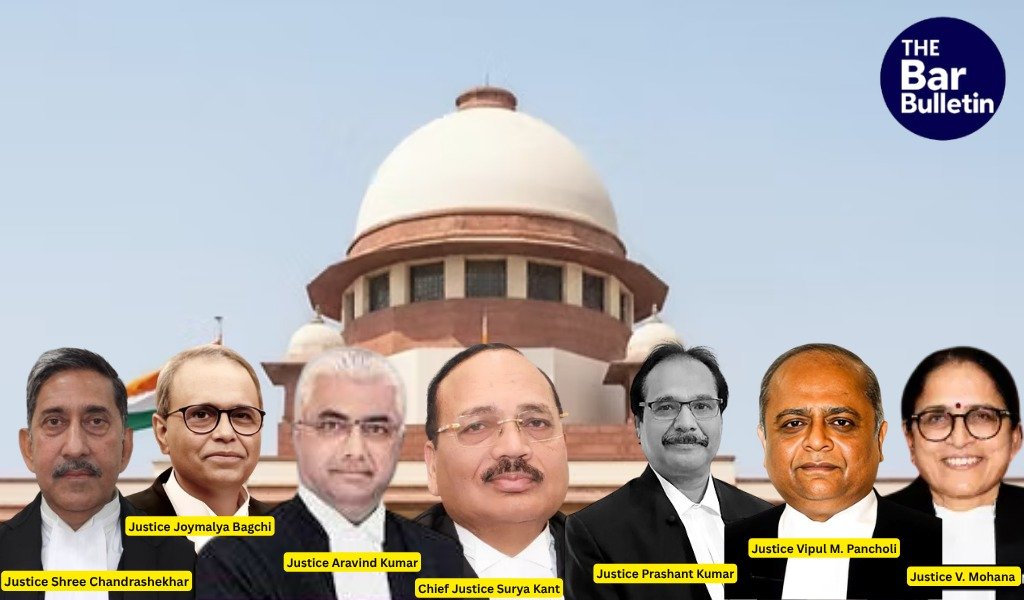

The Supreme Court on Tuesday held that the petitions arising from the Tamil Nadu Legislative Assembly’s 2003 action against journalists of The Hindu had become infructuous after the Assembly subsequently withdrew the resolution imposing punishment on them, while keeping the larger questions of law concerning legislative privileges and fundamental rights open for consideration in an appropriate future case.
The matter was heard by Chief Justice Surya Kant, Justice Aravind Kumar, Justice Prashant Kumar Mishra, Justice Joymalya Bagchi, Justice Vipul M. Pancholi, Justice Shree Chandrashekhar and Justice V. Mohana.
The matter arose from a series of articles and editorials published in The Hindu in April 2003 concerning events in the Tamil Nadu Legislative Assembly. The newspaper carried reports on April 12, 13, 23 and 25, 2003, while Murasoli subsequently carried a Tamil translation of the editorial published in The Hindu on April 25.
The publications were referred by the Speaker to the Assembly’s Committee of Privileges under Rule 226 of the Tamil Nadu Legislative Assembly Rules. The Committee examined the publications on May 5, 2003 and concluded that certain statements contained in them amounted to a breach of parliamentary privilege. Notices were consequently issued to members of the newspaper’s editorial staff, calling upon them to appear before the Committee and explain their position.
On November 7, 2003, before the matter could be finally considered by the House, the Tamil Nadu Legislative Assembly passed a resolution holding the journalists guilty of breach of privilege and ordering 15 days’ simple imprisonment. The journalists approached the Supreme Court challenging the Assembly’s action, and the Court stayed the coercive action shortly thereafter.
The proceedings subsequently assumed a larger constitutional dimension. By an order dated December 8, 2003, the Supreme Court noted that substantial questions of law arose concerning the interpretation of Article 194(3), which deals with the privileges of State Legislatures, its interplay with Article 19(1)(a) guaranteeing freedom of speech and expression, as well as Article 21 and other constitutional provisions. The matter was accordingly referred to a Constitution Bench.
When the matter came before the Constitution Bench in December 2004, however, the Court was informed that the Tamil Nadu Legislative Assembly had, by a unanimous resolution dated July 30, 2004, withdrawn its earlier resolution of November 7, 2003. The withdrawal meant that the immediate grievance of the petitioners no longer survived.
The Bench was nevertheless confronted with an important question: whether the larger constitutional issues raised by the case should still be decided despite the underlying dispute having come to an end.
The reference had arisen against the backdrop of apparently conflicting observations in two earlier Supreme Court decisions in M.S.M. Sharma v. Shri Krishna Sinha, AIR 1959 SC 395 a five-judge Constitution Bench decision, and Special Reference No. 1 of 1964, AIR 1965 SC 745 decided by a seven-judge Bench. The December 2004 order noted that certain observations in the latter appeared to conflict with the law laid down in M.S.M. Sharma, even though the seven-judge Bench had itself stated that it was in agreement with the majority view in M.S.M. Sharma.
This perceived conflict led to the matter being placed before a seven-judge Bench for authoritative consideration. At the heart of the reference was the constitutional relationship between legislative privilege under Article 194 and the fundamental right to freedom of speech and expression under Article 19(1)(a), including the extent to which legislative privileges may be exercised against persons who are not members of the legislature.
During the present proceedings, Senior Advocate Raju Ramachandran, representing the Tamil Nadu Legislative Assembly, brought the July 30, 2004 withdrawal resolution to the Court’s attention. In view of the withdrawal, the parties agreed that the original dispute had become infructuous.
At the same time, counsel pointed out that the case had raised substantial constitutional questions which had been noted in the Court’s December 8, 2004 order. The Court today agreed that those questions could be considered in an appropriate case in the future rather than being answered in an academic exercise after the underlying dispute had ceased to survive.
The Supreme Court accordingly recorded that the petitions had become infructuous, while leaving the questions of law open for determination in an appropriate future proceeding.