

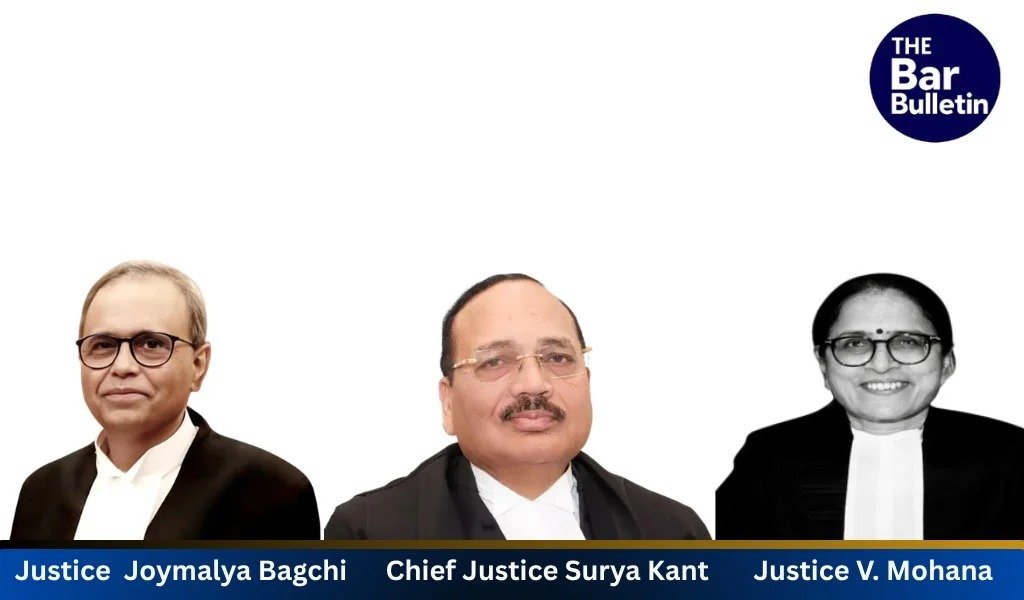
The Supreme Court on Friday dismissed Fortis Healthcare Ltd.’s challenge to the Delhi High Court’s order directing a forensic audit into transactions involving the company, its erstwhile promoters and other entities in proceedings arising from Daiichi Sankyo’s efforts to enforce its arbitral award against the Singh brothers. The matter was heard by Chief Justice Surya Kant, Justice Joymalya Bagchi and Justice V Mohana.
The challenge arose from the Delhi High Court’s August 31 order directing a comprehensive forensic audit into the dissipation of the Singh brothers’ shareholding in Fortis and the subsequent change in control of the company. The High Court’s order also directed examination of transactions involving Fortis, IHH Healthcare Berhad and RHT Health Trust.
Senior Advocate AM Singhvi, appearing for Fortis Healthcare, opened the arguments by stressing that Fortis was a publicly listed company with approximately 2.5 lakh public shareholders, and that it was neither a party to the underlying arbitration nor a judgment debtor or garnishee.Singhvi argued that Fortis was being treated as though it were liable for the personal obligations of its erstwhile promoters, despite having a distinct corporate identity.
“
“I am unconnected, not a judgment debtor, not a party, not a garnishee, not in any manner in the arbitration.”
He also placed considerable emphasis on the entry of IHH Healthcare, submitting that the Malaysian healthcare company had infused approximately ₹4,000 crore into Fortis through a fresh subscription of shares after the Singh brothers had substantially exited.
Singhvi argued that the earlier Supreme Court judgment had specifically distinguished Fortis from the entities whose shares were the subject matter of the enforcement proceedings.
The Bench, however, questioned whether Fortis could completely distance itself from the transactions merely because it was not a party to the arbitration, particularly in view of the allegations concerning its knowledge of the transactions and the subsequent change in control.
On the proposed forensic audit, Mr Singhvi contended that the earlier Supreme Court directions concerning dissipation of shares had focused on banks and financial institutions, rather than Fortis itself. He further argued that there was no factual material identifying any act or omission by Fortis or its officers that could amount to aiding or abetting the alleged dissipation.
Singhvi also relied on the legal framework governing dematerialised shares to argue that Fortis, as a listed company, had no power to prevent its shareholders from transferring their shares.
“
“A listed company like the petitioner has no power or ability to restrict the movement of its demat shares. Under the Depositories Act, shares of public listed company are freely transferable with the listed company having no role in the transfer.”
During this part of the hearing, the Bench questioned whether the company’s knowledge of the transactions, coupled with the circumstances in which the Singh brothers’ shareholding was diluted and a new investor entered, could have implications for Fortis’ role in the transactions.
Mr Singhvi sought to draw a distinction between knowledge of a shareholder’s actions and legal responsibility for those actions, arguing that a listed company could not prevent the transfer of shares by its shareholders without an order from a competent court or regulator.
The Court also explored whether a forensic audit could proceed without prejudicing Fortis in other proceedings. Singhvi sought a clarification that observations made in the High Court judgment should not be treated as final findings of culpability. He submitted:
“
“If this is two things, this will be used in every corporate proceeding collaterally against me is one. Second, this should be uninfluenced by these.”
Senior Advocate Darius Khambata argued that the Singh brothers dissipated their Fortis shares despite assurances given to the Court, with banks and financial institutions allegedly facilitating the process by accepting top-up pledges over previously unencumbered shares. He pointed out that the shares were eventually sold and the proceeds went to the banks towards repayment of their debts, with no money coming to Fortis. He therefore questioned why Daiichi had abandoned its case for an audit of the banks while pursuing a forensic inquiry against Fortis, and further argued that Fortis could not be treated as an enabler of the share transfers because, under the Depositories Act, a listed company has no role in registering transfers of dematerialised shares.
“
“The first irony is that the aider and abetter of the contempt, the banks and lenders who have actually taken the money according to Daiichi should go scot-free.”
Senior Advocate Neeraj Kishan Kaul questioned how Fortis could be regarded as an “enabler” merely because its shareholders transferred their shares. He referred to the statutory framework governing dematerialised securities and argued that the Depositories Act had deliberately removed the listed company’s role in registration of share transfers. Mr Kaul submitted that the earlier Supreme Court judgment had identified specific areas for examination, including the role of financial institutions and the movement of funds in connection with the acquisition of hospitals.
He argued that the Delhi High Court’s direction went beyond what the Supreme Court had contemplated.
Counsel submitted that the forensic audit should determine the role, if any, of the officers and corporate managers of Fortis during the relevant period. He also sought safeguards to ensure that the audit was not influenced by the adverse observations contained in the High Court judgment.
“
“May I request only two things. One is, a general direction from your Lordships that the audit proceeds uninfluenced by any observation and these are only tentative and these are not final. And the second, the auditor chosen has no experience whatsoever in forensic audits. We are suggesting anyone from the SEBI-approved panel.
The Bench, however, questioned why the Court should interfere with the auditor chosen by the High Court, particularly when the audit was investigative in nature.
Senior Advocate Mukul Rohatgi made submissions on the Daiichi side. Rohatgi focused on the sequence of events surrounding the Singh brothers’ shareholding, the subsequent IHH investment and the circumstances in which the ₹4,000 crore investment came into Fortis.
He argued that the chronology of the transactions required scrutiny and that the forensic audit was intended to establish the complete factual chain rather than prejudge the liability of any party.
The submissions also addressed the reduction of the Singh brothers’ shareholding from approximately 71 percent to around one percent and the subsequent entry of IHH. Counsel pointed out that the Supreme Court had passed orders concerning the shares and that the circumstances surrounding their dissipation required examination. Rohatgi also referred to the subsequent movement of the ₹4,000 crore investment and questioned the circumstances in which funds associated with the transaction were allegedly transferred.
The Court intervened to make clear that it was examining the factual chain and was not at that stage making a final determination of culpability. The Court ultimately dismissed Fortis Healthcare’s Special Leave Petitions.
Background of the case
The dispute stems from Daiichi Sankyo’s efforts to enforce its arbitral award against former Fortis promoters Malvinder Mohan Singh and Shivinder Mohan Singh, following the Japanese company’s acquisition of Ranbaxy and subsequent arbitration proceedings. The enforcement litigation subsequently extended to transactions involving Fortis and its former promoters.
The Delhi High Court had appointed S Ramanand Aiyar & Co. as the forensic auditor and directed the exercise to be completed within six months. Its order covers transactions concerning the dissipation of the Singh brothers’ shareholding in Fortis, the subsequent change in control, transactions involving IHH Healthcare and RHT Health Trust, and the role of relevant stakeholders.