


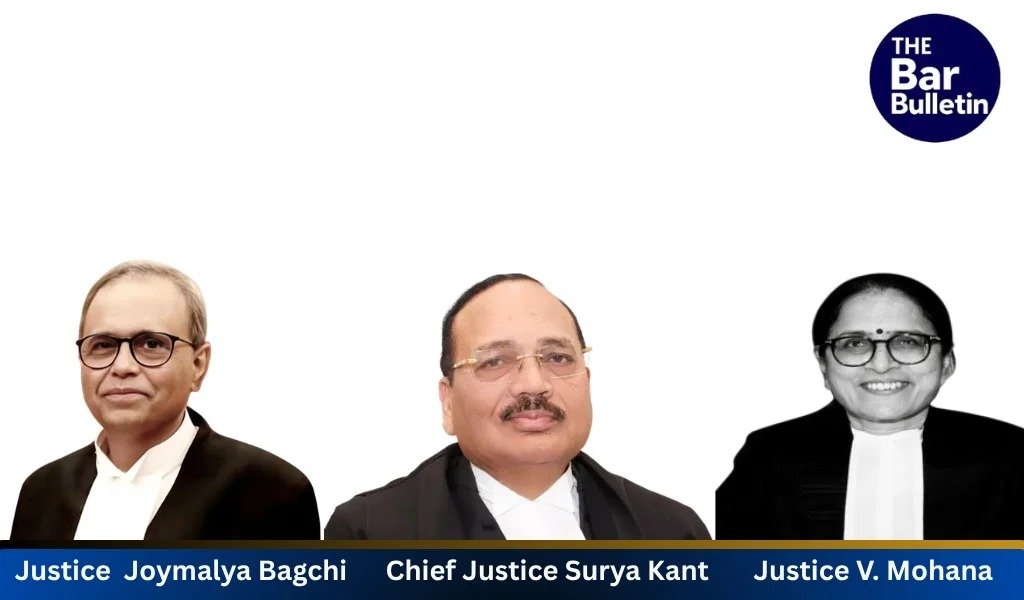
The Supreme Court on Tuesday directed the Enforcement Directorate (ED) to approach the High Court against a Special Court order refusing to take cognisance of its money laundering complaint against M/s Rathi Steel & Power Ltd and three of its officials in the Kesala North coal block allocation case. The Court directed that the ED’s appeal be treated as a revision petition before the High Court. The matter was heard by the bench of Chief Justice Surya Kant, Justice Joymalya Bagchi and Justice V Mohana.
The case concerns the allocation of the Kesala North coal block in Chhattisgarh to Rathi Steel & Power Ltd in 2008. The CBI had alleged that the company misrepresented its landholdings and project preparedness to secure the allocation. The company and three of its officials were convicted in the underlying criminal case in 2016.
The ED subsequently initiated money laundering proceedings, alleging that the coal block allocation letter itself constituted proceeds of crime and the company had received ₹3.08 crore through the issue of preferential shares after disclosing the allocation in its annual report.
However, on March 6, 2026, the Special Court at Delhi’s Rouse Avenue declined to take cognisance of the ED’s prosecution complaint, holding that the existence of proceeds of crime had not been established. The court reasoned that the allocation had not translated into financial or commercial gains through the execution of a mining lease and extraction of coal.
During the Supreme Court hearing, Senior Advocate Abhimanyu Bhandari, appearing for the accused, raised a preliminary objection to the ED approaching the Supreme Court directly. He argued that the challenge to the Special Court’s order should be pursued before the High Court.

“
“Your Lordships have said in three orders now that it should go to the High Court. They cannot come directly against the Special Court order to the Supreme Court. If you come to interdict a trial in the middle, that is different, but once there has been discharged by the Special Court, then you have to go to the High Court and challenge that,” he submitted.
He further argued that the essential ingredient of a money laundering offence was missing because no proceeds of crime had been generated from the coal block allocation. He submitted that even if the allocation letter were treated as a valuable security, the Special Court had considered whether it resulted in any financial gain.
The Supreme Court, subsequently, directed that status quo be maintained with respect to the attached assets until the court passed appropriate interim orders. It clarified that the direction was issued without expressing any opinion on the merits of the matter.
The Court also indicated that the question of whether a money laundering offence could be made out in the absence of proceeds of crime could be argued before the High Court. The High Court was requested to consider the matter expeditiously.