

The Supreme Court has held that an election petition under Section 81(1) of the Representation of the People Act, 1951 must be presented by the election petitioner personally, and presentation through counsel alone does not satisfy the statutory requirement.
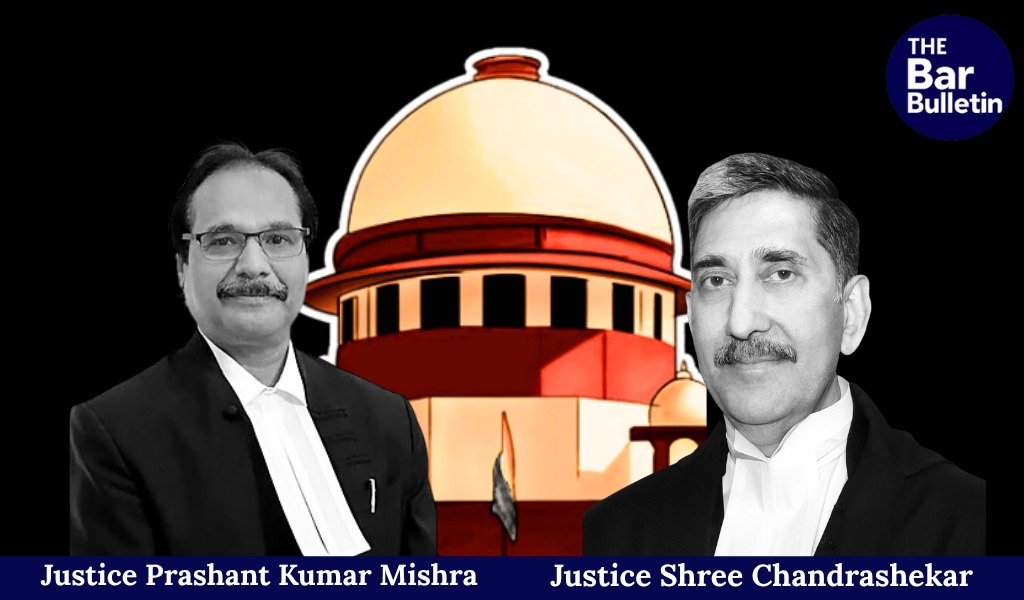
A Bench comprising Justice Prashant Kumar Mishra and Justice Shree Chandrashekar dismissed the Special Leave Petition filed by V. Pon. Paneer Selvam, upholding the Madras High Court’s decision dismissing his election petition as not maintainable. The election petition challenged the election of S. Regupathy from the 181-Thirumayam Assembly Constituency in the 2026 Tamil Nadu Legislative Assembly elections.
The Petitioner had challenged the election under Sections 80, 80A, 81, 83 and 100 of the RP Act, among other provisions, seeking a declaration that the election was void. He had also alleged that the respondent was guilty of corrupt practice of undue influence on account of alleged suppression and false declaration of his spouse’s assets and income in the statutory Form 26 affidavit.
The Madras High Court dismissed the election petition on the ground that it had been presented by Paneer Selvam’s counsel. The High Court relied upon Rule 7 of the Madras High Court Election Petitions Rules, 1967, which provides that every election petition shall be presented by the petitioner in person before the designated officer of the High Court.
The Supreme Court examined Sections 81 and 86 of the RP Act and noted that Section 81(1) prescribes specific requirements governing the presentation of an election petition. These include that the petition must be presented ‘by’ a candidate or elector, before the High Court, within the prescribed 45-day period and on the grounds specified under the Act.
Referring to its decision in G.V. Sreerama Reddy v. Returning Officer, (2009) 8 SCC 736, the Court held that the expression ‘by’ in Section 81(1) has significance. An election petition is a serious proceeding which may result in the vitiation of an electoral process, and the requirement of presentation by the petitioner enables the High Court to undertake preliminary verification at the threshold to ensure that the proceeding is not frivolous or vexatious.
Also Read Criminal Law Bulletin, Key Judicial Developments (September 2026)
The Bench further held that the requirement under Section 81 cannot be treated as a mere procedural formality. Section 86(1) expressly mandates dismissal of an election petition that does not comply with Section 81, and therefore non-compliance with the presentation requirement renders the petition liable to dismissal at the threshold.
The Supreme Court rejected the contention that the Madras High Court could not prescribe rules governing the presentation of election petitions. Relying on Jamal Uddin Ahmad v. Abu Saleh Najmuddin,(2003) 4 SCC 257, the Court held that the conferment of statutory jurisdiction carries with it incidental and ancillary powers necessary for its effective exercise, including regulation of administrative and ministerial functions relating to the receipt of documents.
It accordingly held that Rule 7 of the Madras High Court Election Petitions Rules, 1967 merely regulates the manner in which an election petition is presented and received and does not conflict with Section 81 of the RP Act.
On the facts, the petitioner claimed that he had personally presented the election petition before the Registry on June 16, 2026. The Supreme Court, however, found no contemporaneous record establishing personal presentation. The CISF entry pass only established his presence in the High Court premises, while the receipt evidencing payment of the security deposit under Section 117 was issued in the name of his counsel. The Court also observed that the CCTV footage relied upon by Paneer Selvam could, at the highest, establish his presence in the premises and not the fact of personal presentation.
The Bench also rejected reliance on Dr. Vijay Laxmi Sadho v. Jagdish(2001) 2 SCC 247, observing that the decision concerned a requirement originating solely from the High Court Rules and distinguished between defects under Section 83 and non-compliance with Section 81. While a defect under Section 83 does not attract dismissal under Section 86(1), the Court reiterated that non-compliance with Section 81 does.
The Court further distinguished Sheo Sadan Singh v. Mohan Lal Gautam (1969) 1 SCC 408, where presentation by an advocate’s clerk in the immediate presence of the petitioner had been held to constitute substantial compliance. In the present case, Paneer Selvam had not claimed that he was present alongside his counsel when the election petition was presented.
Holding that the challenge lacked merit, the Supreme Court concurred with the Madras High Court and dismissed the Special Leave Petition
