
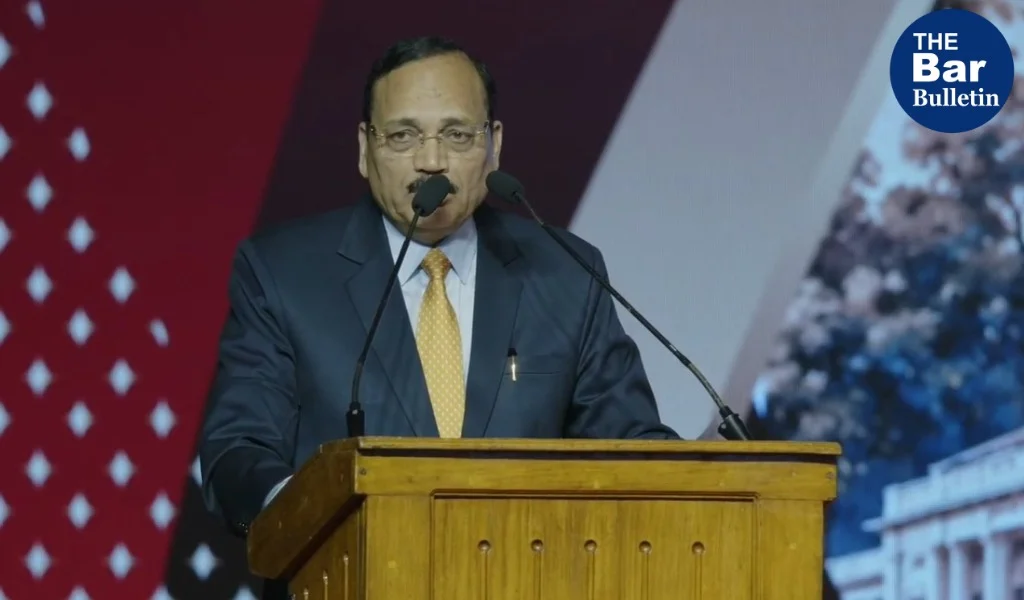

Chief Justice of India, Justice Surya Kant, on Constitution Day, reflected on the Supreme Court’s evolution from an institution once perceived as being more accessible to the privileged few into a people’s court, emphasising that access to justice must not depend on a litigant’s financial means, professional stature or familiarity with the institution.
Addressing the Constitution Day celebrations at the Supreme Court on November 26, CJI Surya Kant said that although the Court had made significant progress in improving access to justice, it must continue to examine whether justice was reaching every citizen for whom it was intended. The Constitution Day celebrations were organised by the Supreme Court of India at the Auditorium of the Administrative Buildings Complex in the presence of President Droupadi Murmu.
Recalling the words of Constituent Assembly member Hansa Mehta, who had said that women had never asked for privileges but sought social, economic and political justice, the CJI said that the distinction between privilege and justice lay at the heart of the Constitution.
He compared the Supreme Court’s jurisprudence to a fine pashmina shawl, observing that thousands of judgments had collectively provided protection to the Republic. However, he cautioned that justice could not remain accessible only to those who already knew how to approach the Court.
‘That era is now over’: CJI on equal access to Supreme Court
Acknowledging that the Supreme Court was once perceived as a court of the privileged, CJI Surya Kant said that it had, at times, been more readily accessible to a familiar few than to the larger population. He pointed out that out-of-turn hearings could sometimes appear to depend on who sought them rather than the urgency of the matter, while people in need of justice often revered the Court from afar but seldom reached it.
He referred to the development of public interest litigation, under which letters and postcards were treated as petitions, including a letter written on behalf of bonded labourers in stone quarries in Faridabad that secured their freedom. Emphasising that the practice of giving preferential access to influential lawyers had changed, he said:
“
“A door held open, however, counts for little if a privileged handful may still stride through it ahead of everyone else, and on this, I see no virtue in delicacy. That era is now over, for even the most eminent among them must appear on exactly the same footing as a lawyer from a small town, bound by the same queue, the same clock, and the same rules. This levelling, which many Judges have laboured long to bring about, is what has made this Court, in the fullest sense, the people’s court.”
Fresh matters automatically listed; liberty cases to reach Bench within two working days
The CJI also outlined measures undertaken by the Supreme Court to improve access to justice and make its listing process more transparent. He said fresh matters were now listed automatically, without advocates having to mention them in Court to seek a date. Cases involving personal liberty or urgent interim relief were required to reach a Bench within two working days.
He added that priority listing was being given to persons with disabilities, acid attack survivors, senior citizens above 80 years, families below the poverty line and litigants approaching the Court through legal aid.
On the use of technology, CJI Surya Kant referred to video-conferencing facilities that allow advocates from places such as Kohima and Kutch to argue before the Supreme Court without leaving their towns. He also mentioned the live-streaming and AI-assisted transcription of Constitution Bench proceedings, the SUVAS translation software, the One Case, One Data initiative and an AI-powered assistant to guide litigants through Court procedures. Highlighting the importance of ensuring that access to justice was governed by a system rather than an individual’s stature, he said:
“
“When access to a court is governed by system rather than by stature, privilege finds little room within it, and it is in this quiet, everyday work, far more than in any proclamation, that a people’s court is truly sustained. It is pertinent to mention, at this juncture, that access to justice begins long before a case reaches any Bench, from the very moment when someone in need first looks for help. Through legal aid, the National Legal Services Authority takes that help to the farthest corners of the country, where its para-legal volunteers are often the first, and sometimes the only, face of the law that anyone in distress will ever see.”
He further emphasised that para-legal volunteers must communicate with justice-seekers in their own local languages and dialects, understand their difficulties and guide them through the legal process.
‘Much remains to be done’
Concluding his address, the CJI acknowledged that much remained to be done before the humblest litigant could feel as comfortable in the Supreme Court as its most celebrated advocate.
He said that those holding judicial office occupied their positions only for a particular period, but the institution belonged to every generation and every citizen who would one day approach it.