
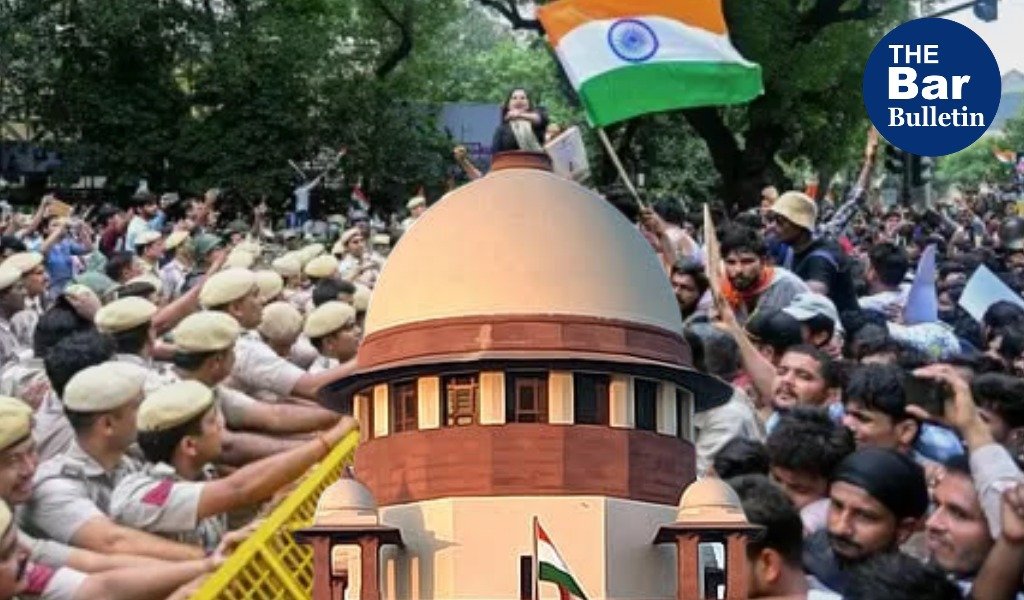
The Supreme Court on Thursday indicated that it would examine whether accredited journalists should enjoy greater protection than self-proclaimed journalists while covering protests, raising broader questions about the definition of a journalist and the safeguards available to media persons dealing with law enforcement agencies. During the hearing, Justice Bagchi observed that self-proclaimed journalists may not enjoy the same protection as accredited journalists.
A Bench comprising Chief Justice of India Surya Kant, Justice Joymalya Bagchi and Justice V. Mohana was hearing petitions concerning allegations that Delhi Police detained and forcibly removed journalists covering the October protests demanding the resignation of Chief Election Commissioner Gyanesh Kumar.
The petitioner argued that the categorisation of individuals as reel-makers and content creators was an afterthought and could not be invoked on the spot to restrain or remove people covering an event. To this, Justice Bagchi remarked:
“
“Even if we lay down the Standard Operating Procedures, the graded response of the law enforcement agency would also depend upon the status and credentials of the person claiming to be a journalist. In this regard, if you are going there as a journalist, you should carry appropriate identification. If you are a journalist working with a newspaper in the print media, you would be covered by the Press Council accreditation framework…..These are the aspects we will have to consider. We are in the realm of atomized individuals claiming to be journalists. Self-proclaimed journalists may not have the same protection as accredited journalists.”
Solicitor General Tushar Mehta highlighted the possibility of individuals creating YouTube channels and adopting names resembling established newspapers to claim journalistic status. He contended that such status could not be self-certified.
Justice Bagchi referred to journalists working with print publications, television channels and online platforms, observing that their professional credentials could be established through accreditation or registration. The Bench noted the difficulty posed by individuals independently claiming to be journalists.
The Court also raised broader questions on whether journalists enjoy any special privilege vis-à-vis law enforcement agencies while covering protests and whether forcibly removing a journalist from a protest site would amount to custody, attracting constitutional consequences. It observed that journalistic freedom would have to be balanced with the maintenance of public order.
Seven journalists’ allegations referred to inquiry committee
The Court also disposed of a plea filed by the Kerala Union of Working Journalists (KUWJ) concerning the alleged detention and manhandling of seven journalists by Delhi Police while covering the October protests. The journalists have been relegated to the court-appointed Empowered Inquiry Committee for examination of their individual allegations, without the Supreme Court expressing any opinion on the merits.
The seven journalists are Suhail Muhammed and V.S. Rahul of 24 News, Sajin of Asianet News, Roshni Rajan of Reporter TV, Vishnuprasad of Mathrubhumi, Miji P. Jose of Manorama News and independent reporter Farasana.
The court directed the inquiry committee to examine the individual allegations of police excesses.
Background of the case
The proceedings arise from allegations by journalists and media organisations that Delhi Police obstructed their reporting during protests against Chief Election Commissioner Gyanesh Kumar.
The petitions before the Supreme Court include those filed by the Network of Women in Media, India, Free Speech Collective, Delhi Union of Journalists and KUWJ. The petitioners have relied on the Supreme Court’s October 11 order, which stated that lawyers, journalists and other professionals should not be hindered in the discharge of their professional duties.
In an earlier affidavit, Delhi Police had maintained that it had not knowingly obstructed journalists from performing their duties. It had also submitted that social media influencers, content creators and reel-makers were not covered by the Court’s earlier direction exempting media personnel from restrictions imposed to regulate movement at protest sites.