
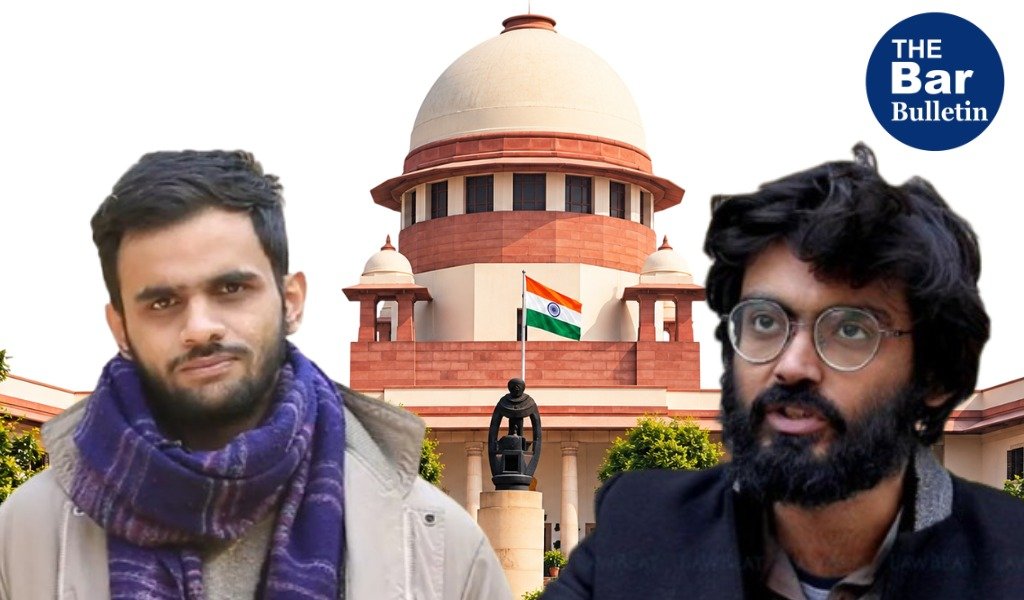

The Supreme Court on Wednesday issued notice on the fresh bail pleas filed by Umar Khalid and Sharjeel Imam, challenging the Delhi High Court’s September 30 decision refusing them bail in the 2020 Delhi riots larger conspiracy case. A Bench comprising Chief Justice of India Surya Kant and Justices Joymalya Bagchi and V. Mohana took up the matter. Senior Advocates Kapil Sibal and Siddharth Dave appeared for the petitioners.
The fresh pleas arose after the Supreme Court, on January 5, 2026, rejected the regular bail applications of Umar Khalid and Sharjeel Imam, describing them as occupying a “higher footing in the hierarchy of participation” and as “ideological drivers” of the alleged larger conspiracy. The same Bench, comprising Justice Aravind Kumar and Justice N.V. Anjaria, granted bail to five other accused, including Gulfisha Fatima, Meeran Haider, Shifa Ur Rehman, Mohammad Salim Khan and Shadab Ahmed, after distinguishing their alleged roles. While denying bail to Umar Khalid and Sharjeel Imam, the Supreme Court had permitted them to renew their applications upon completion of the examination of protected witnesses or expiry of one year from the date of the order, whichever was earlier.
However, in June 2026, the two approached the trial court seeking fresh consideration of their bail pleas, citing subsequent developments, prolonged incarceration and the slow pace of the trial. They pointed out that over 900 witnesses, including 47 protected witnesses, were yet to be examined and that the trial was unlikely to conclude in the near future.
Their fresh applications also relied on the Supreme Court’s May 18, 2026 judgment in Syed Iftikhar Andrabi v. National Investigation Agency, in which a Bench of Justices B.V. Nagarathna and Ujjal Bhuyan granted bail to an accused under the UAPA and expressed serious reservations about the reasoning adopted in the January 5 judgment refusing bail to Khalid and Imam. The Bench emphasised that the principle of bail is the rule and jail is the exception continues to operate even in cases under special statutes, particularly where prolonged incarceration and delay in trial raise concerns under Article 21. Subsequently, the Supreme Court referred the perceived conflict in judicial approaches to a larger Bench for consideration.
The trial court, however, rejected the fresh bail applications on July 4, 2026, holding that it was bound by the Supreme Court’s January 5 order. The Delhi High Court subsequently dismissed their appeals on September 30, observing that it could not modify the conditions imposed by the Supreme Court. Umar Khalid and Sharjeel Imam have now approached the Supreme Court challenging that decision.
During today’s hearing, Senior Advocate Siddharth Dave urged the Bench to consider the interim bail applications separately from the larger reference concerning conflicting judicial observations, submitting that clubbing the matters with the reference could delay consideration of their request.
Senior Advocate Kapil Sibal pointed out that Tasleem Ahmed had been granted interim bail and that fact may be considered in granting bail to Umar Khalid and Sharjeel Imam as they have been incarcerated for nearly six years. Mr Dave pressed for an early hearing, stating that the matter had already been pending for a considerable period. The CJI indicated that a three-judge Bench would be constituted in light of the reference.
“
“Issue notice. The Registry is directed to place the matter before the Chief Justice of India on the administrative side for constitution of a three-judge Bench in light of the order dated July 13 in the Tasleem Ahmed vs state.”