
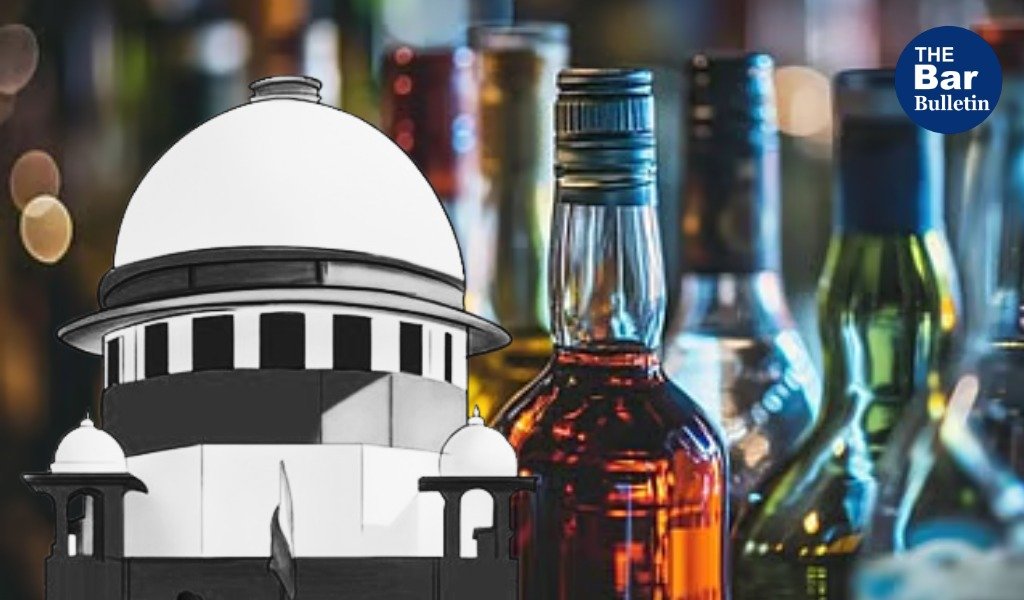

The Supreme Court has upheld the Madhya Pradesh High Court’s direction to renew the liquor licence of a Som Distilleries group company, dismissing the State government’s challenge to that extent. However, the Court set aside the High Court’s directions permitting the company to claim damages, costs and losses from the State for alleged mala fide action, the imposition of ?1 lakh costs on the State, and adverse observations concerning the office of the Advocate General.
A bench of Chief Justice of India Surya Kant, Justice Joymalya Bagchi and Justice V Mohana passed the order while hearing the State of Madhya Pradesh’s challenge to the High Court judgment. Solicitor General Tushar Mehta appeared for the State, while Senior Advocate Mukul Rohatgi represented the Som distillery.
The case arose from a 2011 incident in which a truck carrying around 1,200 boxes of Bluechip whisky was intercepted in Madhya Pradesh for allegedly being transported using forged permits. Following criminal proceedings against individuals associated with Som Distilleries, the State suspended eight excise licences held by Som Distilleries Pvt Ltd and Som Distilleries and Breweries Pvt Ltd in February 2026. The Madhya Pradesh High Court later directed renewal of the licences within 15 days, imposed ?1 lakh in costs on the State and allowed the companies to claim damages and losses in accordance with law. It also criticised the Excise Commissioner’s action as mala fide and remarked that the department had acted on “wrong legal advice” from the Advocate General’s office. The State challenged the ruling before the Supreme Court.
Arguing that the High Court had proceeded on an incorrect factual premise, Solicitor General contended that the court had incorrectly recorded that the conviction of the company’s employees had been stayed, when only their sentences had been stayed.
The Chief Justice, however, observed that the State could recover the excise dues without preventing the industry from operating. “The judge has taken a pragmatic view. You can recover the excise dues while allowing the industry to run. Nothing prevents you from recovering the excise. In the event of non-payment, you can even take coercive measures. You could freeze the accounts,” he said.
Opposing the State’s challenge, Mr Rohatgi argued that the High Court judgment had relied on facts from another case and that the company had been deliberately excluded from the tender process. He submitted that the company had around 3,000 employees and its immediate concern was to resume operations rather than pursue damages against the State.
“
“I am not interested in damages. I have to work. There is an old saying, ‘पानी में रहकर मगरमच्छ से बैर नहीं कर सकते।’ have to live with the State. They should renew my licence so that we can carry on,” he submitted.
The bench subsequently recorded that it found no reason to interfere with the High Court’s direction for renewal of the licence. At the same time, it held that the other reliefs granted by the High Court required to be set aside.
The Court set aside the High Court’s observations in paragraph A-29 granting the company liberty to claim damages, costs and losses from the State for alleged mala fide action, along with the corresponding relief directions. It also held that there was no necessity to impose ?1 lakh costs on the State and set aside that direction.
Further, the bench expunged the High Court’s observations in paragraph A-11 stating that the departmental action against the company was based on wrong legal advice given by the office of the Advocate General.
The petitions were accordingly disposed of.