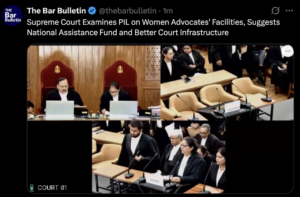

The Supreme Court has issued notice on a public interest litigation filed by a group of women advocates practising across the country, raising concerns over the lack of adequate infrastructure for women lawyers in courts and proposing financial support mechanisms for young advocates during the formative years of legal practice.
Observing that the issues raised concern the accessibility, inclusiveness, and long-term sustainability of women in the legal profession, the Court remarked that meaningful participation of women at the Bar requires more than merely opening the doors of the profession. It must be accompanied by the creation of conditions that enable women advocates to discharge their professional responsibilities effectively, safely, and on equal terms.
The petition highlights the absence of adequately equipped Ladies’ Bar Rooms and other essential facilities in a majority of High Courts, District Courts, Taluka Courts, Revenue Courts, Tribunals, and Commissions across the country. Relying on a nationwide survey and physical inspections of court complexes, the petitioners contend that many courts either lack dedicated facilities for women advocates or provide inadequate amenities such as sufficient seating, clean washrooms, changing spaces, nursing facilities, and other infrastructure necessary for the effective discharge of professional responsibilities.
The Court observed that a court complex is not merely a venue where legal proceedings are conducted but a workplace that often assumes the character of a second home for advocates who spend long hours preparing cases, interacting with clients, and consulting colleagues. It noted that since many advocates cannot afford private offices or support staff, the absence of dedicated facilities disproportionately impacts women lawyers and may, in certain cases, discourage them from continuing practice.
Significantly, the Court observed that the provision of such essential infrastructure bears a direct nexus with the fundamental guarantee of life and dignity under Article 21 of the Constitution. It held that the availability of basic facilities necessary for the comfort, privacy, safety, and professional functioning of women advocates transcends administrative convenience and touches upon the constitutional values of dignity and equal participation in public life.
The Court also examined the financial challenges faced by young advocates, particularly first-generation lawyers and those from economically and socially disadvantaged backgrounds. It noted that the uncertain income and modest stipends available during the initial years of litigation often compel capable young lawyers to abandon the profession, resulting in what it described as a professional ‘brain drain’.
To address this issue, the Court suggested the creation of a Young Lawyers’ Professional Assistance Fund, to be established under the exclusive control of the jurisdictional High Courts or an autonomous body constituted by the Union of India in consultation with the State Governments. The Court observed that such a framework would inspire greater confidence among prospective donors and contributors.
The Bench further suggested that stakeholders consider enacting a suitable legal framework providing for structured contributions by successful senior advocates and other experienced practising lawyers. It also proposed that the Union and State Governments contribute a portion of court fees collected by the judiciary towards the Fund and that courts divert a substantial part of the costs imposed in judicial proceedings as contributions to the corpus.
The Court recorded that the Senior Counsel appearing for the petitioners had also placed valuable suggestions regarding the proposed Corpus Fund, and directed that the note prepared in this regard be taken on record.
The proposed Fund, the Court observed, should provide a reasonable monthly stipend-cum-honorarium to first-generation and economically or socially disadvantaged young advocates during their formative years of practice. Simultaneously, such beneficiaries should be attached to experienced members of the Bar as associates to compulsorily render professional services in lieu of the financial assistance.
The Court further suggested that the financial assistance should ensure basic sustenance during the first three years of practice and thereafter be proportionately reduced, finally coming to an end after seven years of practice, by which time young lawyers are expected to achieve self-sufficiency. It also proposed a mechanism requiring beneficiaries to contribute back to the Fund through phased monthly instalments after becoming financially stable, thereby creating a self-sustaining corpus for future generations of advocates.
Clarifying that these observations are tentative and illustrative, the Court stated that they were consciously made to facilitate discussion among stakeholders and invite broader proposals, and were not intended to limit alternative suggestions that may be placed before the Court. Considering the significance of the issues and their wider ramifications for the legal profession, the Court issued notice to all respondents, returnable on 17 July 2026, and requested the Attorney General for India, the Advocate Generals of all States, and the Standing Counsel for the Union Territories to assist the Court in the matter.