
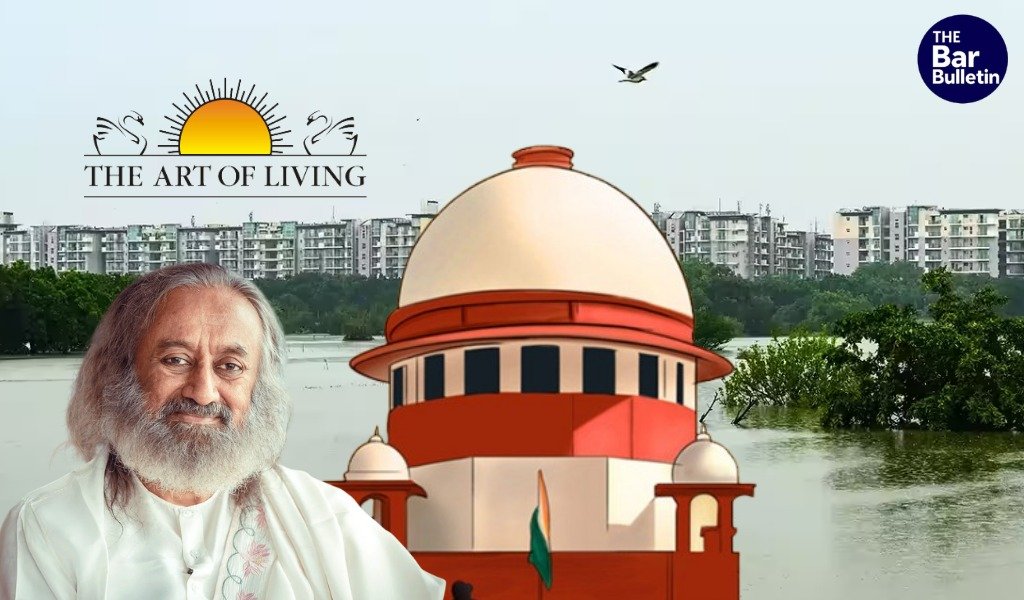

In a significant ruling on the World Culture Festival case, the Supreme Court held that the National Green Tribunal erroneously treated its interim order as final, equated rehabilitation with restoration, and fastened liability on Vyakti Vikas Kendra India (Appellant) without establishing any causal link between the event and the alleged damage to the Yamuna floodplains. The appellant was held entitled to refund of the amount of Rs. 5 crores deposited by it with DDA, and the same was directed to be refunded by DDA within four weeks from the date of the judgment.
The DDA shall continue to carry out the rehabilitation work at the Yamuna floodplains as per the proposed plan and directions issued by the Tribunal from time to time, and clarified that the responsibilities entrusted to DDA concerning the management or rehabilitation of the Yamuna floodplains had not been altered in any manner, added the Court.
The Court clarified that the task of rehabilitation of public resources falls upon the shoulders of the State and must be undertaken by the State by upholding the spirit of public trust doctrine and the principle of intergenerational equity. The responsibility of private persons gets triggered when environmental damage or degradation is attributable to them. The Tribunal, while exercising its powers under Section 15 of the NGT Act, could have ordered compensation for restoration or restitution of the event site to its original condition, but could not have directed rehabilitation of the floodplain, which was beyond its jurisdiction.
The Court also held that the principle of no-fault liability under Section 17(3) of the NGT Act, or the polluter pays principle, requires the establishment of a causal link between the actions of the alleged person and the resultant environmental degradation. The alleged person must be a “polluter” before being held as absolutely liable in law. The principle cannot be invoked unless the degradation is attributable to the alleged person. In the present case, the causal link was not established, and the material on record actually went on to prove that damage, if any, could not be attributed to the appellant.
A Two-Judge Bench comprising Justice Satish Chandra Sharma and Justice Nongmeikapam Kotiswar Singh observed that the interim order of the NGT dated March 09, 2016 was passed hastily on the basis of one visual inspection by the committee and did not incorporate any appreciation of the counter material. The interim order was passed without recording reasons, and reasons were expected to follow but never did. The report dated Feb 22, 2016 merely described the dilapidated condition of the floodplain at the time of the committee’s visit and did not state that the floodplain was in a different and better condition before the commencement of the appellant’s preparatory work.
The Court noted that prior to handing over of the site to the appellant, the site was already in a damaged condition. The expert committee’s own report of October 2015 (filed in the Yamuna matter) had observed that the directions of the Tribunal in the Yamuna matter were not implemented and the floodplain was in damaged condition. The appellant’s letter dated Dec 14, 2015 addressed to DDA recorded that as of that date, construction debris was lying over 25-30 acres of the allotted land, and DDA permitted the appellant to remove the same, thereby admitting its existence. Despite this contemporaneous material, the Tribunal concluded that the appellant had severely damaged the floodplain without examining whether the preparation work carried out by the appellant from Dec 15, 2015 to Feb 19, 2016 caused any additional damage.
The Court further observed that the expert committee’s report dated July 28, 2016 was effectively based on a single satellite image dated Sep 05, 2015 to ascertain the pre-event state of the floodplain, which was in stark contrast to other contemporaneous material on record. The Tribunal accepted this description almost without question and placed reliance on the report and the sole satellite image generated from Google Earth. The Court found the satellite image unreliable not only because it was generated from the internet but also because it was in stark contrast with the entire surrounding material. The Court also noted that the sweeping statement of one expert member that restoration would require Rs. 100-120 crores were released in media and incorporated in the report without any basis, and was even distanced from by the Chairman of the committee as unscientific.
The Court observed that the expert committee did a complete somersault in its report dated Nov 28, 2016, where it acknowledged inherent limitations and constraints in restoration of the site, admitting that it was not possible to assess the ecological status of the riparian ecosystems at the site before the event and to determine the state of ecosystem to which restoration had to be carried out. The committee itself questioned its own assessment of the ecological status of the site before the event. Despite this admission, the committee went on to suggest “rehabilitation” of the floodplain and gave various recommendations on the lines of its earlier recommendations in the Yamuna matter, exceeding its mandate which was limited to suggest measures and expenses for restoration of the event site to its pre-event condition.
The Court also took note of the third report filed by the committee of government officials on July 28, 2017, which inspected the event site and reported that the site was fully covered with grass, portions were under water, there was no debris at the site, no significant wetland/water body was found in the area allotted for the event, and there was not much difference in the condition of the area before and after the event. The Court observed that this third report effectively nullified the allegations of damage and removed the taint of causing damage/degradation from the event organized by the appellant. However, the Tribunal rejected this report merely on the ground that the committee had exceeded its domain, without challenging or disproving the facts reported.
The Court found that the Tribunal fell in error in equating the distinct concepts of rehabilitation and restoration. Going by their plain meaning in the context of environmental jurisprudence, rehabilitation refers to complete reparation of the affected area in a manner that it becomes fully functional and provides optimum ecological services, whereas restoration refers to a process whereby the affected area is simply brought back to its original state, regardless of how optimum the original state was. The Tribunal, while exercising its powers under Section 15 of the NGT Act, could have ordered compensation for restoration or restitution of the event site to its original condition, but the same was clearly ruled out as the expert committee itself admitted that the original ecological condition of the event site could not be known. By passing directions for rehabilitation of the floodplain, the Tribunal exceeded its jurisdiction under Section 15 of the NGT Act.
The Court further observed that the Tribunal burdened the appellant with the task of developing a biodiversity park that it never destroyed. The proposal of biodiversity park at the Yamuna floodplain was a result of the Tribunal’s judgment dated Jan 13, 2015 and was a standalone responsibility of the concerned public authorities/DDA. The Tribunal completely altered the character of the dispute and converted it into a proceeding for fresh development of the Yamuna floodplain.
As regards the principle of no-fault liability under Section 17(3) of the NGT Act, the Court observed that the applicability of this principle is contingent upon various factors, and the foremost factor is the causation of real damage. The establishment of a causal link between the actions of the project proponent and the resultant environmental degradation is equally necessary. The alleged person must be a “polluter” before being held as absolutely liable in law. In the present case, the causal link had not been established by any standard, and there was ample material on record to show that the event site was already in a dilapidated condition prior to its handing over to the appellant.
The Court also agreed with the observations regarding DDA. The manner in which permission was granted by DDA to hold the event on an active floodplain of the river could not be approved. It was not only avoidable but was also not consistent with the precautionary principle and doctrine of public trust. DDA was bound to act in a manner that the trust reposed in it, as the agency responsible for the rehabilitation and ecological maintenance of the Yamuna floodplain, was not shaken in any manner. However, the question of grant of permission by DDA was not a subject matter of consideration before the Supreme Court.
Briefly, the present appeal arose from the common judgment dated Dec 07, 2017 passed by the National Green Tribunal, Principal Bench, New Delhi, in a batch of three applications. The appellant, Vyakti Vikas Kendra India (popularly known as Art of Living), had organised the World Culture Festival (WCF) from 11th to 13th March 2016 on the active floodplains of river Yamuna in Delhi, over an area comprising 25 hectares upstream of the DND flyway. The original applications were filed by respondent no. 1, Mr. Manoj Misra, on Feb 08, 2016, alleging that the scheduled event was being organised on the floodplains and wetlands of Yamuna river and had caused serious harm to the ecological balance and health of the river and its floodplains, in violation of the NGT’s earlier decision dated Jan 13, 2015.
On Feb 11, 2016, notice was issued by the Tribunal and on Feb 19, 2016, an expert committee (High Powered Committee) was appointed to visit the event site and submit its report. The committee submitted its interim report on Feb 22, 2016, opining that the proposed event would damage the floodplains requiring an expense of Rs. 100-120 crores for rectification. On March 09, 2016, two days prior to the scheduled event, the Tribunal passed an interim order recording that the floodplains had been drastically tampered with during the preparatory process. The Tribunal nevertheless permitted the event to take place, subject to payment of Rs. 5 crores by the appellant as environmental compensation and an undertaking that the appellant would bear the cost of restoration in case the floodplains were found damaged after the event. The appellant complied with the order by filing an affidavit, without prejudice to its rights and contentions.
Post-event, the Tribunal directed the committee to furnish a complete report of environmental damage and degradation. The committee submitted its report on July 28, 2016, concluding that the event had severely damaged the floodplain, but did not quantify any cost of restoration. The committee was then directed to submit tentative costs liable to be recovered for the damage caused. In furtherance, the committee submitted its second report on Nov 28, 2016, suggesting an action plan for rehabilitation of the floodplain comprising a physical component (two years, Rs. 28.73 crores) and a biological component (ten years, Rs. 13.29 crores). On July 21, 2017, the Tribunal constituted another committee comprising officials of DDA, Irrigation Department (NCT of Delhi and State of Uttar Pradesh) and Chief Engineers, to prepare an action plan. This committee submitted its report on July 28, 2017, but the Tribunal rejected it on the ground that the committee exceeded its jurisdiction by commenting on the nature of damage instead of merely suggesting an action plan. Ultimately, the Tribunal held the appellant responsible for causing damage to the Yamuna floodplains and passed various directions for restitution/rehabilitation, including recovery of costs of a proposed biodiversity park from the appellant.
