
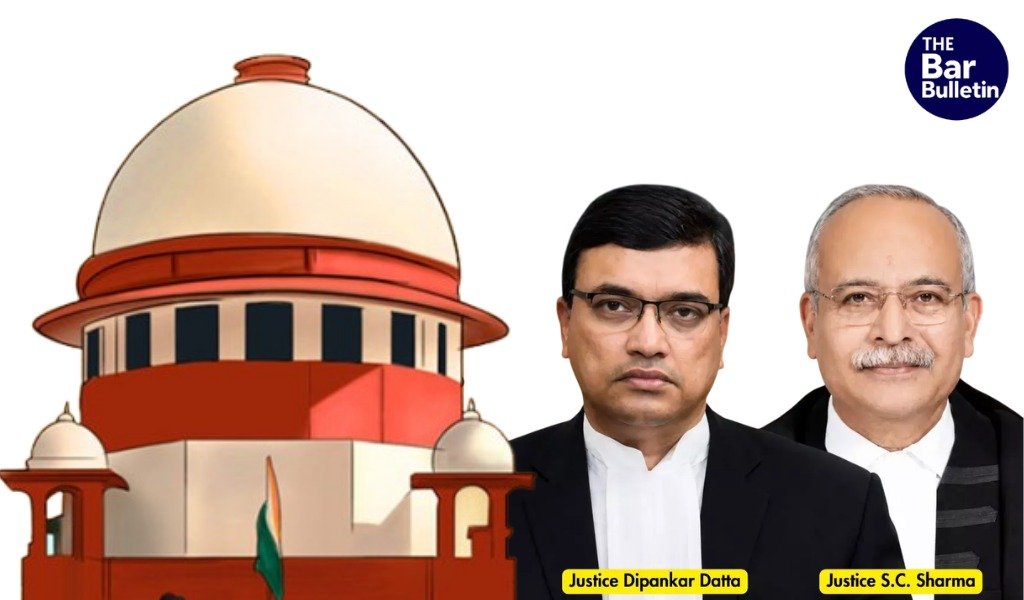

The Supreme Court on Wednesday highlighted the prolonged delays in the adjudication of constitutional questions, with both Justice Dipankar Datta and Justice S.C. Sharma sharing a concurring concern over the time taken for matters to reach and be decided by Constitution Benches.
The observations came while the two-judge Bench delivered a split verdict on whether challenges to the 2023 law governing the appointment of the Chief Election Commissioner and Election Commissioners warranted consideration by a larger Constitution Bench. While the judges differed on the question of reference, Justice Sharma directed that the papers be placed before the Chief Justice of India for consideration of an appropriate Constitution Bench.
The Bench specifically drew attention to the delay that has occurred in previous constitutional references. Referring to Anoop Baranwal, he noted that the writ petition had been instituted in 2015, the matter was referred to a Constitution Bench in 2018, and the judgment was eventually delivered in 2023. Justice Datta also referred to another constitutional reference which, according to him, had taken several years to reach a nine-judge Bench.
He said that the concerns of litigants over such delays could not simply be disregarded and that the institution needed to examine the manner in which constitutional questions are processed and adjudicated.
“
“The petitioners are justified in their anxiety. The delays in deciding constitutional references are an institutional embarrassment and require self-introspection. The resolution of constitutional issues is the primary task and the core priority of this Court. References which remain pending for five, ten, fifteen, twenty years or even more do not reflect well on the institution.”
The Court then suggested that a structural mechanism could be considered to prevent constitutional questions from remaining pending for years. He requested the CJI to explore the possibility of maintaining a permanent five-judge Bench dedicated to deciding pure constitutional questions, noting that the idea was not without precedent in public discussion.
Justice Datta said such a mechanism could help ensure that constitutional questions, which form part of the Court’s core adjudicatory function, are taken up without the prolonged delays that have characterised some earlier references.
“
“We thus take the opportunity of requesting the Honourable Chief Justice of India to explore the necessity of a permanent five-judge Bench to decide pure constitutional issues. This is not a novel suggestion. It has been opined by responsible citizens, and we endorse the same. Given that the resolution of constitutional issues is the primary task of the judges of this Court, that must remain the core priority. Tendency of reference for far too long, any period between five and twenty years or more- does not reflect well on the institution. It is time that the institution addresses the issue with the urgency and promptitude it deserves.
The issues that would engage the consideration of the five-judge bench being of foundational importance to the democratic fabric of the country and its citizenry, we earnestly hope and trust that this reference would not suffer the inordinate delay in its resolution as in other cases.”
Acting on the same line to avoid delay, despite having differing opinions, Justice Datta observed that sending the split issue to another three-judge Bench merely to determine which of the two opinions was correct would result in another layer of proceedings before the substantive constitutional questions could be addressed.
The Bench therefore directed that the papers be placed before the CJI to consider the constitution of a Constitution Bench of such number of judges as may be appropriate to decide the constitutional validity of Section 7 and the other provisions of the Chief Election Commissioner and Other Election Commissioners Act, 2023