
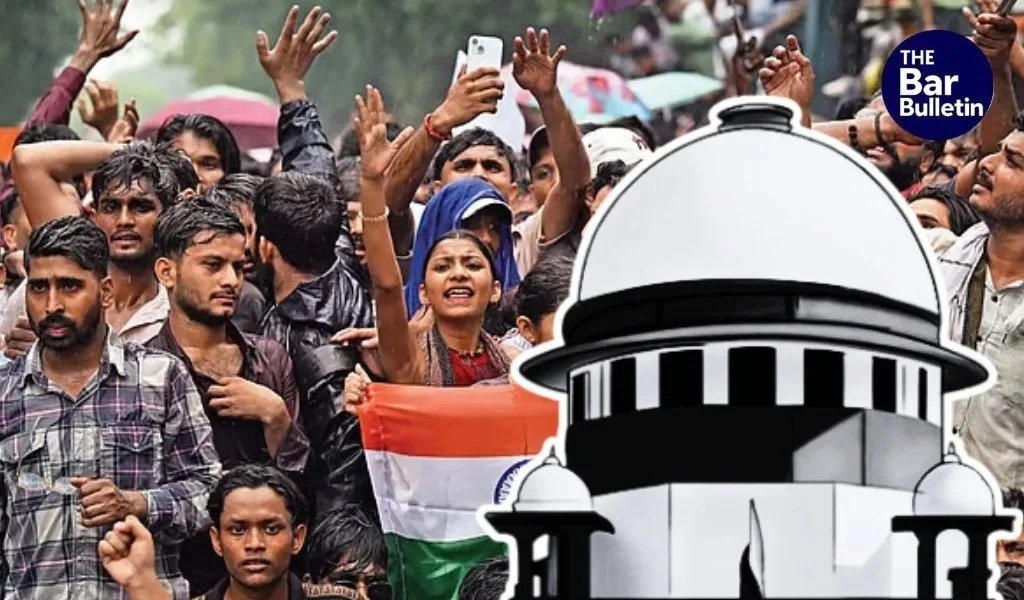
The Supreme Court on Tuesday orally observed that no individual or organisation can claim an indefinite right to occupy a designated protest site, emphasising that the right to protest must be balanced against the rights of others, including traders and daily-wage workers.
A Bench comprising Chief Justice of India Surya Kant and Justices Joymalya Bagchi and V. Mohana made the observations while hearing a batch of petitions arising from the protests in Delhi against Chief Election Commissioner Gyanesh Kumar. The petitions raised issues concerning alleged police excesses, mass detentions, internet restrictions, surveillance, the closure of metro stations, and the disruption of business activities.
“
“You cannot occupy a site for all times. Where will farmers, journalists, etc. go? Everyone has a right to protest. Designated sites must be given for a designated period,” the CJI observed.
The Court said that the right to protest and the right to trade were both important and that a mechanism would have to be worked out to ensure that one did not completely impede the other.
Traders seek restriction on protests during festive season
Senior Advocate Mukul Rohatgi, appearing for the Kirana Committee Delhi and other traders’ associations, submitted that the protests had severely affected commercial activity in the area, particularly during the festive season. He submitted that around 50 lakh people lived in the surrounding areas and that shops in commercial areas, including Connaught Place, had remained shut. He claimed that businesses had suffered losses running into thousands of crores and sought restrictions on protests for two months.
Mr Rohatgi also highlighted the impact on workers, loaders, transport operators and other people dependent on daily business. He urged the Court to find an “out-of-the-box” solution that would protect the livelihood of those affected. The Bench asked the traders’ associations to implement the organisations that had organised the protests, observing that the Court could not determine the competing claims without hearing the organisers.
The Court issued notice on the traders’ plea seeking restrictions on protests during the festive period and directed the petitioners to bring the concerned protest organisers on record.
Solicitor General Tushar Mehta submitted that permission for the Jantar Mantar protest had been granted for one day, but the site continued to be occupied beyond the permitted period. He argued that organisations calling for protests must take responsibility for the consequences and referred to the proposed march towards Parliament.
Justice Bagchi questions facial recognition surveillance at public places
The Bench also heard submissions on the use of facial recognition technology and surveillance at designated protest sites. Advocate Prashant Bhushan, appearing for the Software Freedom Law Centre, India, questioned the legal basis for the use of facial recognition technology and the collection and use of citizens’ biometric data.
Justice Joymalya Bagchi questioned how the data collected through surveillance cameras was being utilised and whether images captured from public places were being matched against existing databases.
The Solicitor General responded that facial recognition technology was not conclusive proof of a person’s involvement in an offence. He submitted that a match would only trigger further verification, including examination of mobile tower locations and statements from people in the vicinity.
Lawyers’ bodies raise allegations of detentions, internet disruption
The Bench also took up petitions filed by lawyers’ associations raising concerns over the alleged detention of advocates, restrictions on access to court premises and chambers, and disruption of internet services during the protests.
Counsel submitted that a circular issued on October 9 had required lawyers to appear through virtual hearings on October 10. However, the internet was allegedly disrupted across the area, affecting lawyers with chambers near the Supreme Court, Delhi High Court, and Patiala House Court.
It was submitted that when lawyers came out, prohibitory orders under Section 163 of the Bharatiya Nagarik Suraksha Sanhita were imposed, barricades were put up, and several advocates were allegedly picked up from the roads. Photographs and other material were stated to have been placed before the Court.
The Bench considered contempt-related petitions alleging non-compliance with its earlier directions concerning journalists. Counsel referred to journalist Ryan Thomas, who was allegedly manhandled and picked up despite the Court’s earlier order. Another petition concerning the Delhi Union of Journalists raised the alleged seizure of devices. The Bench was also told that another journalist had allegedly been picked up after the Court had passed directions.
The Solicitor General opposed the issuance of notice in the contempt proceedings. The CJI indicated that one counter-affidavit would be sufficient in response to the allegations.
Indira Jaising seeks separate SIT for complaints by women journalists
Senior Advocate Indira Jaising sought the constitution of a separate Special Investigation Team to exclusively deal with complaints of sexual harassment and sexual violence against women journalists during the protests. She submitted that she had submitted names of proposed members in a sealed-cover envelope, as directed earlier, and requested that the Court consider constituting a separate investigative team.
The matter concerning the sexual harassment of journalists during the protest was directed to be listed separately on November 23.
The Bench was also apprised of a petition concerning a woman journalist who allegedly faced physical harassment by LOP Rahul Gandhi within the Supreme Court precincts during the protests. Senior advocate Gaurab Bhatia submitted that she had been pushed and had to be taken to the hospital. The Bench directed that the matter be listed separately on November 23 and asked the concerned parties to file their responses.
Nine categories of petitions; fresh pleas to be screened
Towards the end of the hearing, the Bench decided that the connected petitions would be organised into nine categories and taken up on different dates to facilitate a structured hearing.
The Solicitor General submitted that the two nodal counsel appointed earlier had jointly completed the categorisation exercise and signed off on the nine categories. The CJI accepted the exercise but asked the nodal counsel to revisit it in light of the new petitions filed in the meantime.
The Bench asked the parties to provide the proposed sequence of arguments and the time required by each counsel. It indicated that time would be allocated to ensure that the proceedings could be completed in an orderly manner and that overlapping submissions could be avoided.
The CJI also cautioned against the filing of fresh writ petitions raising issues already covered by the existing proceedings. He indicated that the court may direct the registry not to entertain any fresh writ petition:
“
“I’m proposing to direct the registry not to entertain these fresh WPs unless the advocate-on-record gives it in writing that the point raised is completely new and different from those already there. Otherwise, it will have to be considered in the existing categories.”