

In a strongly worded verdict, the Supreme Court held that branding an officer with an ‘outstanding’ track record as ‘dead wood’ barely two months after promoting him to Joint Secretary smacks of malice in law and a colourable exercise of power under Fundamental Rule (FR) 56(j). The Court ruled that a promotion earned on merit, and not by dint of seniority alone, immediately prior to an order of compulsory retirement would, by itself, render such order susceptible to invalidity, because it stands as proof of a recent and objective assessment of the entire service record.
While earlier adverse material may be considered in a holistic review under FR 56(j), earlier isolated materials must yield to a consistent and long-standing stellar record, particularly where the immediate past reflects exemplary performance. The Apex Court held that bureaucratic reliance only on a particular subset of precedents favouring the department, divorced from the qualifications and balancing principles accompanying those propositions, cannot furnish a rational basis for the exercise of power.
The Court characterised the confidential note of the then Additional Secretary & DGAD, based on oral complaints from industry representatives who were themselves reluctant to lodge any written complaint, as ‘not worth the paper it had been written on’, and held that such material cannot form the foundation for retiring an officer from service. The Court also reiterated that while the scope of interference with an order of compulsory retirement is limited, such review is fully available where the order is vitiated by arbitrariness, perversity or malice in law, and that judicial non-interference in such cases would be abdication, not restraint.
Accordingly, the Apex Court set aside the impugned judgment of the Delhi High Court, the order of the CAT, and the order of compulsory retirement. Since the appellant had already attained the age of superannuation, reinstatement in service was not possible, and the Court moulded the relief by directing that the appellant shall be entitled to all such service benefits as per law, including notional promotion if any of his juniors had been granted promotion during the period he remained out of service.
The Court further directed that the appellant shall be called back in office by the Director General of Foreign Trade for being bidden farewell with full honour, in the manner he would have received on the date of his superannuation but for the unceremonious premature severance. Costs were assessed at Rs. 6 lakhs, and a further sum of Rs. 9 lakhs were awarded as compensation for the loss of reputation suffered by the appellant.
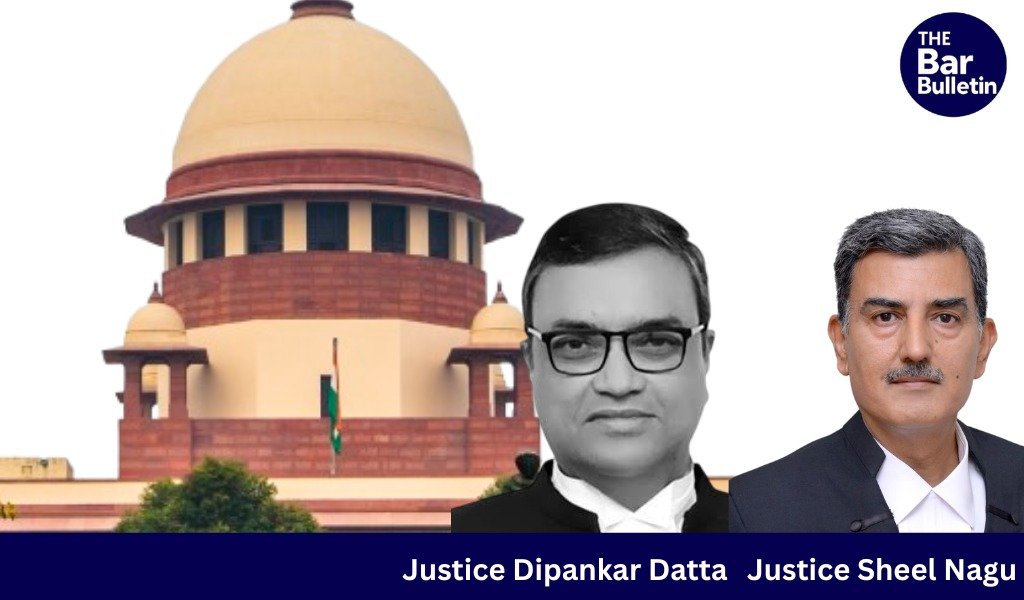
A Two-Judge Bench comprising Justice Dipankar Datta and Justice Sheel Nagu observed that undertook a meticulous examination of the appellant’s complete service dossier spanning over two decades and found that, apart from two stray remarks, one in the 1998-99 ACR (a few complaints received, no substance found) and another in the 2014-15 APAR (there is room for improvement), there was not even a slight hint of the appellant’s integrity being questionable. The Court noted that the 1998-99 remark was made twenty years before the retirement order and that the complaints were found to lack substance, while the 2014-15 remark was accompanied by a grading of 8.75 out of 10, which could hardly be treated as an adverse remark warranting compulsory retirement.
The Court further observed that the appellant, instead of making a representation against the 2014-15 remark, took the criticism in the right spirit and raised his performance to secure a grading of 9.6 in the very next year, 2015-16. The Court found the confidential note dated March 30, 2017, of the then Additional Secretary & DGAD, which formed the basis of the retirement order, to be ‘not worth the paper it had been written on’, since it was founded on unsubstantiated oral allegations from industry representatives who were themselves reluctant to lodge any written complaint.
The Court remarked that the manner of decision-making, where ‘OUTSTANDING’ gradings were completely ignored and a recent promotion was trivialised, disclosed that the officers were determined to ensure the appellant’s ouster at any cost and had invented reasons to sustain a pre-decided conclusion. The Court also noticed that the officer who had issued the order of compulsory retirement was himself a member of the Representation Committee that endorsed the retirement in the second round, though this circumstance was not made the basis of interference.
Briefly, the appellant, S.S. Das, a former Indian Trade Service (ITS) officer appointed in 1989, was compulsorily retired from service on 10th May 2018 under Fundamental Rule 56(j), nearly five years before his date of superannuation. The order was issued by the Joint Director General of Foreign Trade, Department of Commerce, on behalf of the President, on the ground that it was in public interest to do so.
The appellant had a stellar service record, having been promoted to Deputy Director General of Foreign Trade in 1994, Joint Director General in 2001, and most recently to the Senior Administrative Grade of Joint Secretary on 27th February 2018, with the approval of the Appointments Committee of the Cabinet (ACC) and on the recommendation of the Union Public Service Commission (UPSC). His Annual Confidential Reports (ACRs) from 1994-95 to 2008-09 consistently bore ‘OUTSTANDING’ gradings, and his APARs from 2009-10 onwards never fell below 8 out of 10, except on one occasion. The appellant challenged the order before the Central Administrative Tribunal (CAT), which dismissed his original application, and thereafter before the Delhi High Court, which also declined interference.
