
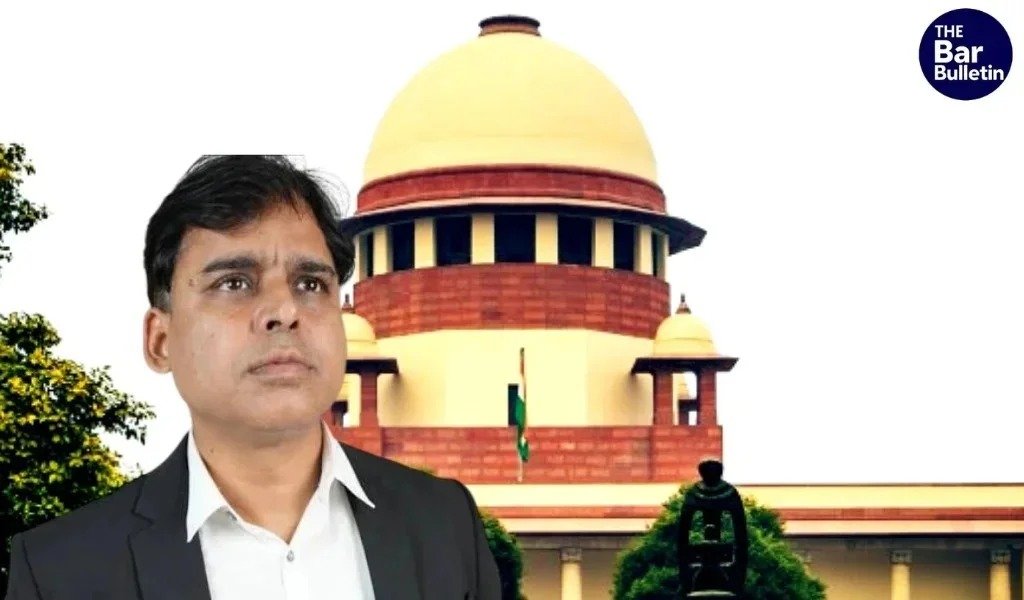

The Supreme Court on Wednesday quashed a notice issued by the Ghaziabad Police to social media platform X, seeking extensive digital information relating to journalist Abhishek Upadhyay’s account, holding that the demand for personal data covering a period before the registration of the FIR could not be sustained. The Court also directed that any personal information obtained pursuant to the notice shall not be used against him, continued his interim protection from arrest and coercive action, and ordered the release of his seized vehicle within two days.
The petitioner had approached the Court in connection with an FIR registered over an alleged road-rage incident. According to the allegations recorded during the proceedings, the petitioner had allegedly abused and threatened the complainant after his vehicle approached the complainant’s motorcycle from behind, and made remarks after asking about the complainant’s name and caste. The petitioner denied the allegations and claimed that the incident had been staged because of his reporting.
The dispute subsequently widened after the petitioner learnt of a notice dated August 22, 2026, issued to X under Section 94 of the Bharatiya Nagarik Suraksha Sanhita (BNSS), seeking extensive information about his account. The notice sought login and logout IP addresses, alternative email ID, mobile number, location data, latitude and longitude, device details, IMEI number, name, address, phone number and IP logs relating to account registration and access from June 1 to August 22, 2026. The petitioner argued that the request extended well beyond the alleged incident of August 18 and could expose his journalistic sources.
During the proceedings, the Commissioner of Police, Ghaziabad, filed an affidavit stating that efforts had been made to locate the petitioner after registration of the FIR and the notice was intended to trace his whereabouts and facilitate investigation. The petitioner disputed this explanation, arguing that the breadth and duration of the data sought were inconsistent with the stated purpose.
Also Read: Supreme Court Stays FIR Against Journalist Abhishek Upadhyay Over Alleged Road-Rage Incident
The Bench noted that the explanation furnished by the police commissioner appeared to be at odds with the contents of the notice issued to X.
“
“It may thus be seen that the explanation given by Commissioner of Police, Ghaziabad, in his affidavit that information was sought primarily to trace and arrest the petitioner is in somewhat contradiction with the contents of the notice dated 22nd August 2026. In that as it may, no confidential or personal information of the petitioner can be obtained for the period prior to the date of reference.”
The Court also considered the proportionality of obtaining personal information for the period after August 22, noting that the authorities had not established why less intrusive investigative measures would be inadequate. It stressed that the collection of personal digital data must be justified by the requirements of the investigation and accompanied by appropriate safeguards for privacy.
Setting aside the notice dated August 22, the Bench of Chief Justice Surya Kant and Justice Joymalya Bagchi directed that any personal information obtained under it should not be used against the petitioner. It also made absolute the interim orders passed on August 25 and September 7, 2026, thereby continuing the protection against arrest and coercive action.
“
“The principle of proportionality or proportional measures are applied and less intrusive measures available are not exercised and where the alternative measures to take the investigation to a logical conclusion are found to be inadequate. No such plea has been raised on behalf of the respondents.”
The Court clarified that it had not expressed any opinion on the merits of the FIR and that the petitioner remained free to challenge it before the jurisdictional High Court in accordance with law. The interim protection granted by the Supreme Court, however, would continue.
Senior advocate Pradeep Rai submitted that the vehicle had been seized during the investigation but has not been released. Directing its release, the Court ordered that the vehicle be returned forthwith and, in any event, within two days.
The Court also clarified that the petitioner could avail himself of the legal remedies available against the FIR, while the existing protection against arrest and other coercive action would remain in force.
Separate Plea On Guidelines For Collection Of Digital Data
During the hearing, the issue of laying down broader guidelines governing the collection of personal and private digital data during criminal investigations was also raised. Counsel submitted that the matter had implications beyond the individual case, particularly for journalists and the confidentiality of their sources.
The Bench indicated that a separate petition could be filed seeking guidelines on the issue. The Court granted the petitioner liberty to approach the appropriate court seeking guidelines for the collection of personal and private digital data during criminal investigations.