
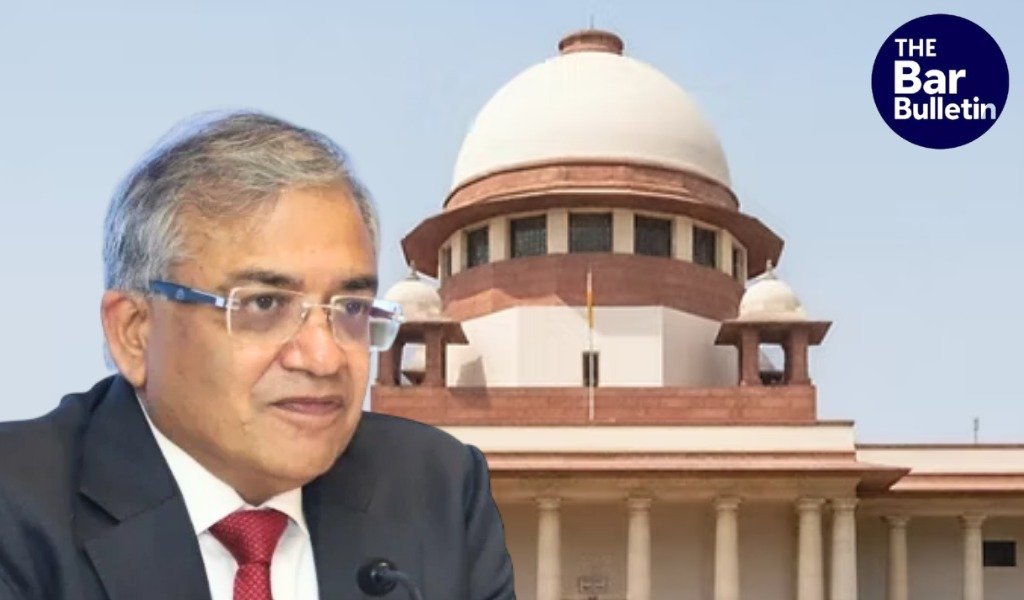

The Supreme Court on Monday refused to pass an immediate interim order suspending Chief Election Commissioner Gyanesh Kumar, while issuing notice to the Election Commission of India (ECI) and the concerned Election Commissioners on a plea alleging that decisions of the poll panel were being taken unilaterally.
A Bench of Chief Justice of India Surya Kant, Justice Joymalya Bagchi and V. Mohana was hearing petitions challenging the manner in which the Election Commission has allegedly been functioning, including allegations that decisions concerning the electoral process were taken without the concurrence of the other Election Commissioners.
The petitioners sought an interim direction restraining Kumar from functioning as CEC and, in the alternative, sought that his authority to act as Chief Election Commissioner be divested pending adjudication of the challenge.
During the hearing, the Senior Advocate Vikas Singh argued that the issue went to the very credibility of the Election Commission and urged the Court to intervene immediately.
“
“We are dealing with a very grave situation today. A grave situation which can undermine the very basis of our democracy. Today our democracy is vibrant and known all over the world because of the way we are able to conduct our election. Now, this election,s which has been conducted for 76 years, with the Election Commission having a certain amount of respect… today, we are having a situation where the very CEC as a constitutional body is acting in a manner which is completely contrary to the statute under which he is appointed. If he is working like this, can he be permitted… Lord, some interim order will be required. Otherwise, this will go on. Till today there is no denial.”
The petitioner also referred to the Chief Election Commissioner and Other Election Commissioners Act, 2023, particularly its provisions governing the manner in which business of the Commission is to be transacted.
It was argued that while the Commission may regulate the procedure for transaction of its business and allocation of work by unanimous decision, the substantive functioning of the Commission is governed by the statutory requirement of unanimity, failing which the matter has to be decided by majority. The petitioner urged the Court to at least direct the Commission to strictly follow the statutory scheme during the pendency of the proceedings.
The Bench, however, was not inclined to pass an interim order on the basis of newspaper reports alone and indicated that it wanted the ECI’s response and the relevant records before determining whether the allegations were made out. The Court observed:
“
“News report may be 100% correct, may be partially correct, may be partially incorrect. Because we cannot really today pass an order on that basis. But we definitely would like to have their response and then whatever requirements are there, we will issue them.”
The petitioner thereafter sought a limited interim direction making it clear that decisions of the Commission could not be taken in breach of the statutory requirement of unanimity or majority. The Bench indicated that it would examine the records and, if it found that decisions had been taken contrary to the statutory scheme, appropriate orders could follow. The Court said:
“
“If they come up and the records show that ABC decision was neither by majority nor by unanimity, we will injunct those decisions.”
The petitioner, however, pressed for an interim safeguard, arguing that merely setting aside individual decisions at a later stage could create complications, particularly where electoral rolls or elections had already been affected. Justice Bagchi responded that it was conscious of the difficulty and therefore wanted the statutory scheme to be followed in the meantime.
The petitioner also raised concerns regarding the integrity and preservation of records relating to the disputed decisions, urging that the original records be produced before the Court. The Court indicated that it would examine the records and observed that the concerned authorities would have to respond to the allegations.