
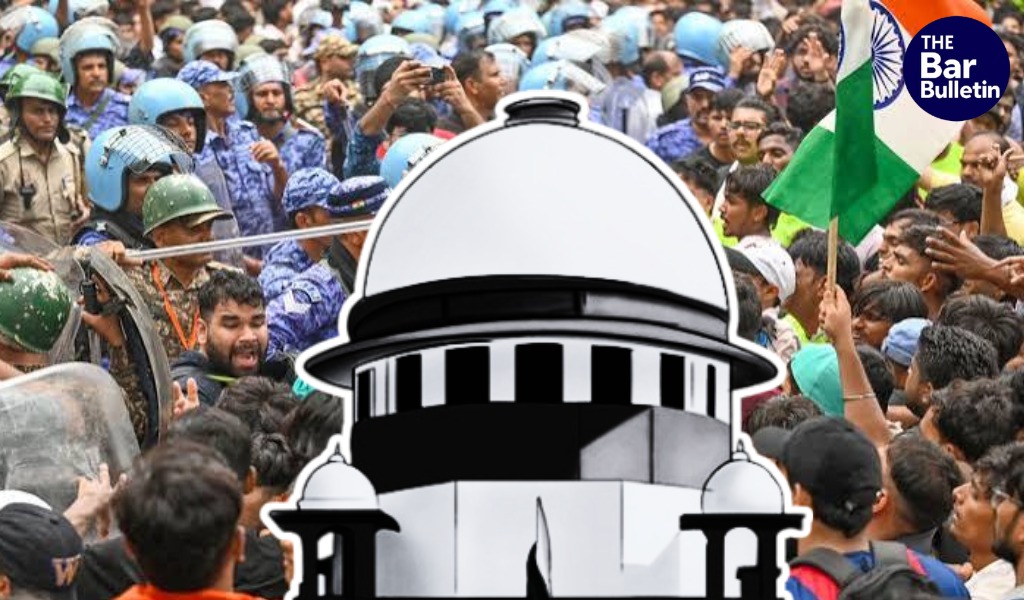

The Supreme Court on Tuesday ordered an independent probe into allegations of excessive police force during the nationwide protests over the alleged NEET paper leak, observing that the demonstrations were, by all accounts, peaceful and within the constitutional framework. The Court held that allegations of police excesses warranted an impartial inquiry while stressing that accountability must follow wherever misconduct is established.
A Bench of Chief Justice Surya Kant, Justice Joymalya Bagchi and Justice V Mohana was hearing a batch of petitions highlighting alleged use of pellet guns, electric batons, tear gas, lathis embedded with nails, assaults by police personnel in civil dress, attacks on media persons, and illegal detentions during the protests held at Delhi’s Jantar Mantar and other parts of the country. Petitioners also placed before the Court instances from Madhya Pradesh, Bihar, Maharashtra and other States.
During the hearing, the Chief Justice observed that the students’ agitation was protected by the Constitution, while acknowledging that anti-social elements could infiltrate otherwise peaceful demonstrations. The Court further emphasised that an inquiry would serve little purpose unless responsibility for any unlawful conduct was identified.
“
“There has to be completely independent probe. Whoever has committed excess, law will take its course. Probe is meaningless if no responsibility is fixed.”
Senior Advocate Gopal Sankaranarayanan, appearing for the petitioners, submitted that police had failed to follow established crowd-control protocols and argued that accountability must extend up the chain of command. Senior Advocates Shyam Divan and Shoeb Alam referred to credible reports and visual material alleging the use of pellet guns, electric shock weapons, excessive lathi-charge and violence against women, urging the Court to ensure an independent investigation.
Appearing for the Centre, Solicitor General Tushar Mehta stated that students undoubtedly had a right to protest peacefully and that those responsible for any wrongdoing should be brought to book. At the same time, he submitted that more than 250 police personnel had sustained injuries and contended that criminal elements had infiltrated the protests. Justice Joymalya Bagchi cautioned that there was always a danger of peaceful movements being discredited by such elements.
Recording that the allegations made by the petitioners prima facie disclosed a case for an independent and fair probe, the Bench observed that such an inquiry would also address the concerns raised by the State regarding injuries to police personnel. Before passing further orders, the Court granted the concerned States an opportunity to place their responses on record.
Directions
The Court directed that:
● All CCTV footage, drone footage, body-camera recordings and wireless communications relating to the protests shall be preserved.
● Police authorities shall preserve the digital data of protesters, and such data shall not be placed in the public domain for the time being.
● No personal data of student protesters shall be published by the authorities.
● No coercive action shall be taken against students who participated in the protests.
● All States shall release minors (below 18 years) arrested during the ongoing student protests who have no criminal antecedents.
● Notice was issued to the Chief Secretaries of Delhi, Madhya Pradesh, Maharashtra, Bihar, Kerala, Uttar Pradesh, Assam, West Bengal and other States to file their replies.
