
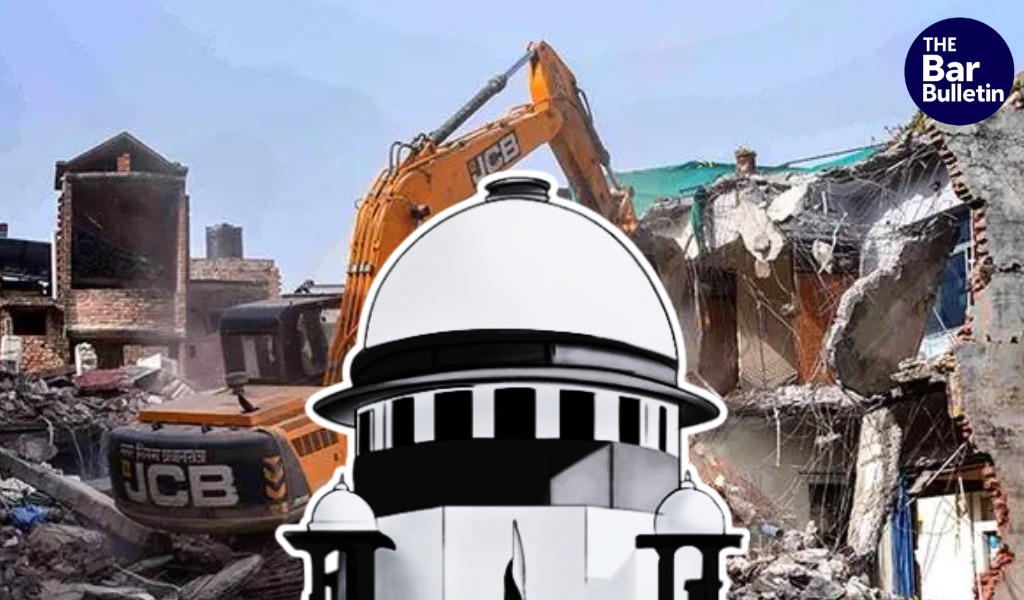

The Supreme Court on Thursday transferred a batch of contempt petitions alleging violation of its judgment regulating demolition of structures to the respective jurisdictional High Courts, holding that disputes over compliance with its directions would often involve factual inquiries best undertaken by constitutional courts in the States.
A Bench comprising Chief Justice of India Surya Kant, Justice Joymalya Bagchi and Justice V. Mohana passed the directions while hearing In Re: Directions in the Matter of Demolition of Structures (W.P.(C) No. 295 of 2022) along with several connected petitions and contempt cases arising from alleged violations of the Court’s anti-bulldozer demolition guidelines.
The Bench observed that while the principles laid down in its earlier judgment constitute binding law, determining whether authorities had actually violated those directions would frequently require an examination of disputed facts such as whether the property was private or public, whether the construction was authorised, whether notices had been served, and whether affected persons had been granted an opportunity of hearing. Questioning whether the Supreme Court should undertake such fact-finding in every individual case, the Court observed:
“
“The primary grievance appears to be that you are not following the prescribed procedure… They will say we have followed the procedure; the petitioners will say it has not been followed. Why should the highest court hear every such matter? There will be a factual inquiry required in every case to see whether notice was issued, to whom it was issued, whether objections were filed, whether those objections were heard. All these questions are bound to arise.”
The Bench noted that the directions contained in paragraphs 92 and 93 of its earlier judgment now form part of the law of the land and are binding upon all authorities. The Court observed:
“
“We follow your submission that the directions given by this Court become a part of the law which every authority is required to follow and respect. Any breach would naturally attract consequences. The question is only: what is the appropriate remedy and which forum should determine whether there has, in fact, been a breach?”
Senior counsels appearing in one of the matters concerning demolition of a mosque, argued that certain cases involved “egregious” violations of the Supreme Court’s directions and should continue before the apex court. Referring to paragraph 93 of the judgment, it was submitted:
“
“Needless to state that the authorities hereinafter shall strictly comply with the aforesaid directions… Violation of the directions would lead to initiation of contempt proceedings in addition to prosecution. This is not a case of encroachment on public land. It concerns private property with sanctioned construction. Despite High Court protection, demolition was carried out. I will demonstrate that they are in egregious breach of Your Lordships’ directions.”
The Court, however, emphasised that while clear violations must invite consequences, the existence of disputed factual questions made the High Courts the appropriate forum to determine whether contempt had been committed. The Bench remarked:
“
“If somebody has demolished property in violation of the directions of this Court, the consequences must follow. But if there is a bona fide action, or the action is otherwise justified, or there is a dispute whether the land is public or private, or whether the construction is authorised or unauthorised, this entire exercise will have to be undertaken by someone after examining the facts.”
The Court also clarified that its earlier judgment was not intended to shield illegal encroachments. Emphasising the context in which the anti-bulldozer directions were issued, the Bench observed:
“
“The foundation of that judgment was not municipal law. It was the rule of law. The concern was that under the guise of implementing municipal law there should not be a categorisation of individuals for special treatment. Where only the property of an accused person is targeted to create an impression of reprisal, that is where the rule of law comes under scrutiny.”
The Court further noted that statutory safeguards governing demolition continue to apply irrespective of its judgment. It observed: “What we wanted should not be misconstrued. The statutory requirements and due process must always be followed.”
Directions
The Court directed that the contempt petitions be transferred to the respective jurisdictional High Courts, which will determine:
● whether the property is private or public;
● whether the construction is authorised or unauthorised;
● whether the prescribed statutory procedure and the Supreme Court’s directions were followed before demolition; and
● whether violation of the Supreme Court’s judgment amounts to contempt warranting further action.
The Bench also directed that the interim protection already granted by the Supreme Court would continue, while granting liberty to parties to seek appropriate modification before the concerned High Courts. The High Courts were requested to decide the matters expeditiously, preferably within four months, after permitting parties to file additional pleadings and evidence where necessary.