
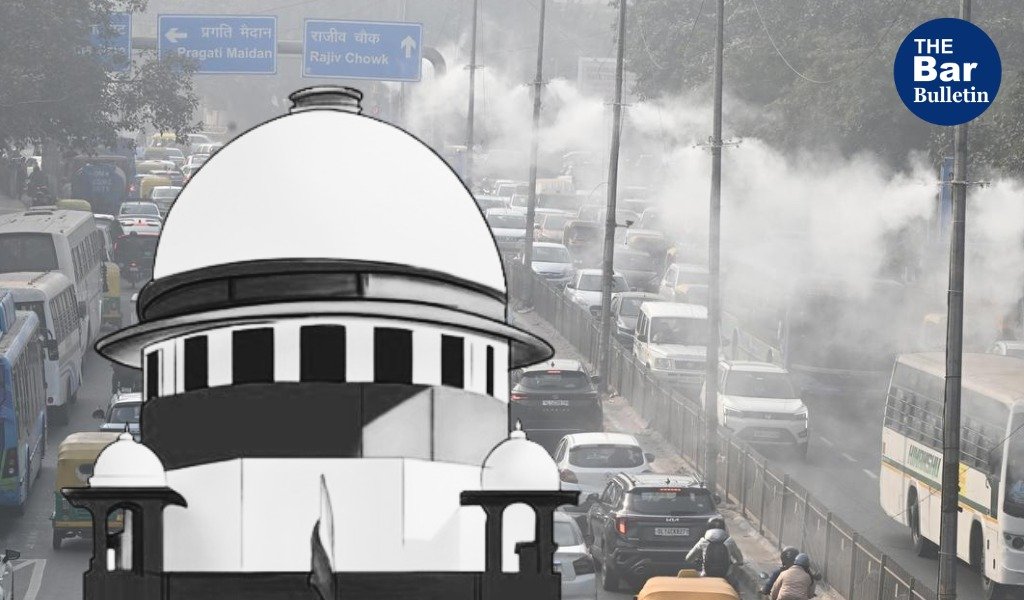

The Supreme Court on Friday heard the suo motu proceedings concerning air pollution in the National Capital Region, focusing on vehicular emissions, stubble burning, enforcement gaps and the implementation of pollution-control measures under the Graded Response Action Plan (GRAP). The matter was heard by a Bench comprising Chief Justice of India Surya Kant and Justices Joymalya Bagchi and V. Mohana.
During the hearing, the Amicus Senior Advocate Aparajita Singh submitted that stubble burning contributed around 14% to Delhi’s pollution as on November 5. However, submissions based on the Ministry of Earth Sciences’ decision-support system for air quality management in Delhi indicated that transport was the largest contributor in the pollution breakdown presented before the Bench.
The amicus submitted that the focus on stubble burning alone was misplaced, as local sources of pollution were also responsible for Delhi’s deteriorating air quality.
“
“Stubble burning is one of the problems because Delhi is already polluted. And with stubble burning, it tips over. So the entire focus on stubble burning is a little problematic. We need to actually work on our local pollution as well as stubble burning. Basic concentration should be to convert yellow into green. That is what efforts are required to be made.”
The amicus curiae submitted that stubble burning was no longer the dominant concern, with its contribution to Delhi’s pollution recorded at 14% on November 5. She argued that the disproportionate focus on farm fires was diverting attention from local pollution sources, particularly vehicular emissions.
On crop-residue management, she pointed to the difficulties faced by farmers in operating machinery due to high fuel costs and the unsuitability of such equipment for smaller farms. The Bench suggested placing stubble-management machinery at the disposal of gram panchayats so that it could be shared among farmers. It also proposed that the government notify a procurement price for stubble in advance, allowing farmers to sell the residue instead of burning it.
Children’s lung health: Supreme Court stresses need for expert opinion on school restrictions
The Supreme Court also considered whether schools across Delhi-NCR should shift to online or hybrid classes if air pollution levels worsen, and whether restrictions should apply uniformly to children across different age groups. Counsel argued that children across different grades should be treated as one category while assessing the health risks of exposure to polluted air. “My summation is that both of them should all categories of children should be treated as one class. The lungs of a fifth grade is not any different from that of a sixth grade,” counsel submitted.
Justice Joymalya Bagchi, however, said the Court would rely on the assessment of the expert body rather than independently second-guessing the classification adopted by the authorities. He observed that the expert body was expected to have considered paediatric recommendations.
“
“We have to refer to the decision of an expert body, expecting that they had taken into consideration paediatric suggestions. So let us not second-guess the authorities’ classification.”
Amicus referred to observations by chest surgeon Dr. Arvind Kumar, who had reportedly said that even children’s lungs were not pink while conducting surgeries in Delhi. The counsel argued that children were particularly vulnerable to prolonged exposure to polluted air.
“
“Even the lungs of children are not pink in Delhi. That is the hard reality. And that’s the reason we stress on children, because adults can still manage. Children are of tender age. Once harmed, it’s very difficult for them to recuperate.”
The Bench, however, made it clear that it would rely on scientific research and expert opinion while examining the issue, rather than anecdotal accounts. It called for evidence, including peer-reviewed research, to assess the health impact of pollution on children.
Vehicular pollution and idling at border points
The Bench expressed concern over vehicular congestion in Delhi-NCR, particularly the bumper-to-bumper traffic on roads connecting Delhi with Noida, Greater Noida and Gurugram. The Court observed that the problem was not merely the number of vehicles but the volume of traffic on the roads and the absence of an effective mechanism to monitor vehicles entering the National Capital Region. It also noted that vehicles registered in neighbouring States could enter Delhi without any assessment of the emissions they were generating. CJI remarked:
“
“The major cause of the problem is this vehicular pollution. Look at the roads in Delhi. Look at the roads connecting Delhi with the NCR region, whether it is Noida side, Greater Noida side, Gurgaon side, Sonipat side. You try to take view of any road. The kind of bumper-to-bumper vehicles are going. That is the major cause. They have their own justification because if they have to go, how to go, because they don’t have public transport system which can facilitate them. So, unfortunately, we are lacking in that.”
The amicus curiae, Senior Advocate Aparajita Singh, drew the Court’s attention to its earlier directions requiring the National Highways Authority of India (NHAI) and the Municipal Corporation of Delhi (MCD) to ensure that vehicles were not made to wait at toll plazas and border points. She submitted that the directions had not been fully implemented despite the deadline having passed in October. She also pointed out that the Delhi Government’s decision to stop certain vehicles from entering the city at its borders could itself lead to vehicles remaining stationary with their engines running, thereby adding to pollution.
“Both at the toll plaza and now at Delhi, if the vehicles are idling, it leads to more emission,” the amicus submitted, urging the authorities to address the issue. She also suggested that the CAQM verify the implementation of the earlier directions rather than relying only on the claims made by the agencies.
Responding to the concerns, the authorities informed the Court that a Multi-Lane Free Flow (MLFF) system had been installed at nine major toll plazas, through which nearly 90% of the traffic passes, and that testing was underway. It was submitted that the infrastructure was in place and that no vehicles were being made to wait at these toll plazas. The amicus, however, questioned the claim and urged the Bench to have the CAQM conduct an independent inspection, stating, “Let the CAQM respond to this. They can actually give a fair report.”
The Bench also questioned whether any scientific inquiry had been undertaken to determine why pollution levels continued to remain high despite the various measures introduced by the authorities. It asked whether the problem was linked to the sheer volume of vehicles or whether other factors, including the type of fuel used and the emissions generated by vehicles entering Delhi from other States, were contributing to the crisis.
In response, Additional Solicitor General Aishwarya Bhati referred to the measures undertaken to regulate vehicular emissions. She submitted that pollution-under-control certificates were now geotagged at the location where checks were conducted, that fuel was not being dispensed to vehicles without valid certificates, and that complaints regarding visibly polluting vehicles received through an app and social media were acted upon. She acknowledged, however, that the measures were not foolproof.
The amicus further urged the Court to seek explanations from the NCR States and Punjab regarding the implementation of the Comprehensive Action Plan and GRAP measures.
She submitted that while several policy interventions and judicial directions were already in place, their implementation remained a major concern. She sought status reports from the concerned States and agencies detailing the measures taken, gaps in compliance and additional steps proposed to contain pollution.
The matter remains part heard and will be listed post-Diwali.