
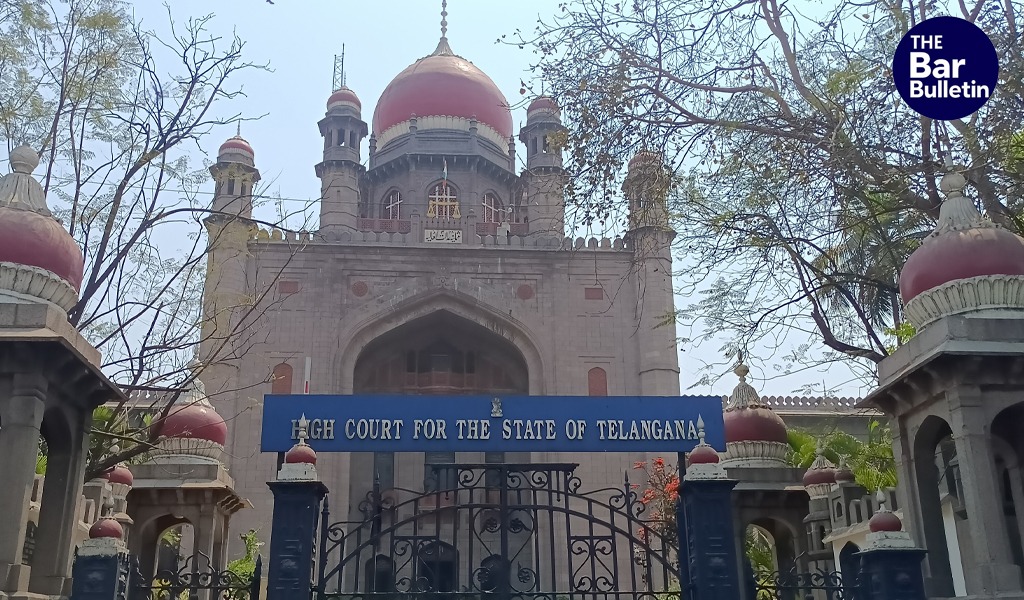

The Telangana High Court (Hyderabad Bench) has held that the Telangana State Human Rights Commission lacked jurisdiction to entertain complaints filed by an employee against Wells Fargo International Solutions Private Limited and its employees because they were private parties and not public servants. Essentially, a State Human Rights Commission cannot entertain complaints against a private company and its employees in the absence of any allegation against a public servant under the Protection of Human Rights Act, 1993.
The High Court clarified that under Section 12(a) of the Protection of Human Rights Act, 1993, the State Human Rights Commission can inquire only into complaints alleging violation of human rights, abetment, or negligence in preventing such violation by a public servant. Complaints directed exclusively against a private company and its private employees, arising from a private employment dispute, are outside the Commission’s statutory jurisdiction. The seriousness of the allegations, including workplace harassment or alleged impact on dignity and bodily integrity, cannot enlarge that jurisdiction.
The Division Bench comprising the Chief Justice Aparesh Kumar Singh and Justice G.M. Mohiuddin identified the core issue as whether the State Human Rights Commission under the 1993 Act could inquire into complaints of human rights violations against a private company and its employees who were admittedly not public servants. The Court examined Section 12 of the Act and held that the Commission’s inquiry power is triggered only when the complaint alleges violation of human rights, abetment, or negligence in preventing such violation by a public servant.
The Court made it clear that the expression “by a public servant” is the foundational jurisdictional requirement under Section 12(a). It held that this qualifying phrase governs the entire clause, and therefore the Commission cannot exercise jurisdiction unless the complaint is against a public servant or alleges negligence by a public servant in preventing the violation. Since the petitioner was a private limited company and its employees did not fall within the statutory definition of “public servant”, the jurisdictional requirement was absent.
The Court further observed that the Human Rights Commission is a creature of statute and does not have inherent or plenary powers. Its jurisdiction cannot be enlarged merely because the allegations concern dignity, equality, or serious workplace harassment. The Court relied on the statutory scheme and held that however grave the allegations may be, they cannot themselves create jurisdiction where the statute does not confer it.
The Court also referred to the 2013 Regulations governing the Commission’s procedure and noted that Regulation 2(1)(b) expressly defines a complaint as one alleging violation or negligence by a public servant. It also noted that the prescribed forms under the Regulations are addressed to an “authority”, showing that the procedural framework itself is designed around public authorities and public officials, not private employers. On that reasoning, the Court held that the Commission acted beyond both the Act and its own Regulations in issuing notices to and calling for reports from a private company.
On the nature of the dispute, the High Court held that the employee’s allegations arose out of an employer-employee relationship. The complaints concerned workplace interactions, performance appraisal, harassment allegations, and the company’s internal grievance handling. These were matters rooted in employment and internal service conditions. The Court stated that merely calling such a dispute a human rights issue does not automatically confer jurisdiction on the Commission.
The Court also rejected the Commission’s attempt to distinguish service disputes from harassment complaints for jurisdictional purposes. It held that whether the allegation concerns service benefits, performance issues, or workplace harassment, the decisive test remains the same: whether Section 12 is satisfied. Since there was no allegation against any public servant and no negligence by any public servant in preventing the alleged violation, the Commission could not lawfully proceed.
The Court acknowledged that allegations of harassment of women at the workplace are serious and require legal redress. It also noted that remedies may be available under the Sexual Harassment of Women at Workplace (Prevention, Prohibition and Redressal) Act, 2013 or other applicable law. But it stressed that the existence of a serious grievance cannot expand the jurisdiction of the Human Rights Commission beyond the limits imposed by the 1993 Act.
The Court also held that the Commission’s assumption of jurisdiction, despite the absence of statutory prerequisites, amounted to action beyond its authority and offended Article 14. A party cannot be compelled to participate in proceedings before a forum that lacks inherent jurisdiction. Since the company had raised the objection at the earliest opportunity, it was entitled to challenge the proceedings directly through writ jurisdiction.
Briefly, the employee had joined the company on May 09, 2011 and was later working as a Senior Commercial Loan Servicing Representative. In July 2019, she made an internal complaint before the company’s HR Department against two colleagues, alleging workplace harassment and dissatisfaction with her performance appraisals. The company conducted an inquiry, which took time because she was on medical leave and later submitted voluminous documents. In December 2019, the HR Department concluded that her allegations were not substantiated.
Thereafter, on Feb 20, 2020, the employee issued a legal notice repeating her allegations and alleging inaction by the company. In March 2020, she escalated the matter to the Employee Relations Department, which conducted an independent inquiry by interviewing her multiple times, examining witnesses cited by her, and interacting with other team members. That inquiry also concluded that the allegations were unsubstantiated, and the closure was communicated to her by email dated Aug 20, 2020.
Even before the ER inquiry concluded, the employee had already filed two complaints before the TGHRC on Feb 28, 2020, alleging violation of her human rights on account of harassment by superior officers and failure of the company to address her grievances. The company entered appearance before the Commission and objected to maintainability, arguing that the Commission had no jurisdiction under Section 12 of the Protection of Human Rights Act, 1993 because the complaints were against a private company and private individuals, not against public servants.
The matter remained pending before the Commission for some time. After a new Registrar was appointed in April 2025, the company was again summoned. The Commission agreed to consider maintainability as a preliminary issue, directed the company to produce the HR and ER inquiry reports, and then, by common order dated Oct 14, 2025, rejected the company’s jurisdictional objection. The Commission held that the complaints were not about service benefits alone, but about harassment of a woman employee affecting dignity and gender equality, and therefore it had jurisdiction to proceed.
