
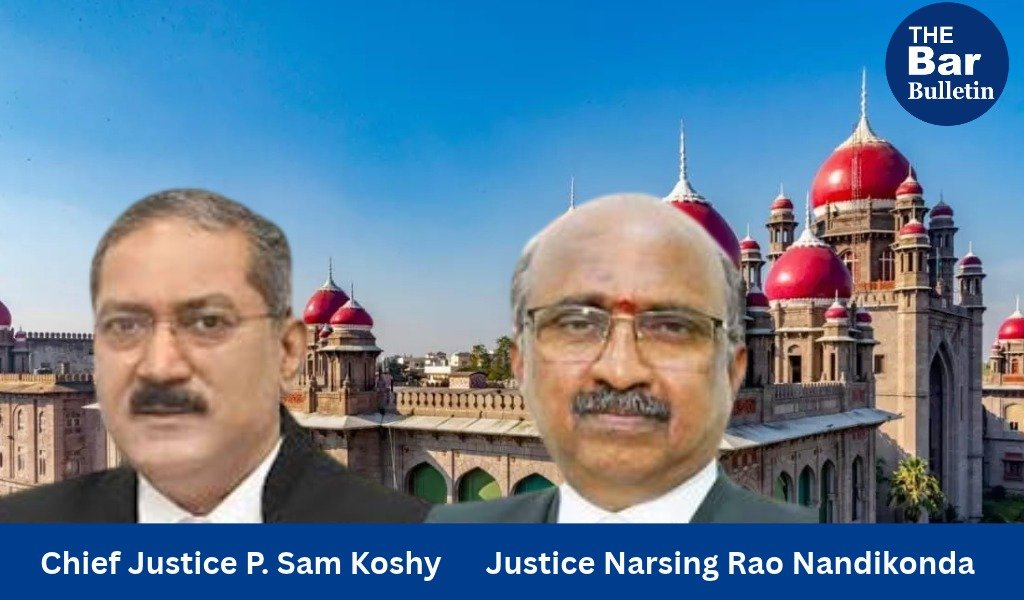

In a writ petition filed before the Telangana High Court by a lawyer challenging the valididity of Section 12 of the Telangana Advocates Welfare Fund Act, 1987 (Act), which required fixing of Rs. 100/- welfare fund stamp on a vakalatnama as well as Section 12-A, which distributes the aforesaid collected money to the Telangana Advocates Fund and the Telangana Advocates Clerks Welfare Fund, a Division Bench of Acting Chief Justice P. Sam Koshy and Justice Narsing Rao Nandikonda dismissed the petition.
The petitioner stated that the original Act contained no mandatory stamp requirement, that collection began in 1992 at Rs.8/-, and that the amount was enhanced over the years to Rs.12/-, Rs.20/-, Rs.30/-, Rs.50/-, and Rs.100/-, and finally to Rs.250/- in 2025, with a split of a ratio of 215:35 between Advocates and Advocates Clerks.
It was contended that Section12 was bad in law as it was not within the legislative competence of the Telangana State as making law was within the exclusive domain of the Parliament. The petitioner asserted that the 2018 Amendment by which the stamp value was increased from Rs. 50/- to Rs. 100/- was bad in law in terms of Article 245, 254, and 246 of the Constitution. Further, it was argued that ‘advocates welfare’ was not a state subject to be legislated and it could not be imposed upon the advocates to pay the welfare fund.
The Court framed four questions. First, whether Sections 12 and 12A were beyond the legislative competence of the State by reason of Entry 78 of List I, or amounted to colourable legislation. Second, whether the provisions were repugnant to the Advocates Act, 1961 or the Advocates Welfare Fund Act, 2001, and whether the enhancing amendments were invalid for want of Presidential assent under Article 254(2). Third, whether the provisions violated Articles 14, 19(1)(c) and 19(1)(g), and failed for non-compliance with Article 31C. Fourth, whether the levy was invalid because it was neither a tax nor a fee and because the proceeds were not credited to the State Exchequer as contemplated by Article 283.
The Court began with the presumption of constitutionality, noting that the burden lay on the petitioner to show a clear transgression. Applying the doctrine of pith and substance, it held that the Act was in its true character a measure of social welfare for members of the legal profession and their staff, falling under Entries 23 and 26 of List III, and that any effect on Entry 78 of List I was incidental because the Act did not prescribe who might practise or confer or take away the right to appear. It was stated that Section 12 does not deal with the entitlement to practise, but only with a contribution that accompanies the filing of a vakalatnama. Since the State had competence over the subject matter under Entries 23 and 26 of List III, the Court found no room for a charge of colourable exercise.
On repugnancy, the Court held that Articles 244, 255 and 256 did not bear on the controversy and treated the petitioner as having invoked Article 254. It found no direct conflict, since Sections 6 and 7 of the Advocates Act did not prohibit a State from making a compulsory contribution, and the silence of the Central Act of 2001 on a compulsory levy was not a prohibition. Because there was no repugnancy, the Court held that Presidential assent was not a condition of validity. As the Court did not find any repugnancy to the existing law of Parliament, Article 254(2) was not attracted and the amendments did not require fresh assent.
On Article 19(1)(c), the Court held that the Welfare Fund Committee was a statutory body and that the petitioner was not compelled to join any association. On Article 19(1)(g), it held that the stamp did not prevent the petitioner from practising and was a reasonable burden, and that the Registry merely complied with the statute in declining a vakalatnama without the stamp. Article 31C was held to be a protective provision, and since Article 19 was not violated, the Court found no occasion to consider it. Under Article 14, the Court found that the petitioner showed no unequal treatment, and the ratio of distribution was a matter of legislative policy with a rational basis.
The Court rejected the tax-versus-donation dichotomy, holding that the Act supplied the authority of law, that the stamp was only a mode of collection, and that the obligation arose from the statute and could not be called a donation. On Article 283, the Court held that the proceeds were impressed with a trust for a statutory purpose and did not become State revenue, and that any deficiency in custody would go to administration and not to validity. It was also held that the court fee and the welfare stamp served different purposes, and it noted that Section 38 of the Advocates Welfare Fund Act, 2001 did not supersede the existing State fund Acts, which further supported the beneficial nature of the State Act.
Hence, the Court held that Sections 12 and 12A of the Act, as amended from time to time, were valid, within the legislative competence of the State, not repugnant to any law made by Parliament, and not violative of Articles 14, 19(1)(c) and 19(1)(g). Thus, the petition was dismissed. Lastly, the Court said that a society that expects its members to serve it must also expect them to bear a small share of the burden of caring for one another. It was said that an individual objection to a modest sum must yield where the sum is collected under valid law and applied to a larger interest in which the contributor himself shares.
Further, the Court stated that since the Central statute expressly exempted the notified fund Acts of the respective States which includes the State of Andhra Pradesh (State of Telangana after bifurcation), it stands proved that the State Welfare Fund Act is found to be beneficial in
nature in the wisdom of the Parliament and for the stakeholders who intend to stand benefitted, which is ultimately a more compelling ground to not declare the impugned Act as ultra vires or unconstitutional.
The Court said that “The stamp that is affixed to a Vakalat costs the contributor little and is soon forgotten. Gathered over many hands and many years it becomes the immediate financial support to which a widow or an orphaned child or an aged parent can turn before any other help arrives.” Hence, the Court held that the Act and the Fund were neither unconstitutional nor ultra vires the Constitution.
ALSO READ: Tamil Nadu Has 2,423 Pending Corruption Cases; Madras High Court Calls For More Special Courts
