
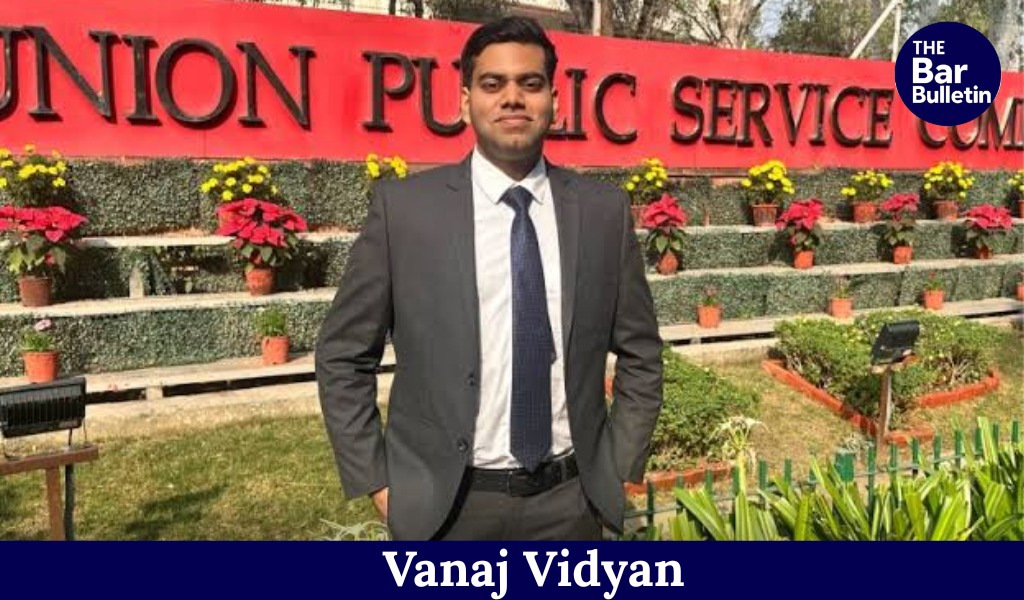
Vanaj Vidyan secured AIR 278 in the UPSC Civil Services Examination 2025, with Law optional. He graduated with University Gold Medals in both B.A.LL.B. (Hons.) from RMLNLU Lucknow and LL.M. from the University of Delhi, served as Law Clerk (A) to Hon’ble Justice N. Kotiswar Singh at the Supreme Court, practiced as Advocate before the Supreme Court, and was honoured as India’s National Youth Icon by Prime Minister Sh. Narendra Modi.
1. Vanaj, first of all, congratulations on securing AIR 278. UPSC journeys are often described through ranks and results, but behind every result there is a story. If you had to describe your UPSC journey in one sentence, what would it be?
Thank you. There is indeed a long story behind any result, but none of it would have been possible without the unconditional support of my family and friends. So before anything else, I would dedicate this journey to them. There is a couplet that captures it best for me:
“
“Apne kya hai iss jeewan mein, sab toh liya udhar. Saara loha un logon ka, apni keval dhar.”
Whatever edge I may have brought, that edge was forged by the people around me.
2. You come from a law background and chose Law Optional. Looking back, do you think law gave you an advantage in understanding governance, constitutional values and public administration, or did it create its own challenges?
Yes, the advantages of knowledge of law are real and substantial. Polity and General Studies Paper II are already familiar terrain. Answer-writing benefits enormously, because citing articles, statutes, conventions, and constitutional provisions comes almost like second nature.
But there is another, quieter advantage. As lawyers, we always had a fallback that aspirants from other backgrounds simply don’t have. I always knew that if UPSC did not work out, I would walk back into a courtroom and build a deeply meaningful career. That knowledge gave me a kind of peace of mind that took real pressure off the preparation. When the existential stakes are slightly lower, you tend to think more clearly.
I cannot overstate how much I love law. A significant part of my preparation years was spent genuinely debating whether I should commit fully to litigation instead. Right after Mains 2025, I began my Clerkship under Justice N. Kotiswar Singh at the Supreme Court. I am immensely grateful to Sir for his kindness, for broadening my horizons on how the Apex Court functions, and most importantly, for teaching me values of humility, compassion and service-delivery through his exemplary conduct. The learnings I carried under Sir’s tutelage shall always stay with me, and I hope I can deliver on the expectations he said the country has on me as a young civil servant.
After my UPSC Interview, I finally realised my dream of joining the Bar, starting my practice under Mr Mukesh Gupta at the Delhi High Court, who kindly agreed to train me despite impending Civil Services results and imparted enormous learnings. I hope to spend the next several decades putting law to use in service.
And a small footnote to this answer: I was sitting inside a courtroom at Patiala House Court waiting for my matter to be called out, when the final results were declared.
3. You have spoken about mistakes made in earlier attempts. Looking back now, what was the single biggest misconception you had about the UPSC examination when you began preparing? Many aspirants spend years collecting resources, making notes and constantly changing strategies. At what point did you realise that success in UPSC is often less about resources and more about clarity and execution?
I cleared this examination on my third attempt. My first attempt came while I was still in my final semester at RMLNLU Lucknow. In hindsight, it took me two to three years of honest, sometimes uncomfortable, mental processing to truly understand what this examination demands.
People often call Civil Services the hardest examination in the world, and I think that perception exists because of its sheer breadth. But the deeper truth, one that took me far too long to see, is that the exam doesn’t merely reward knowledge. It rewards the intelligent deployment of knowledge. You cannot clear this examination by simply studying more. Across three attempts, my notes did not change. My books did not change. What changed was the way I consumed and applied those same resources. I earnestly believe that UPSC is not checking for the person who can consume the most resources- but for someone who can analyse and interlink multidimensional knowledge across subjects under a pressure situation.
4. There is a growing culture of comparison in the UPSC ecosystem. Aspirants constantly compare test scores, study hours and preparation strategies. How did you protect your confidence while navigating that environment?
The competitive intensity of this examination is both its most challenging and most energising quality. Consider the numbers- over 13,00,000 applicants at Prelims, filtered down to roughly 14,000 at Mains, and finally around 900 selections. You are, at every stage, competing against the most driven people in the country.
My honest approach was to accept that reality fully rather than resist it. I never tried to insulate myself from the competition, but I absorbed it as fuel. However, I also came to believe, eventually, that the only competition that truly matters is with yourself. If you are more prepared today than you were yesterday, that is all the scoreboard that counts.
One small story captures how competition shaped my preparation. While studying at a library, I became quietly obsessed with ensuring that no one outworked me. There was one person with similarly long study hours, and entirely in my own head, I declared a competition with him. My goal became simple: be the first to enter at 8 AM and the last to leave at midnight. It was probably not the healthiest mindset, but there are phases in a long preparation when you need that fire to keep you moving after motivation has run out. Kobe Bryant’s Mamba Mentality captures it well. When you finally succeed, knowing you left nothing on the table makes the victory far more meaningful.
Of course, this is not to take away from the significance of mental health during the preparation. I will speak about the mental health dimension separately. (Refer Question 10)
5. One point you have repeatedly emphasised is that prelims is not merely a knowledge test but a decision-making examination. What changed in your approach to prelims that finally made the difference?
My trajectory with Prelims is an interesting one. I wrote my first Prelims in 2023, barely a month after graduating from RMLNLU with the University Gold Medal. Those in the examination community would recall that the 2023 paper was considered unconventional and unexpected. I cleared it, though I did not make it past the Mains that year.
In 2024, the attempt where, objectively, I was the best prepared and the examination was more conventional, I did not clear the Prelims. That was a significant setback. You lose an entire year, and have to return to the starting line.
So going into 2025, I sat down to seriously diagnose what had gone wrong. It was not a lack of preparation. The problem was decisional- what was happening inside the examination hall. Overthinking. Over-reliance on semantic precision. Approaching a generalist paper with the adversarial instincts of a lawyer trained to spot every possible counter-argument. That habit, which serves you well in a courtroom, can be fatal in the Prelims Hall.
In 2025, the hardest work I did wasn’t on content but on mindset. Trusting instinct. Understanding the examiner’s intent. Recognising patterns rather than dissecting options. My approach shifted from answering the paper to solving it, and that subtle distinction changed everything.
6. Law teaches you to argue both sides of an issue. Did that training ever help during the personality test, where the panel is often assessing judgment rather than just knowledge?
I scored 210 marks in my first-ever UPSC interview, and I would attribute it significantly to the role of my legal training. The exposure we receive through moot courts, written submissions, and adversarial argument teaches us something invaluable: how to hold multiple perspectives simultaneously, and how to engage seriously with a position we might personally disagree with. That is not a rhetorical trick, but something that reflects a genuine intellectual discipline.
There is a perception in UPSC circles that lawyers tend to score well in the personality test. I would gently push back on that framing. It is not because we are lawyers. It is because legal training, at its best, cultivates a capacity for critical judgment- and when that judgment happens to align with what the Interview Board is looking for in an incoming civil servant, the marks do follow.
7. One of the most interesting observations you made was that the UPSC interview panel is not sitting there to reject candidates but to select them. Why do you think so many aspirants continue to fear the interview stage?
The fear is understandable, and it comes from several directions at once.
First, reaching the interview is itself an extraordinary achievement. By that stage, the selection ratio has shifted from roughly one in fourteen hundred at Prelims to one in three. You are standing at the threshold, which is why the cost of not making it feels catastrophic as failure sends us back to Prelims, to ground zero, after everything.
Second, the Mains and Prelims cycle demands a kind of deliberate isolation- long hours, sacrificed social life, withdrawn from the ordinary world. And then, suddenly, the interview asks that same candidate to walk into a room, appear composed and articulate, and present their best self, in what may be the most consequential 30 minutes of their life. For candidates who come from backgrounds where such settings feel unfamiliar, this is genuinely daunting.
My personal situation added its own pressure: I had only nine days to prepare, having been scheduled in the very first week of the three-month interview phase. But if I am honest about my headspace on the morning of the interview, it was, more than anything, grateful and calm. Walking into Dholpur House, knowing you are among the privileged few who get to stand in those halls that determine who will run the country for the next thirty-five years, to be assessed by five people whose combined experience is atleast five times your age- that is not a moment to be afraid of. It is a moment to be genuinely grateful for.
8. Do you remember a particular interview question that genuinely challenged your thinking rather than your knowledge?
My interview was the first to happen in the morning (candidates receive this information only once inside the UPSC Bhawan). Soon as I entered and had hardly settled myself, the very first question put to me was: “Vanaj, how long was your presentation to the Prime Minister which led to your appointment as National Youth Icon?”, followed by several questions building on that. It set the tone immediately. I realised the Board had engaged closely with my profile and that the conversation would be held to a high standard.
But what I would rather emphasise is this: across the interview, there were several questions to which I simply said I did not know the answer. I was transparent about the limits of my knowledge. And I still ended up with one of the higher scores in my batch. I think that is the clearest possible evidence of what the Board is actually evaluating. It is not your capacity to recall facts. It is your thinking, your judgment and your integrity as a future public servant. The interview is not a quiz. It is a conversation about who you are.
9. Aspirants often focus heavily on answer writing and test series. But what is one underrated skill that you believe contributes significantly to success in the examination?
Answer-writing is, without question, a cardinal pillar of preparation. With 1,750 out of 2,025 Mains marks riding on written answers, it would be unwise to understate it. But the examination demands something beyond that, and the skill I consider most underrated is mental resilience, and specifically, the ability to trust your own judgment.
This examination demands a commitment of at least two to three years, which means a significant opportunity cost at one of the most formative phases of your life. Layer onto that the social media age, where every second person is a UPSC influencer selling a course with a clickbait promise, manufacturing FOMO and pushing aspirants toward shortcuts rather than the painstaking, unglamorous work of completing each head of the syllabus thoroughly.
Cutting out that noise, staying committed to the resource you chose, continuing to trust the judgment you exercised when you chose it, requires a kind of quiet mental strength that no test series can measure. I am yet to meet a single successful candidate who said they cleared the examination because they discovered some obscure resource at the last moment. When the odds are fourteen hundred to one, wild experimentation is a luxury you cannot afford. The ability to stay the course, boringly and consistently, is itself a skill that deserves far more credit than it receives.
10. There is increasing discussion around burnout, anxiety and uncertainty in long-term UPSC preparation. How did you deal with self-doubt during phases when results did not go your way?
Uncertainty is, without doubt, the hardest part of this examination. The opportunity cost is real. The self-doubt is real. And any failure at any stage sets you back by at least two years. Burnout is also a real risk, because after the first attempt, preparation gradually shifts from learning new things to repeatedly revising what you already know. That transition can often feel stagnant. I realised over time that the only sustainable way to prepare was to consciously lower the psychological stakes of the examination.
The first thing I did was impose a hard cap: three attempts, and no more. That boundary was liberating rather than limiting, and was probably the reason why I could walk into my third attempt with a genuine willingness to take risks.
Second, I always tried to have a life beyond UPSC. I pursued an LL.M., which kept me intellectually engaged with law, gave me lifelong friendships and, eventually, another University Gold Medal. Later, being honoured by Prime Minister Modi as India’s National Youth Icon, and being invited by the Hon’ble President for the At-Home Reception at the Rashtrapati Bhawan this 26th January, reminded me that life continues to offer meaningful opportunities, irrespective of the outcome of any one examination. That perspective became invaluable during difficult phases.
Finally, I cannot overstate the importance of having a Plan B. Not to necessarily pursue in parallel, but to know it exists. For me, it was litigation. Knowing that I could return to a profession I deeply loved meant that failure in one examination would never define my life. I shall always remain indebted to Senior Advocate Mr Vikramjit Banerjee, Additional Solicitor General, who reassured me that the preparation years would aid my practice if I were to ever enter. My supersenior and mentor, Mr. Abhikalp Pratap Singh, Advocate-on-Record, consistently told me: give your best attempt at Civil Services, for the Bar will always have a place for you. These assurances relieved the weight of the preparation, and ironically, once I stopped treating UPSC as the only path to a meaningful future, I believe I became a much better candidate for it.
11. If you could go back and speak to your younger self on the first day of preparation, what advice would you give?
This question genuinely made me pause.
I would tell my younger self: things happen when they are meant to happen. I spent years trying to control every variable of my preparation, but it was only when I released that grip and walked in with nothing but faith on my preparation, that the results followed.
There is a Shloka in the Bhagavad Gita: you have the right to your actions, never to their fruits). I often felt I had worked the hardest in my first and second attempts, and approached the third most lightly. I do not think that is a coincidence. Most of my successful CSE batchmates have observed something similar, that success came once they stopped trying to control the outcome.
But I will say this honestly: I do not think that realisation can come from reading about it. It can only come from going through the fire yourself, for it is perhaps the natural arc of this kind of preparation. Because by then, the knowledge is already there. What finally arrives is the right attitude to deploy it.
12. And finally, now that the examination journey is behind you and public service lies ahead, what does becoming a civil servant mean to you beyond securing a rank?
Many things converge in the answer to this question, but let me begin where it really began.
When I was thirteen years old, my father gifted me a copy of P.M. Bakshi’s Commentary on the Constitution of India. He inscribed a very sweet note inside. In hindsight, that was the moment I understood that my career would be bound to law, and to something larger than personal ambition.
My father had himself appeared in the UPSC Civil Services interview in his time, not making it past. He built a distinguished career regardless- he currently serves at the Joint Secretary scale with the Government of India- but that particular fire, the desire to make it through the Civil Services, was something I carried quietly. Life did come full circle, for him as for me, when he drove me to UPSC Bhawan on the morning of my interview.
And so, when my selection came, what he said has stayed with me as the truest measure of what lies ahead. He said:
“
I am happy you have qualified. But I will be truly happy when the service you do is for the marginalised, for the last, voiceless person who expects his voice to come from you.
It is my Gandhian Talisman. The freedom fighters who built this nation were people who achieved superhuman things in the face of odds that threatened India’s very existence. The India of today is more resourced. The challenges may be more entrenched, but we have far greater wherewithal to address them.
“
I hope to serve fearlessly and with full fervour, to use the trust the State places in me, and the resources it provides, entirely in the service of our country.
35 years later, when I come back to this interview, I hope I would have lived true to these words.