
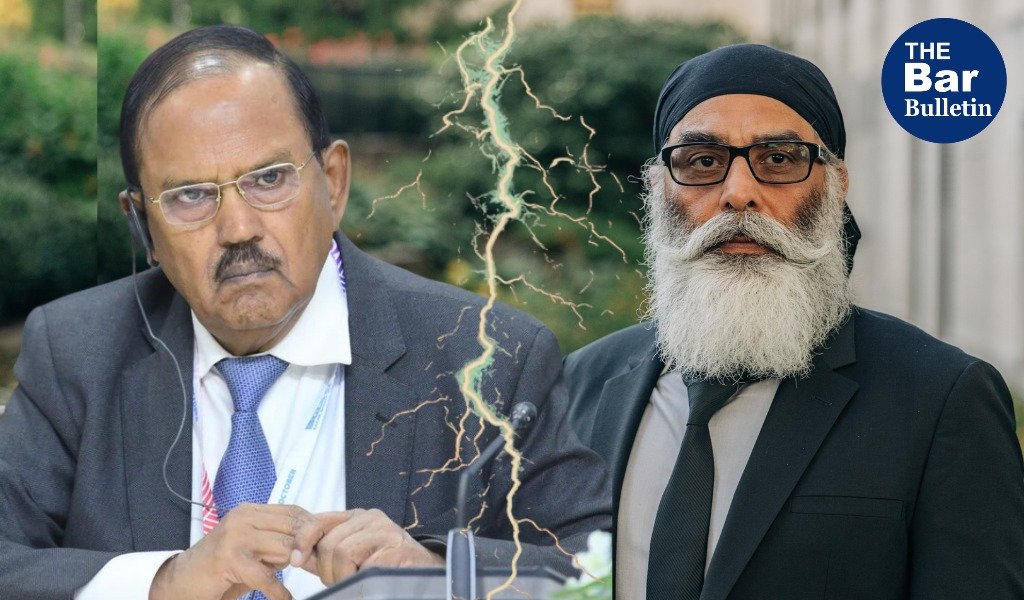

A United States District Court has permitted Sikh separatist Gurpatwant Singh Pannun to serve National Security Advisor Ajit Doval and former Research and Analysis Wing (RAW) chief Samant Goel through Indian courts in a civil lawsuit alleging a conspiracy to assassinate him in New York.
US District Judge Katherine Polk Failla of the Southern District of New York, in an order dated November 9, 2026, allowed Pannun’s request to serve the two defendants through Indian courts under Article 19 of the Hague Convention on the Service Abroad of Judicial and Extrajudicial Documents, read with the Code of Civil Procedure, 1908.
Gurpatwant Singh Pannun’s lawsuit alleges that Ajit Doval, Samant Goel, RAW agent Vikram Yadav and other defendants conspired to assassinate him at his New York residence in retaliation for his role in a movement supporting the creation of an independent Sikh state.
The court noted that Gurpatwant Singh Pannun had attempted personal service on Ajit Doval during three of his official visits to the United States but was prevented from doing so by security personnel. He had also attempted to serve Ajit Doval, Samant Goel and Vikram Yadav through India’s Central Authority under the Hague Convention, but those efforts were unsuccessful.
The Court observed that India’s response to the service requests did not clearly establish that the country had determined the Hague Convention to be inapplicable.
“
“The Refusal Statement is hardly a model of clarity. Unlike the German cases, the Indian Central Authority did not adopt the reasoning of an Indian district or appellate court explaining the Hague Convention’s inapplicability or cite to a specific provision of the Hague Convention to justify its refusal to serve. Rather, the Indian Central Authority simply stated that the request ‘fail[ed] to cover in the above categories’. Absent clarification from the Indian Central Authority, the Court cannot discount the possibility that this laconic response constituted a denial on procedural or technical grounds, rather than a merits determination that the Hague Convention does not apply to Plaintiff’s request.”
The Court also rejected Gurpatwant Singh Pannun’s argument that India’s response was conclusive on the applicability of the Convention, holding that treaty interpretation ultimately remained a matter for the courts.
Having held that the Hague Convention applied, the Court examined Article 19, which permits service through methods authorised under the receiving country’s domestic law, even if they are not among the Convention’s standard procedures.
The Court relied on Section 29(c) of the Code of Civil Procedure, which permits foreign court summonses to be sent to Indian courts and served as though they were summonses issued by those courts. It also referred to the January 12, 2009 notification issued by India’s Central Authority extending Section 29 to civil courts in countries that are parties to the Hague Convention.
Explaining the legal basis for permitting service through Indian courts, the judge held that Article 19 of the Hague Convention allows contracting states to adopt more permissive methods of service under their domestic laws. Referring to the Supreme Court and the Second Circuit’s recognition of Article 19, the Court observed that Section 29(c) of India’s Code of Civil Procedure, read with the January 12, 2009 Gazette notification, permits summonses issued by foreign courts to be transmitted to Indian courts and served as if they were summonses issued by those courts.
The Court accordingly granted the motion to serve Ajit Doval and Samant Goel through the Indian courts having jurisdiction over their respective addresses. It directed Gurpatwant Singh Pannun to submit, by November 30, a proposed service packet containing the summonses, relevant Indian legal provisions, the earlier rejected Hague Convention service documents and a formal request to the receiving Indian courts to effect service.
Once the materials are approved, the US Court will direct its Clerk to transmit the packets to the identified Indian courts.
