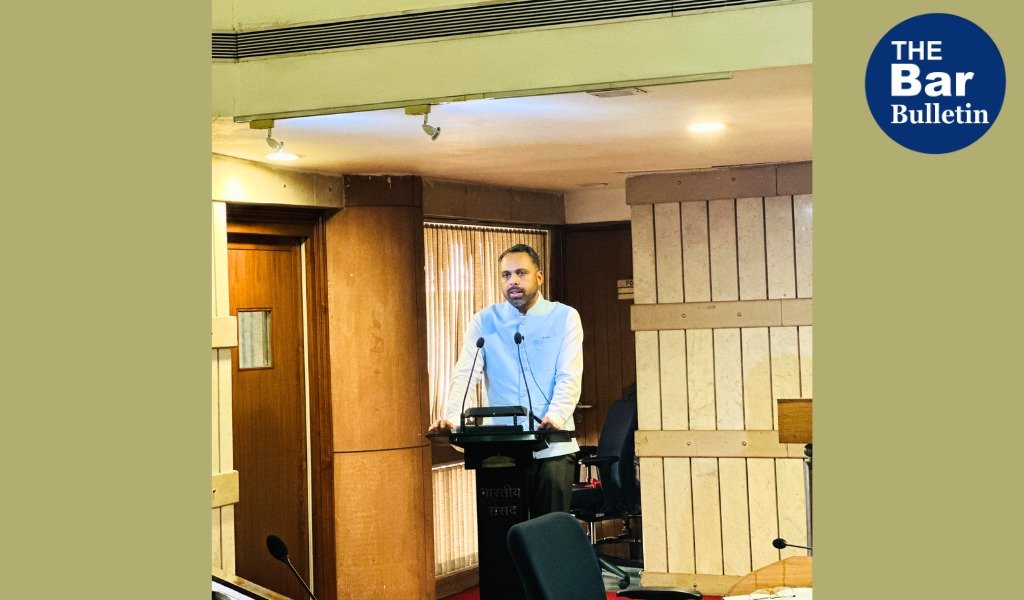

Senior Advocate Shashank Garg, Member of the Court of the London Court of International Arbitration (LCIA), addressed participants on “Ethics and Human Rights in AI Systems” at the Certificate Course on Cyber Security and Artificial Intelligence, organised by the Institute of Constitutional and Parliamentary Studies (ICPS) in collaboration with South Asian University (SAU), New Delhi.
Speaking on October 28, 2026, Garg examined the growing intersection of artificial intelligence, ethics and human rights, highlighting how algorithmic decision-making can affect equality, privacy, fairness and accountability. His session formed part of the programme’s third day, dedicated to privacy, digital rights and socio-legal frameworks.
Opening with the phrase “Cogito ergo sum” : “I think, therefore I am”, Shashank Garg reflected on the distinctive role of human reasoning in an age where machines increasingly influence decisions affecting everyday life. He acknowledged the benefits of AI, citing the use of facial recognition to help identify missing children, AI-enabled translation of parliamentary proceedings into multiple languages, and the use of technology to make judicial decisions more accessible across linguistic barriers.
However, he cautioned against viewing AI as an infallible or entirely predictable technology. Drawing an analogy with the Golem, a powerful but clumsy creature from ancient legend, he explained that AI possesses significant capabilities but can also produce unintended consequences.
A central theme of his address was the principle “Code is Law”, referring to how software and algorithms increasingly determine what individuals can and cannot do in the digital world. He observed that, unlike laws enacted through democratic processes, algorithmic rules may operate without public debate, legislative scrutiny or meaningful opportunities for citizens to challenge them.
He emphasised that AI must be understood not merely as a tool but, increasingly, as an agent capable of making decisions based on data. This distinction, he noted, raises important questions about accountability and the need for appropriate safeguards as automated systems assume greater decision-making responsibilities.
He also highlighted the risks of algorithmic bias, explaining how AI systems trained on historical data can reproduce existing social inequalities. Referring to examples involving recruitment algorithms, facial recognition technologies and automated assessment systems, he illustrated how seemingly neutral systems can disadvantage particular groups even without any explicit intention to discriminate.
Discussing the implications for human rights, he underlined that fundamental principles such as equality, privacy, fair hearing and accountability remain unchanged, even as decisions increasingly come to be made or influenced by machines.
He invited participants to reflect on three fundamental questions: Who is accountable when an AI system causes harm? Can a person challenge a decision that they cannot see or understand? And is a system that is fast, inexpensive and mostly accurate good enough when the cost of its errors falls disproportionately on the most vulnerable?
He emphasised that technological advancement must be accompanied by a clear understanding of its ethical and human rights implications, particularly where automated decisions affect individual rights and access to opportunities.
The session was part of the five-day certificate course on Cyber Security and Artificial Intelligence, being conducted from October 26 to 30, 2026, at the Parliament Library Building, New Delhi. The programme brings together legal professionals, academics, public officials and participants to examine emerging legal, constitutional and policy challenges arising from developments in artificial intelligence and cybersecurity.