
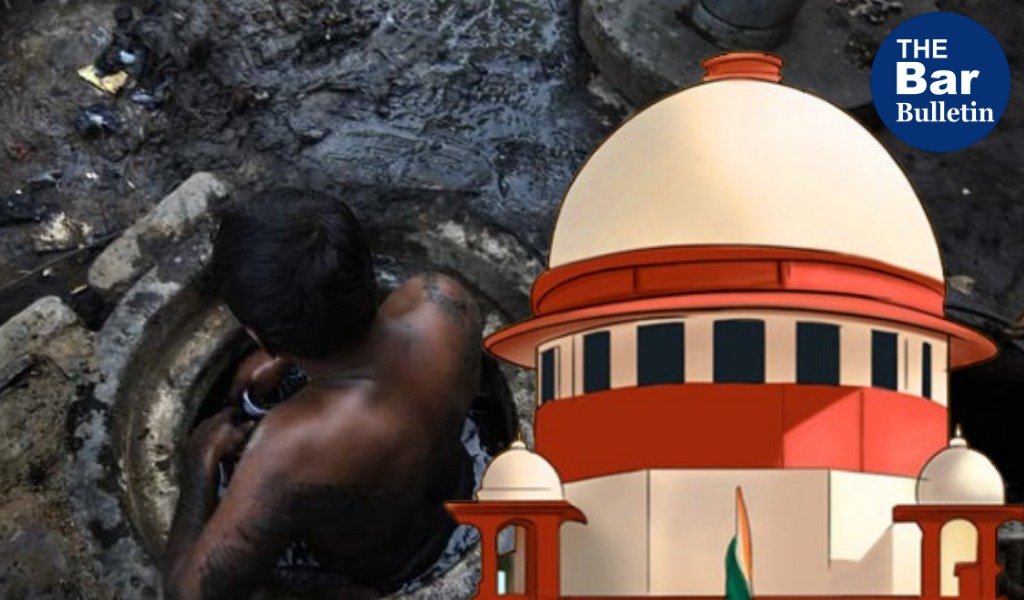
The Supreme Court has directed States and their authorities to ensure effective implementation of its directions on compensation to the families of persons who die while engaging in manual scavenging and hazardous sewer or septic tank cleaning. The Court emphasised that any breach of its directions would be viewed seriously.
During the hearing, the Court examined compliance affidavits filed by 15 States concerning payment of enhanced compensation of ₹30 lakh to the families of deceased workers, registration of FIRs and initiation of criminal proceedings against those responsible for the deaths.
The Bench noted discrepancies in the States’ compliance reports, including cases where compensation had been sanctioned but actual disbursement had not been established, and instances where FIRs had not been registered or their status remained unclear. It directed the concerned States to submit additional affidavits clarifying the status of compensation payments, registration of FIRs and subsequent criminal proceedings.
The Court reiterated that the State or its instrumentalities cannot avoid their obligation to pay compensation merely because a private contractor or establishment employed the deceased worker. The State must ensure that the compensation reaches the victim’s family and may subsequently recover the amount from the party responsible.
The Court also considered a model compensation scheme for sewer and septic tank workers, formulated in consultation with the Ministry of Social Justice and Empowerment. The proposed scheme provides for mandatory reporting of deaths and disabilities, registration of FIRs, legal assistance to victims’ families and mechanisms for disbursing compensation.
The Court granted the concerned States a further opportunity to comply with its directions and called for additional compliance affidavits within four weeks in the matters where discrepancies or deficiencies remained.
Appearances
Shri K Parmeshwar , Senior Adv, as amicus, Ms. Rashmi Nandkumar , For NALSA
Mr. Pawan Reley for petitioners in dr Balram case, Rajo case (connected matters)
For State (Karnataka) : Kunal Vajani, AAG