
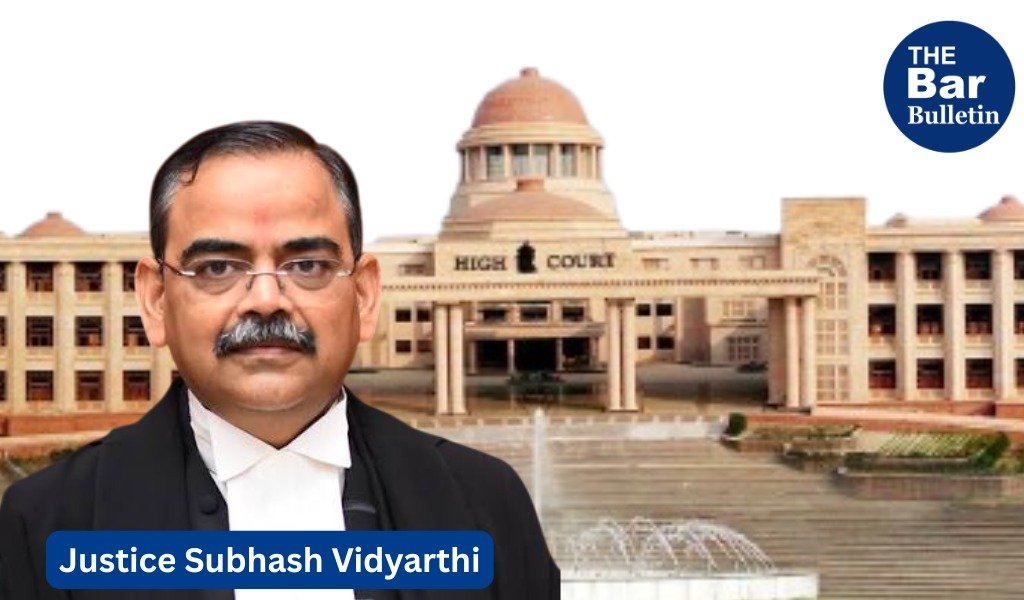

In an appeal filed before the Allahabad High Court under Section 374(2) CrPC to challenge the validity of a judgment and order dated 30-09-2024 by an Additional Sessions Judge in Raebareli, for a case under Section 326-A of the IPC, whereby the appellant was convicted and sentenced to undergo rigorous imprisonment for 10 years along with a fine of Rs. 20,000/-, a Single Judge Bench of Justice Subhash Vidyarthi set aside the impugned order, but convicted the appellant under Section 324.
The case was instituted on a written complaint dated 17-03-2017, which alleged that the appellant, who was from the complainant’s family, and his two brothers-in-law came on a motorcycle and poured acid on the complainant’s father, before running away. The victim was examined at the Primary Health Centre, where the medico-legal report recorded acid burn injuries of about 35%, and he was referred to the District Hospital, Raebareli. The appellant, in his statement under Section 313 CrPC, denied the allegations and claimed that he had been falsely implicated because of a property partition dispute in which he had succeeded. The appellant also mentioned that he did not own a motorcycle.
The trial court held that the prosecution evidence proved the allegation of commission of offence under Section 326-A IPC beyond reasonable doubt and convicted and sentenced the appellant accordingly. Hence, the present appeal.
The appellant asserted that there was no evidence that the victim had suffered grievous hurt, and that the record did not show whether the victim was treated at the District Hospital or any higher centre. The State fairly produced an extract of the case diary containing a medical certificate dated 30-03-2017, which stated that no injury was present on any part of the victim’s body when he was examined that day.
The Court stated that the first essential condition to attract Section 326-A is causing permanent or partial damage or deformity to, or burning or maiming or disfiguring or disabling any part or parts of the body of the victim or causing grievous hurt by throwing or administering acid to the victim. It was noted that although medical evidence established that the victim had suffered burn injuries on 17-03-2017, there was no evidence regarding any further treatment undergone by him. Since, the medico-legal exam showed that no visible marks of the injuries remained after 13 days, the Court opined that the victim’s injuries were not grievous in nature.
Further, the Court found no evidence regarding any permanent or partial damage, deformity, maiming, disfigurement, or disability suffered by the victim. The Court held that, because Section 326-A carries a stringent punishment, it had to be strictly interpreted. It further held that “burns” had to be interpreted ejusdem generis, and in line with the noscitur a sociis principle, along with the other categories in the provision.
The Court concluded that the injury must have a lasting impact on the body part and that a simple burn which healed in 13 days was not the “burn” envisaged by the Section. The Court held that the word “burns” in Section 326-A, should be read and understood by reading it along with the seven other conditions mentioned. Considering the circumstances, the Court held that the offence under Section 326-A was not made out, however, it opined that an offence under Section 324 of the IPC was made out.
Hence, the appeal was allowed in part. The Court set aside the conviction and sentence under Section 326-A IPC and instead convicted the appellant of the lesser offence under Section 324 IPC. It sentenced him to the maximum of 3 years’ imprisonment and a fine of Rs. 10,000/-, with 3 months’ additional simple imprisonment in default of payment. Since the appellant had already served more than that period, he was not required to deposit the fine.
Lastly, the Court directed the applicant to be released, if not required in any other case, on furnishing a personal bond and two sureties under Section 437-A CrPC.
