
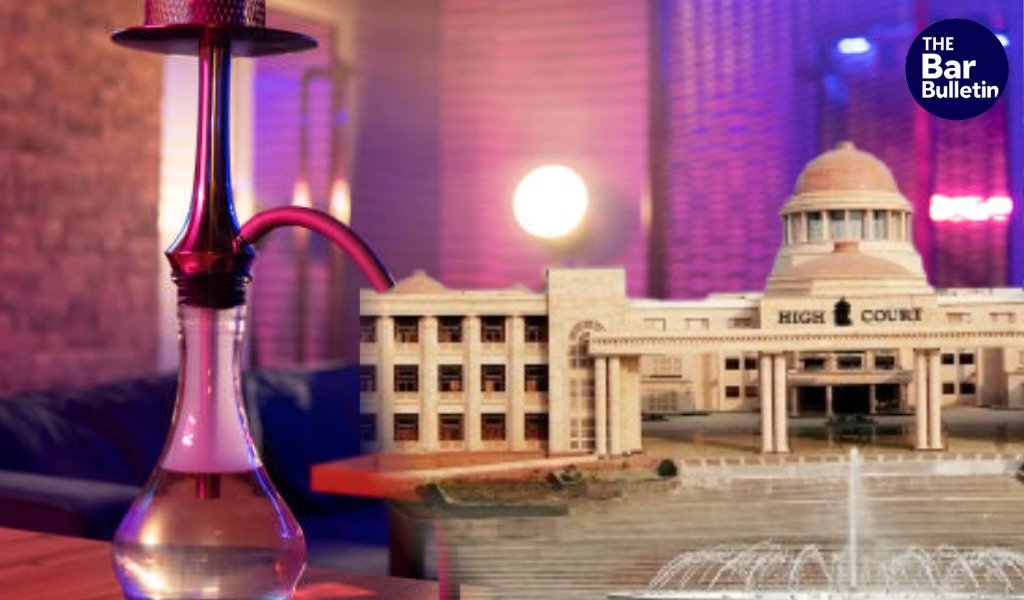

The Allahabad High Court has held that restaurants and similar establishments in Uttar Pradesh cannot provide hookah services, including within a designated smoking area. A Division Bench of Justice Shekhar B. Saraf and Justice Abhdesh Kumar Chaudhary dismissed a batch of connected petitions concerning the operation of hookah bars and provision of hookah services in restaurants.
The Court held that providing hookah service in a Designated Smoking Area is prohibited under Rule 4(3) of the Prohibition of Smoking in Public Places Rules, 2008, as amended in 2017, read with the Cigarettes and Other Tobacco Products Act, 2003 (COTPA). The Bench clarified that the issue before it was not whether smoking tobacco through a hookah, by itself, was prohibited. The question was whether restaurants could provide hookah as a service where smoking was otherwise permitted in a Designated Smoking Area.
The Court answered this in the negative, holding that while a Designated Smoking Area creates an exception to the general prohibition on smoking in public places, it does not permit establishments to provide services there.
The Court noted that Rule 4(3), as amended in 2017, specifically provides that “No service shall be allowed in any smoking area or space provided for smoking.” The Bench found this change significant in light of the Supreme Court’s earlier judgment in Narinder S. Chadha v. Municipal Corporation of Greater Mumbai, which had dealt with the earlier version of the rule.
Under the earlier provision, the prohibition was against “other service(s)” in a smoking area. In Narinder S. Chadha, the Supreme Court had held that provision of a hookah did not fall within the expression “other service” and had consequently permitted hookah smoking in a designated smoking area under the then-existing statutory framework.
The Allahabad High Court, however, observed that the rule was subsequently substituted in 2017 and now prohibits “any service” in a smoking area. It therefore held that the earlier Supreme Court interpretation had to be considered in the context of the previous statutory language.
The petitioners had also proposed that restaurants could adopt a “self-service” model, under which the hookah would merely be prepared and handed over to the customer. The Bench rejected this argument, observing that preparing and operating a hookah involves several steps, including assembling the apparatus, placing tobacco in the bowl, filling the base with water, preparing the foil and placing heated charcoal. According to the Court, these activities require expertise and cannot realistically be treated as ordinary self-service by patrons.
The Court also rejected the argument that supplying a hookah amounted merely to renting equipment. It noted that customers were required to consume the hookah within the Designated Smoking Area and that restaurants generally undertake activities such as lighting the hookah, replenishing charcoal, removing ash and changing tobacco.
The Bench accordingly held that preparing, assembling, delivering, lighting, maintaining and replenishing a hookah for consideration amounts to rendering a service.
The Court further emphasised the constitutional dimension of the issue, holding that the right of a non-smoker to breathe clean air in a public place is protected under Article 21 and cannot be curtailed by the commercial interests of an establishment claiming protection under Article 19(1)(g).
At the same time, the High Court held that the Food Safety Department and Municipal Corporation do not have the statutory power to issue licences authorising the operation of hookah bars. The Court nevertheless upheld the enforcement powers of the police under COTPA.
The connected petitions were accordingly dismissed.