
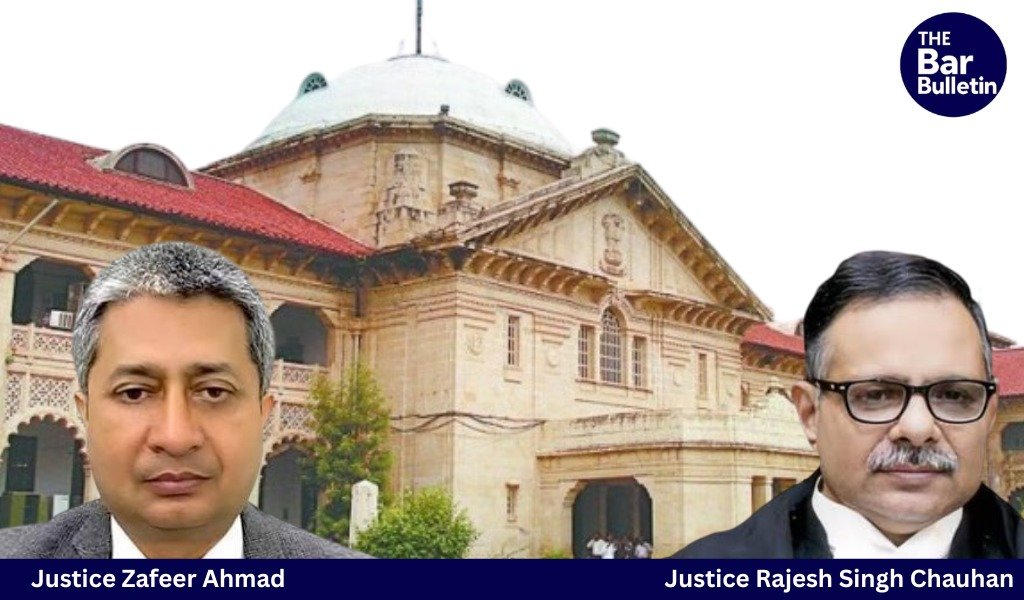
The Allahabad High Court, Lucknow Bench, has upheld a murder conviction arising out of a village land dispute, holding that an accused who returns after an initial quarrel, arms himself with a firearm and comes back to shoot the victim after sufficient time has elapsed for tempers to cool cannot claim the benefit of Exception 4 to Section 300 IPC. The Court also explained the operational difference between a single-shot country-made pistol and self-loading or automatic firearms while rejecting a challenge to the recovery of a spent cartridge.
A Division Bench of Justice Rajesh Singh Chauhan and Justice Zafeer Ahmad dismissed the appeal against conviction and also refused to interfere with the acquittal of the remaining co-accused, affirming the trial court’s judgment in its entirety.
The prosecution case arose from an altercation over irrigation of agricultural land. The evidence showed that the parties first argued in the field, after which they dispersed. The assailants then went back to their respective houses, procured firearms and returned to the complainant’s house, where multiple shots were fired, one of which fatally struck the deceased.
Rejecting the plea that the case fell within Exception 4 to Section 300 IPC, the High Court held that the facts clearly established premeditation. It observed that the initial quarrel had already ended, sufficient time had passed for passions to cool, and the assailant consciously armed himself before returning to the scene. Such conduct, the Bench held, could not be characterised as an act committed in the heat of passion upon a sudden quarrel, making the exception wholly inapplicable.
The Court also dealt extensively with the defence argument that the prosecution story was doubtful because an empty cartridge was recovered from the convicted person on the day following the incident. The defence contended that no prudent offender would continue carrying a spent cartridge after committing a crime.
Rejecting the contention, the Bench explained that the weapon used was a single-shot country-made pistol, whose functioning is fundamentally different from that of a self-loading or automatic firearm. Unlike automatic weapons, which ordinarily eject spent cartridges upon firing, a single-shot country-made pistol does not automatically eject the empty cartridge. The cartridge must be manually removed from the chamber before the weapon can be reloaded. Therefore, if the assailant fled immediately after firing without attempting to reload the weapon, the presence of the spent cartridge in the weapon or in his possession could not be considered unnatural or improbable. The Court emphasised that a duly proved recovery cannot be discarded merely because the defence assumes the offender ought to have behaved differently after the crime.
The High Court further noted that the ballistic evidence independently corroborated the prosecution case. The recovered .315 bore country-made pistol, together with the empty cartridge and live cartridges recovered from the convicted person, was examined by the Forensic Science Laboratory. After test-firing the weapon, the ballistic expert concluded that the recovered empty cartridge had in fact been fired from the same country-made pistol, thereby scientifically linking the firearm to the offence.
The Bench also rejected the contention that the medical evidence contradicted the eyewitness account merely because only one firearm injury was found despite allegations of multiple shots being fired. It observed that the prosecution consistently maintained that although several shots were fired, only one bullet struck the deceased. The absence of blackening, tattooing or scorching only indicated that the firing was not from close range, while the absence of the projectile was explained by the existence of a corresponding exit wound.
Holding that the eyewitness account stood fully corroborated by the medical, ballistic and forensic evidence, the High Court upheld the conviction for murder. It also declined to interfere with the acquittal of the co-accused, finding that the trial court’s decision to extend them the benefit of doubt was based on a plausible appreciation of the evidence.
Appearances
Counsel for Appellant(s) : Smriti Counsel
for Respondent(s) : G.A., Amit Chaudhary