
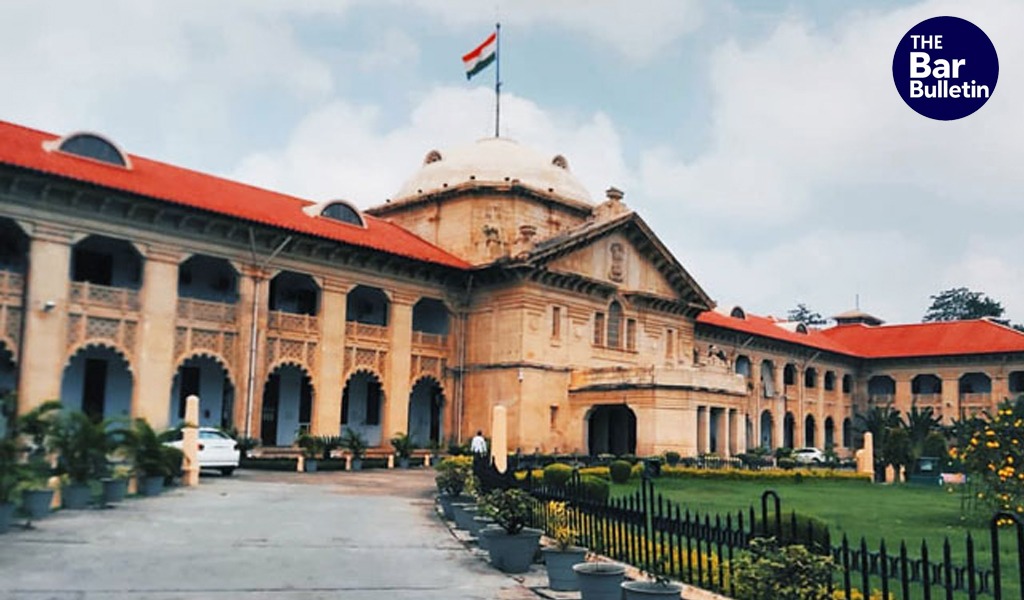

The Allahabad High Court has dismissed an election petition against BJP Member of Parliament (MP) from Bhadohi, holding that Article 102(2) of the Constitution read with Paragraph 2 of the Election Symbols (Reservation and Allotment) Order, 1968, disqualifies only ‘for being’ a member, not ‘for being chosen’. The Court clarified that a sitting Member of Legislative Assembly (MLA) who voluntarily gives up membership of his political party by contesting as a candidate of another party stands disqualified only from continuing as a member of the existing House, but he is not barred from contesting a fresh election to Parliament or another State Legislature.
The Court explained that while Article 102(1) covers disqualification both ‘for being chosen’ and ‘for being’ a member, Article 102(2) read with the Tenth Schedule covers disqualification only ‘for being’ a member. The omission of ‘for being chosen’ is deliberate and constitutionally significant. Accordingly, the Court said that merely reproducing the statutory language or chanting the section like a mantra does not amount to pleading material facts. The election petitioner must set out specific primary facts constituting a complete cause of action.
Further, the Court pointed out that since corrupt practice allegations are akin to criminal charges and must be proved beyond doubt, Section 83(1)(b) RP Act mandates full particulars including names, dates, places, and the precise role of the returned candidate. Vague, speculative or conjectural allegations are insufficient. Also, the Court said that for grounds of improper acceptance of nomination or non-compliance with statutory provisions, it is mandatory to plead and prove how the result of the election was materially affected. Mere breach or non-observance, without material effect, does not void the election.
A Single Judge Bench of Justice Raj Beer Singh undertook a detailed examination of the relevant statutory and constitutional framework, including Section 83 of the RP Act (which mandates a concise statement of material facts), Section 100 of the RP Act (which enumerates the grounds for declaring an election void), Article 102 of the Constitution (which deals with disqualifications for membership of Parliament), Paragraph 2 of the Tenth Schedule (which deals with disqualification on the ground of defection), and Paragraph 13 of the Election Symbols (Reservation and Allotment) Order, 1968 (which prescribes when a candidate is deemed to be set up by a political party).
The Court noted the structural distinction between Article 102(1), which covers disqualification both ‘for being chosen’ and ‘for being’ a member, and Article 102(2), which covers disqualification only ‘for being’ a member. The Court relied on Hari Shankar Jain v. Sonia Gandhi [2001 Lawsuit (SC) 1215], and Kanimozhi Karunanidhi v. Santhana Kumar [2023 SCC Online SC 573], to emphasise that bald and vague averments do not satisfy the requirement of pleading material facts under Section 83(1)(a) of the RP Act, and that charges of corrupt practice must be precise, specific, and unambiguous since they are akin to criminal charges.
Also read
Briefly, the case arises out of the 2024 Lok Sabha elections from the 78-Bhadohi Parliamentary Constituency in Uttar Pradesh. The petitioner, Lalitesh Pati Tripathi, lost to the returned candidate, Dr. Vinod Kumar Bind (BJP), by a margin of approximately 44,072 votes, with the latter securing 4,59,982 votes against the petitioner’s 4,15,910 votes. The petitioner challenged the election on five grounds, namely, i) improper acceptance of the returned candidate’s nomination paper; ii) the returned candidate was not qualified or was disqualified under the Constitution to contest; iii) improper rejection of nomination papers of two other candidates, Zia-Ul-Haq and Lalti Devi; iv) non-compliance with the provisions of the Constitution, the Representation of People Act, 1951, the Conduct Rules, 1961, and orders of the Election Commission of India; and v) commission of the corrupt practice of bribery under Section 123(1)(B)(a) of the RP Act.
The returned candidate filed an application under Order VII Rule 11 CPC seeking dismissal of the election petition on the ground that it did not disclose any cause of action. The central factual premise was that Dr. Bind was a sitting MLA from the NISHAD Party (Majhwan Assembly Constituency) but contested the parliamentary election as a BJP candidate without formally resigning from NISHAD, and he resigned from the Legislative Assembly only on June 14, 2024, after being elected as MP.
