
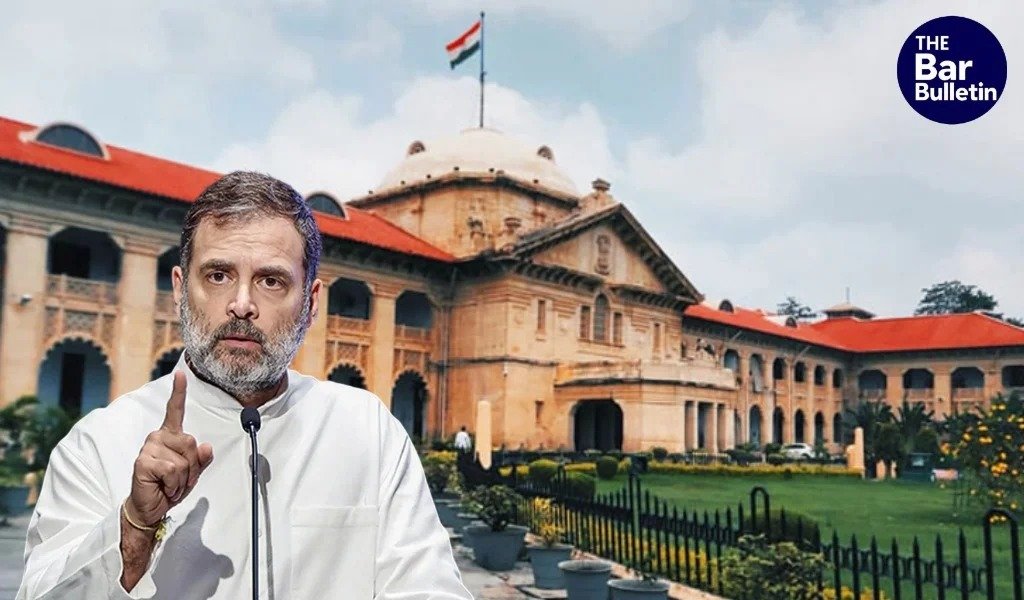

The Allahabad High Court has dismissed a plea seeking registration of an FIR against Leader of Opposition Rahul Gandhi over his remarks concerning the security and religious freedom of Sikhs in India during his September 2024 visit to the United States.
Justice Vikram D. Chauhan held that Gandhi’s alleged remarks did not disclose a cognizable offence under Section 152 of the Bharatiya Nyaya Sanhita (BNS), which deals with acts endangering the sovereignty, unity and integrity of India.
The remarks were made while Gandhi was addressing an Indian-American gathering in Herndon, Virginia, on September 9, 2024. During the interaction, he asked a Sikh attendee, Balinder Singh, about his name and said:
“
“The fight is about whether he, as a Sikh, is going to be allowed to wear his turban in India; or whether he, as a Sikh, is going to be allowed to wear a ‘kada’ in India; or whether he, as a Sikh, is going to be able to go to a gurdwara. That’s what the fight is about, and not just for him, but for all religions.”
The applicants had alleged that Rahul Gandhi’s remarks suggested that Sikhs were unsafe in India and could not freely practise their religion. They contended that the statement was inflammatory and could encourage separatist activities. They also relied on the endorsement of the remarks by a separatist leader to argue that they could be used to spread violence and anti-India propaganda.
Rejecting these submissions, the High Court observed that the alleged speech, on its face, raised concerns about a community or section of society. It noted that Rahul Gandhi, being an elected representative, was entitled to raise concerns relating to different sections of society. The Court further observed that questioning the rights of minorities by an elected representative could not, by itself, constitute an offence. It held that the alleged speech did not tend to incite violence or disturb public order and that the applicants had failed to place material demonstrating that the ingredients of Section 152 BNS were attracted. The court observed:
“
“The respondent no. 2 (Rahul Gandhi) being an elected representative has a right to raise concerns in respect of section of society. Further, questioning the rights of minorities by elected representative by itself cannot be an offence and the said speech of respondent no. 2 will have protection of freedom of speech and expression under Article 19 of Constitution. It is further to be noted that certain sections of society or individuals may not agree with statement of respondent no. 2 however that itself would not be a cause for considering the said speech as an offence. Disagreeing with one’s view is part of vibrant democracy.”
It also noted that the applicants had not furnished the complete extract of the alleged speech or established how it had resulted in secession, armed rebellion, subversive activities or any threat to India’s sovereignty and integrity.
The Court emphasised that freedom of speech and expression under Article 19(1)(a) must be protected, and that criminal proceedings arising from alleged offending speech require careful scrutiny. It observed that mere disagreement with a public representative’s views cannot be a ground for criminal prosecution.
The plea was filed under Section 528 of the Bharatiya Nagarik Suraksha Sanhita (BNSS), challenging orders passed by the Varanasi Magistrate and the revisional court, both of which had declined to direct registration of an FIR against Rahul Gandhi.
Finding no cognizable offence made out from the alleged speech, the High Court dismissed the application and declined to interfere with the orders of the lower courts.
