
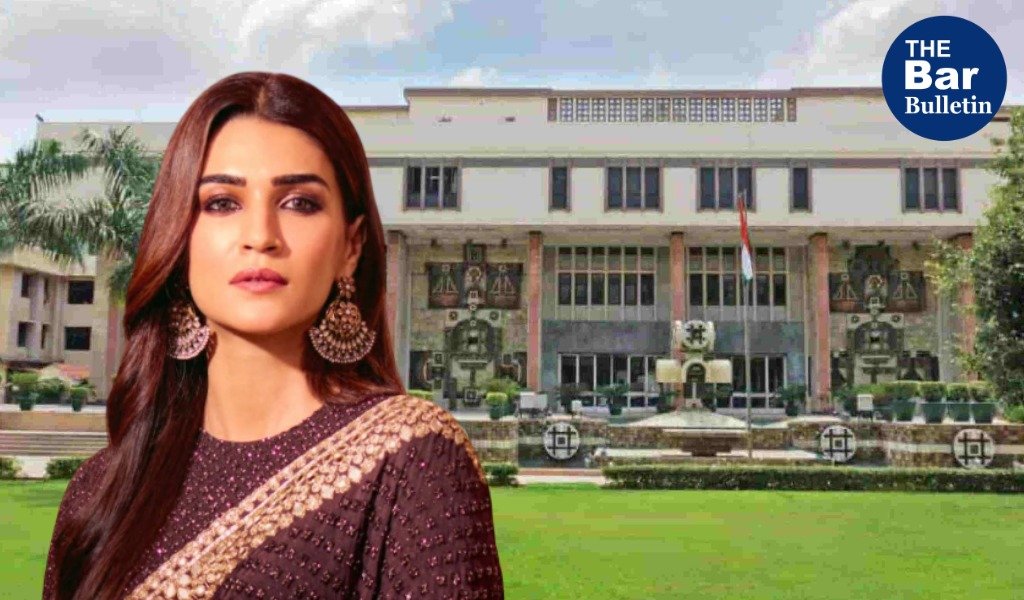

The Delhi High Court has clarified that ‘personality rights’ are not a single standalone right and distinguishes publicity rights from privacy rights while ordering takedown of deepfakes, impersonation content and AI-generated misuse of the actor’s persona. The High Court observed that the expression ‘personality rights’ is merely an umbrella term covering different legal claims such as privacy, publicity rights, passing off, defamation, trademark rights, copyright rights and performers’ rights, each governed by its own legal requirements.
The Court held, prima facie, that privacy protects personal interests such as dignity and reputation, while publicity rights protect the commercial value of an individual’s identity and can be licensed or commercially exploited. The Court also found that sexually explicit deepfakes, morphed content, fake social media accounts, synthetic voice models and AI chatbots falsely presented as Kriti Sanon cause irreparable harm to privacy, dignity and commercial interests.
The Court reiterated that content removal orders must identify specific unlawful material, and intermediaries cannot be expected to decide the scope of disputed personality rights on their own. The Court expressly clarified that its interim order does not prohibit legitimate news reporting, reviews, criticism, commentary, satire, parody, caricature or fan expression that does not amount to impersonation, privacy invasion or unlawful exploitation of identity.
Briefly, Actor Kriti Sanon filed a commercial suit before the Delhi High Court alleging widespread misuse of her name, image, likeness and voice across various online platforms. She claimed that third parties were offering fake celebrity booking services, operating social media accounts impersonating her, circulating AI-generated and morphed images, selling merchandise using her persona, creating AI chatbots and synthetic voice models in her name, and publishing pornographic deepfakes depicting her. Despite issuing notices to intermediaries, most grievances remained unresolved, prompting her to approach the Court seeking protection of her publicity and privacy rights.
A Single Judge Bench of Justice Purushaindra Kumar Kaurav observed that the case raises important questions relating to so-called ‘personality rights’. It noted that Indian law does not presently contain any statute specifically creating a unified personality right. Instead, what is commonly referred to as personality rights comprises several distinct legal claims such as privacy, publicity rights, passing off, defamation, trademark rights, copyright rights and performers’ rights, each having separate legal ingredients and remedies.
The Court drew a distinction between the right of privacy and the right of publicity. It observed that privacy protects personal interests such as dignity, autonomy and reputation and cannot be assigned or licensed. Publicity rights, on the other hand, protect the commercial value attached to a person’s identity and are capable of being licensed or commercially exploited. Therefore, the two concepts cannot be treated as identical.
The Court further clarified that personality-related rights are available to every individual and are not exclusive to celebrities. Fame may influence the commercial value of a person’s identity, but it is not a legal prerequisite for claiming protection. At the same time, mere use of a person’s identity is not automatically unlawful and must be assessed in the context of the specific legal right allegedly infringed.
The Court emphasized that plaintiffs must identify, defendant-wise and content-wise, the exact nature of the alleged infringement. It cautioned against seeking broad omnibus injunctions under the generic label of personality rights, particularly when different causes of action involve different legal standards and defences.
Also read Acid Attack Survivors’ Railway Concession: SC Asks Parties to Resolve Differences Over Draft Policy
Referring to the regime under the Information Technology Act, 2000 and the Information Technology (Intermediary Guidelines and Digital Media Ethics Code) Rules, 2021, the Court reiterated that intermediaries are generally not primary wrongdoers and can be directed to remove content only when specific unlawful material is identified. The Court also noted that the 2026 amendments to the Rules specifically address synthetically generated information and provide expedited timelines for compliance.
On a prima facie examination, the Court found that impersonating accounts, AI-generated sexually suggestive content, synthetic voice models, AI chatbots posing as the plaintiff, and pornographic deepfakes caused serious and irreversible harm to the plaintiff’s privacy, dignity and commercial interests. Such content warranted immediate interim protection.
