
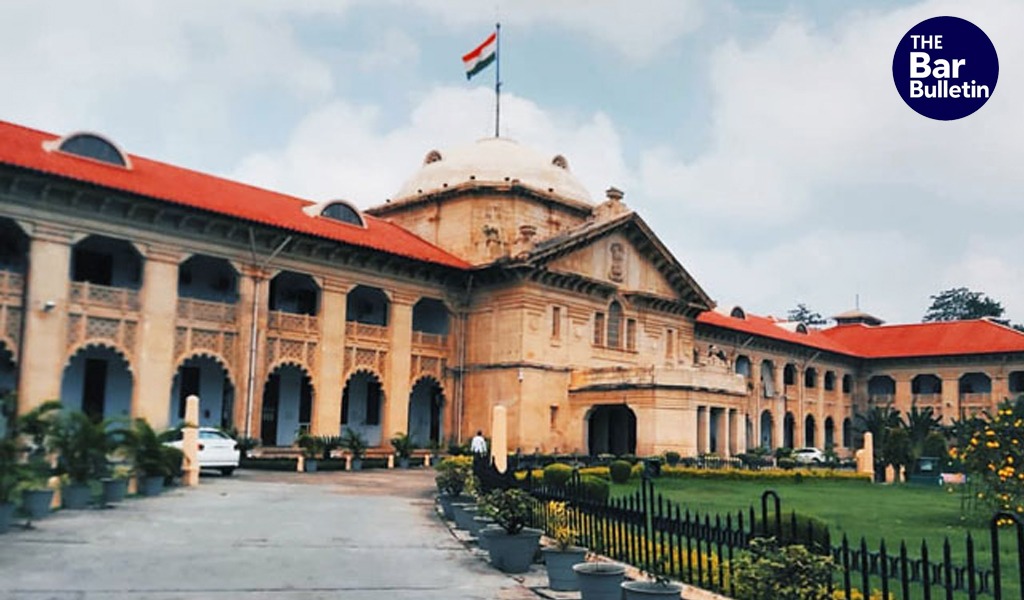

In a criminal misc. writ petition filed before the Allahabad High Court seeking quashing of a First Information Report (FIR) dated 24-08-2026 filed for commission of offences under Sections 223, 353, and 356 of the Bharatiya Nyaya Sanhita, 2023 (BNS), a Division Bench of Justice Abdul Moin and Justice Pramod Kumar Srivastava stayed the operation of the impugned FIR until further orders.
The petitioner, working as a journalist, had gone to Purva Madhyamik Vidyalaya, Begriya Mau, Gosaiganj, Lucknow, on 20-08-2026 to report on the condition of the school, where he found the toilets in a shabby condition, drinking water unavailable, and the overall condition poor, and he had also taken interviews of certain teachers. On 24-08-2026, the impugned FIR was lodged indicating that the school was in excellent condition, the toilets were clean, the petitioner had entered without permission, interrupted the studies of children, compelled two lady teachers to speak about the school, and that the reporting was done due to political prejudice.
The petitioner contended that Section 356 of BNS pertained to defamation, and argued that in cases of criminal defamation, neither could an FIR be lodged nor could a direction be issued under Section 156(3) of the Cr.P.C., since proceedings had to be initiated only by way of complaint by the aggrieved person. As to Section 353, it was argued that the exception thereto applied, since the petitioner had reasonable grounds for believing the statement to be true and had published it in good faith, without any such intent as barred by the section. Regarding Section 223, it was argued that no such order restricting entry into the institution existed.
The Court noted that in the present case, the impugned FIR could not have been straightaway lodged under Section 356 of BNS and found it apparent that the authorities had patently erred in law by lodging the impugned FIR so far as the said Section was concerned. Further, it was stated that the exception to Section 353 of BNS is that the person publishing or circulating any statement has reasonable ground to believe that such statement is true and does so in good faith.
Noting the photographs annexed along with the petition, the Court found that they indicated the abysmal condition of the school premises. It was further noted that the authorities had also erred in law by straightaway lodging the impugned FIR under Section 223 of BNS. The Court found it relevant to mention that the FIR under Section 223 of BNS could not have been lodged considering the provisions of Section 215 of BNS, which specifically provided that no court shall take cognizance of any offence punishable under Sections 206 to 223, except upon a complaint in writing made by the public servant concerned.
The Court stated that the petitioner was an accredited journalist who had prima facie exposed shortcomings in a State Government educational institution, and referred to the Right of Children to Free and Compulsory Education Act, 2009, particularly Sections 18 and 19 and the Schedule thereto, which mandated an all-weather school building with separate toilets for boys and girls, safe drinking water, a kitchen, playground, and boundary wall or fencing. It was stated that once the norms and standards for a school are read in accordance with the 2009 Act, it emerges that there is a mandate on the government to provide an all-weather building for a school.
It was said that once the petitioner had highlighted the shortcomings in the school and its infrastructure, it was for the government to have looked into it and to have initiated action for removal of the shortcomings instead of making it an ego issue by initiating the impugned FIR. The Court found it apparent that the FIR was a retaliatory action to the shortcomings being exposed by the petitioner and amounted to “killing the messenger”, which is not countenanced in the eyes of law.
Among other judgments, the Court referred to Arnab Ranjan Goswami v. Union of India (2020) 14 SCC 12, and found that the Supreme Court had categorically held that the exercise of journalistic freedom lies at the core of the speech and expression protected by Article 19(1)(a) and that India’s freedom will rest safe as long as journalists can speak truth to power without being chilled by a threat of reprisal. Hence, the Court ordered that the operation of the impugned FIR would remain stayed and directed no action to be taken against the petitioner until further orders.
The Court directed the Additional Chief Secretary, Basic Education, Government of U.P. to file his personal affidavit within four weeks indicating the present condition of the school with duly annexed photos of the school premises and also whether after the report done by the petitioner on 20-08-2026, any construction or repair has been done.
The matter will now be listed after four weeks.
