
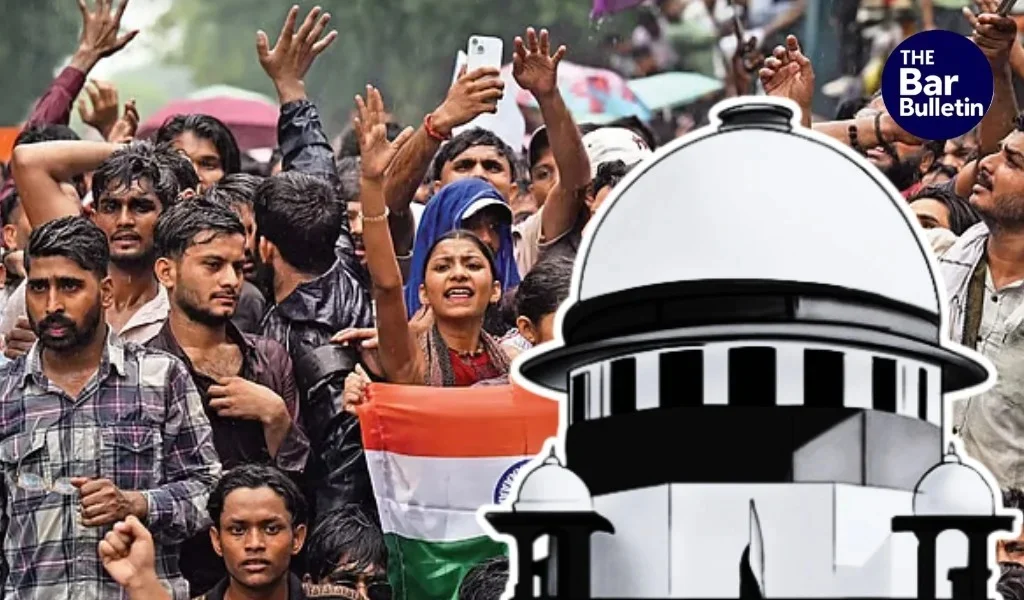

The Supreme Court on Thursday stressed that the High-Powered Enquiry Committee constituted to examine allegations arising from the Cockroach Janta Party (CJP) student protests must become functional immediately, while addressing concerns over access to the committee and protection of vulnerable witnesses. The five-member committee, headed by former Supreme Court judge Justice R. Subhash Reddy, was constituted to examine allegations of police excesses against protesters as well as violence by protesters and other related issues.
During the hearing, counsel sought a mechanism through which vulnerable victims and witnesses could directly approach the committee without having to go through existing nodal officers. A suggestion was also made for a dedicated nodal officer for vulnerable victims and a portal through which people across the country could submit complaints and material. The Bench said the committee could evolve an appropriate mechanism and emphasised that there should be no gap between the committee and witnesses seeking to approach it.
The Court made it clear that the committee would function as an extension of the Court and that the material gathered by it would ultimately be subject to the Supreme Court’s scrutiny.
“
“The committee is our extended hand. Please appreciate it. It’s basically the committee’s job responsibility given by us. And they will record evidence, they will collect evidence, they will give their opinion, they will give their expertise on it. Only for the purpose of facilitating and assisting the court to pass final orders. So therefore, whatever will ultimately be produced before the committee, that will be for the final scrutiny before us only. So that no witness should have any apprehension of any kind in mind. Therefore, the protection standard of vulnerable witnesses must not be less than what we are expected to provide them in the judicial proceedings. There we call them as protective witnesses. Sometimes we call them as vital witnesses. We normally use the word vulnerable witnesses also. So, that standard of protection which we extend in criminal proceedings, that can be extended by the committee.”
During the hearing, concerns were also raised regarding a 14-year-old girl. Counsel alleged that an FIR had been registered against the child even as persons allegedly involved in violence and threats against her remained at large. Counsel sought reports from the Delhi and Uttar Pradesh governments on the FIRs, security being provided to the child and her family, and the status of action against persons allegedly involved in the incidents.
The Bench was told that the girl had been listed as a bona fide victim and that her identity had not been disclosed. The Court cautioned against identifying the child in open proceedings, noting the risks associated with live-streaming and social media. It observed that if there was even a “grain of truth” in the allegations, preventive measures to protect the child and her family would be required.
The Bench also discussed how the HPEC would deal with cognisable offences that may emerge during its fact-finding exercise. It indicated that the committee would first examine and crystallise the allegations, identify victims, examine relevant officers and make recommendations, rather than the Court pre-emptively deciding the course of action.
The Court ultimately stressed the need for the committee to begin its work without delay and for reports to start coming in, with the Bench stating that it wanted the committee to become “functional immediately.”