
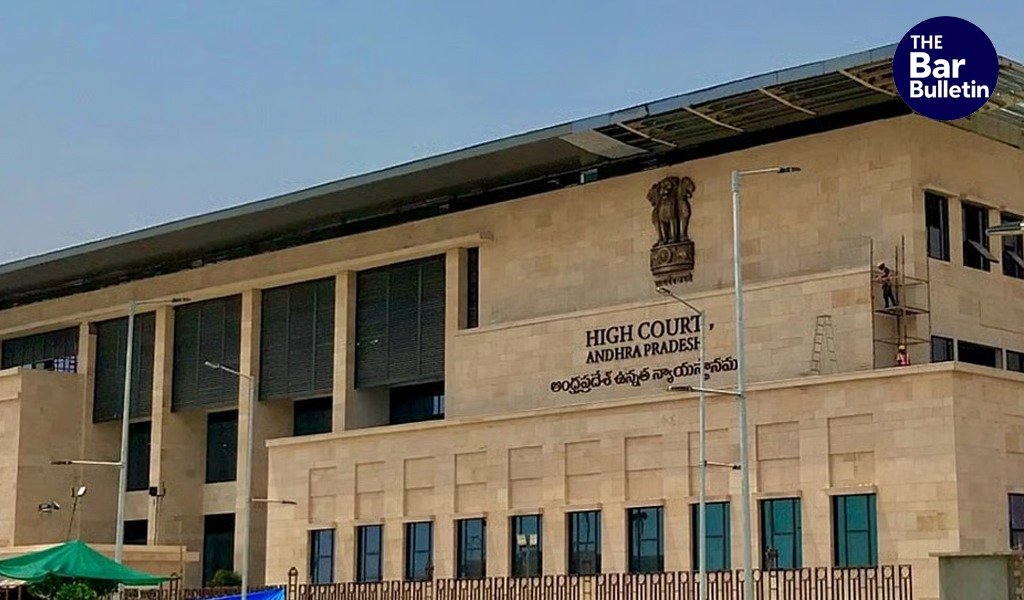

In a couple of review petitions filed before the Andhra Pradesh High Court by Jayendra Nagar Residents Welfare Association, Kakinada to review and set aside a common order dated 08-01-2026, a Single Judge Bench of Justice Harinath. N recalled the impugned order and directed an inquiry into the fraud played on the Court.
A writ petition was filed to seek a direction to declare the respondents’ action in trying to construct a compound wall over an extent of 700 sq. yards of land belonging to the petitioner as illegal, arbitrary, and unconstitutional. Whereas, the other writ petition was filed against the respondents’ interference with possession and development of the petitioner’s land. The impleaded Residents Welfare Association specifically contended that the open areas were gifted to the municipality pursuant to the layout, that they were specially earmarked for public purposes, and that the compound walls were constructed over 3 such open spaces. It was submitted that when the construction on the fourth open area was undertaken, the writ petitioner approached the court.
As per the counters filed by the Kakinada Municipal Corporation, it was their stand that the subject property formed part of an open space of a layout, and that it was the municipal corporation’s responsibility to protect the open spaces earmarked for public purposes. The Residents Welfare Association also contended that the subject properties vested in the municipal corporation for all purposes.
The writ petitions were disposed of by a common order on 08.01.2026 after the counsel for the welfare association conceded the claim, submitting that they did not have any claim over the subject property, and the Commissioner of the Municipal Corporation filed a completely opposite affidavit dated 06-01-2026 that was completely opposite to its initial counter. Aggrieved by the common order, the Residents Welfare Association filed writ appeals which were disposed of on 13-03-2026, with an observation that no writ appeal could apply against an order of consent, but left it open for the appellants to file a review before the High Court.
The review petitioner submitted that the order suffered from an error apparent on the face of the record because the erstwhile counsel conceded the prayer without any oral or written instructions from the review petitioner. It was argued that the said counsel appeared to have been influenced by the writ petitioner as well as other advocates. It was also submitted that the market value of the property was close to Rs. 15 Crores, with a prevailing rate of about Rs. 75,000/- per square yard, and that fraud was played on this Court to secure the order dated 08-01-2026.
The Court noted that the order dated 08.01.2026 was evidently not decided on the merits of the case, and that the writ petitioner’s claim was conceded by the counsel for the respondents. It was also noted that Kakinada Municipal Corporation’s affidavit was diametrically opposite to its earlier stand for which there was no explanation. The Court directed the Commissioner of the Kakinada Municipal Corporation to appear virtually on 30.06.2026. Upon enquiry regarding who instructed the filing of the opposite affidavit dated 06.01.2026, the Commissioner reported ignorance, stated that he had recently joined, and was unaware of the case history. He further informed that unauthorised constructions were stopped upon his intervention.
It was found that these instances led to a suspicion of a well-planned fraud on this Court. Citing decisions by the Supreme Court, the Court reiterated that fraud vitiates everything, and recalled the order dated 08-01-2026, while allowing the review petitions. An opportunity of hearing was directed to be extended to the parties in the writ petitions. Further, the Court expressed grave displeasure at the advocates, noting that their conduct revealed a deliberate attempt to commit fraud. It was said that
“
“the trust and faith reposed in the advocates as officers of the court is immense; the trust runs deeper than mere professional courtesy.”
The Court verified the docket orders and vakalatnamas, revealing a critical sequence of events, and stated that the counsel appearing for the State and its instrumentalities had failed in discharging their fiduciary duties. It was stated that the risk of privileged information leaking across marital relationships, even unintentionally, subsists and exists. Since public property worth several crores of rupees belonging to the Kakinada Municipal Corporation was planned to be knocked off by fraud, the Court determined that the matter required a thorough inquiry by an investigating agency.
The Director General, Anti Corruption Bureau, Vijayawada, was directed by the Court to entrust the inquiry to an officer not below the rank of Inspector General, Anti-Corruption Bureau. Lastly, the enquiring officer was directed to consider any additional information received during enquiry and to submit a report within twelve weeks.
