
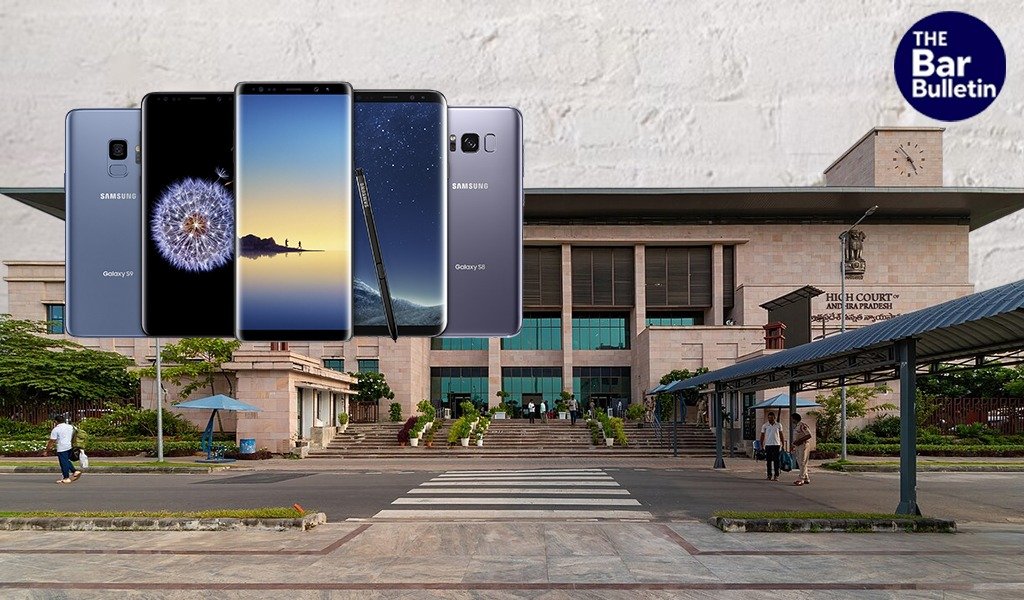

The Andhra Pradesh High Court has held that manufacturers are not required to declare the screen size or physical dimensions of mobile phones on product packaging under the Legal Metrology (Packaged Commodities) Rules, 2011, ruling that such disclosure is mandatory only where the size of a commodity is relevant to its sale and pricing. Setting aside proceedings initiated against Samsung India Electronics Pvt. Ltd., the Court observed that a mobile phone is purchased primarily on the basis of its brand, model, processor, storage capacity, camera and other functional specifications, and not its physical dimensions.
Justice Subba Reddy Satti allowed Samsung’s writ petition challenging orders of the Legal Metrology authorities, which had held the company liable for failing to mention the screen dimensions on packages of Samsung Galaxy A31 mobile phones seized during an inspection of a retailer in Andhra Pradesh. The authorities had treated the omission as a violation of Sections 18 and 36 of the Legal Metrology Act, 2009 read with Rules 4 and 6(1)(f) of the Legal Metrology (Packaged Commodities) Rules, 2011.
Examining the statutory framework, the Court held that Rule 6(1)(f) is conditional and not of universal application. The obligation to declare dimensions arises only “where the sizes of the commodity contained in the package are relevant.” The Court emphasised that this qualifying expression cannot be ignored and that the Rule does not mandate disclosure of dimensions for every pre-packaged commodity.
The Court further observed that Rule 15 of the 2011 Rules reinforces this interpretation by requiring disclosure of dimensions only where they bear a relationship to the price of the commodity. Reading Rules 6(1)(f), 14 and 15 together, the Court held that the legislative scheme applies to commodities ordinarily bought and sold by measurement, such as bedsheets, fabrics, sarees and towels, and not to products like mobile phones.
To provide clarity, the Court formulated a three-fold test to determine when dimensions become relevant under Rule 6(1)(f). According to the Court, dimensions must be declared only if: (i) the commodity is ordinarily traded or identified by reference to its physical dimensions; (ii) those dimensions have a direct and proximate relationship with its price; and (iii) an ordinary prudent purchaser principally purchases the commodity on that basis. If any of these conditions is absent, Rule 6(1)(f) is not attracted.
Also Read Allahabad HC Orders Fresh Demolition Drive Against Illegal Advocate Chambers in Lucknow
Applying this test, the High Court held that a mobile phone is identified and purchased by consumers based on its brand, model, RAM, storage capacity, processor, camera specifications, IMEI number and maximum retail price, rather than its physical measurements. The Court also rejected the authorities’ reasoning that screen size influences consumer preference, observing that the screen is merely one component of the mobile phone and cannot be treated as a separate commodity requiring independent declaration.
The Court additionally reiterated the settled principle that penal statutes must be construed strictly. It held that the Legal Metrology authorities could not enlarge the scope of penal provisions by stretching the language of Rule 6(1)(f) beyond its plain meaning. Where two reasonable interpretations are possible, the one favouring the person proceeded against must prevail.
Holding that the invocation of Sections 18 and 36 of the Legal Metrology Act against Samsung was unsustainable, the High Court allowed the writ petition, quashed the orders of the Legal Metrology authorities and set aside the proceedings initiated against the company
Appearances
For Petitioner: Mr. O. Manohar Reddy, Senior Advocate, Mr. Varun Byreddy, Advocate-on-record and Aditya Nayyar, Tarang Agarwal, and Sandhya Chawla
For Respondent: Government Pleader for Civil Supplies Mr. P. Venkata Sai Krishna