

SUPREME COURT
Percept Talent Management Limited & Anr. v. Sourav Chandidas Ganguly, SLP(C) No. 24927/2026 [Order dated September 28, 2026]
The Supreme Court on Monday dismissed an appeal filed by Percept Talent Management Ltd. challenging the Calcutta High Court judgment that had upheld a ₹14.49 crore arbitral award in favour of former Indian cricket captain Sourav Ganguly. The dispute arose from a 2003 Player Representation Agreement between Ganguly and Percept concerning the management of his commercial and endorsement engagements.
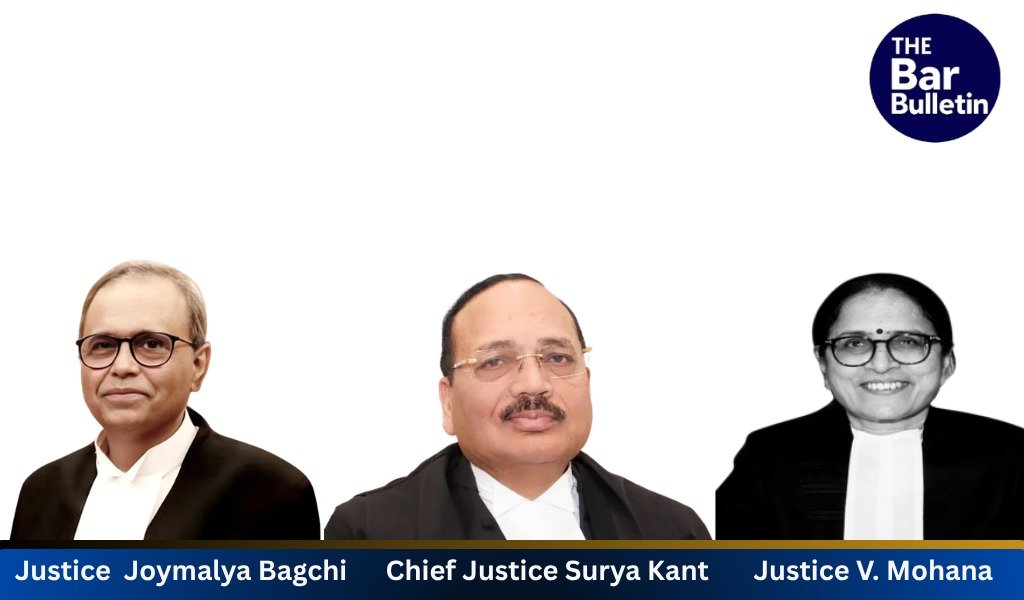
A Bench comprising Chief Justice of India Surya Kant, Justice Joymalya Bagchi and Justice V. Mohana heard Percept’s challenge to the High Court judgment. The arbitral tribunal had awarded Ganguly ₹14.49 crore along with 12% annual interest and ₹50 lakh towards costs.
Prakash Narain Sharma vs Burmah Shell Co-operative Housing Society [Decided on August 31, 2026]
In a co-operative housing society membership dispute, the Supreme Court has held that the High Court rightly set aside the Arbitrator’s and Tribunal’s orders that proceeded on a presumption of membership despite clear documentary evidence of resignation and rejection of re-admission. The Court upheld the High Court’s reliance on equitable considerations, noting that four prior claimants had senior claims to allotment of a plot, and the original claimant’s claim based merely on contributing a small sum in 1952 was not justifiable in the face of such prior entitlements.
The Apex Court explained that where concurrent orders of an Arbitrator and Tribunal under the Delhi Co-operative Societies Act, 1972 ignore relevant documentary material on record and proceed on a presumption of membership contrary to clear evidence of resignation and rejection of re-admission, the High Court is justified in interfering in exercise of certiorari jurisdiction, since such findings amount to errors of law based on no evidence or perverse inferences warranting supervisory correction.
SC : Contractual Bar Can Oust Arbitrator’s Power to Award Pre-Reference Interest
North-Eastern Electric Power Corporation Limited (NEEPCO) vs Astra Construction Pvt Ltd [Decided on September 22, 2026]
The Supreme Court has held that an express, independent bar on delayed payments, standing apart from any dispute, ousts the arbitrator’s power to award pre-reference interest under Section 31(7)(a) of the Arbitration and Conciliation Act, 1996. The Court explained that the opening words ‘unless otherwise agreed by the parties’ expressly subordinate the arbitrator’s statutory power to the bargain between the parties. An express contractual bar suffices to exclude that power, even if not specifically addressed to the arbitrator’s jurisdiction.
BOMBAY HIGH COURT
Municipal Corporation of Greater Bombay v. M/S Atul Raj Builders Pvt Ltd, Decided on 03.09.2026
The Bombay High Court has held that limitation for challenging an arbitral award cannot be kept in abeyance merely because a party claims it did not receive formal notice from the court regarding the filing of the award, where the party was otherwise aware of the award. The Court accordingly dismissed a challenge filed by the Municipal Corporation of Greater Bombay (MCGM) after an 802-day delay.
DELHI HIGH COURT
Hanson Agro Limited vs Gail (India) Limited [Decided on September 01, 2026]
While declining to retrospectively invalidate unilaterally appointed Tribunals solely because Section 34 petitions were filed after the cut-off date, the Delhi High Court has ruled that 2015 Amendment to the Arbitration and Conciliation Act is substantive and not merely clarificatory. Hence, it applies prospectively from Oct 23, 2015, and cannot be retrospectively imported into arbitrations that commenced before that date merely because the Award or the Section 34 challenge was filed later.
M/S URC Construction (P) Ltd. v. Airports Authority of India [Decided on 01-09-2026]
In an execution petition filed before the Delhi High Court under Section 36 of the Arbitration and Conciliation Act, 1996 (Act), seeking enforcement of an arbitral award dated 26-03-2019, corrected by an order dated 07-05-2019 under Section 33 of the Act, whereby the decree holder was awarded Rs. 2,59,07,248.60/- crores along with pendente lite and future interest at 10% per annum, a Single Judge Bench of Justice Om Prakash Shukla issued directions for the procedure to be followed when an insufficiently stamped domestic arbitral award is presented for enforcement.
Plausible View Is Not Enough for Interference: Delhi HC Restores NIL Arbitral Award
Otsuka Chemical (India) Pvt Ltd vs Trans Engineers India [Decided on September 01, 2026]
While restoring the NIL Arbitral Award passed by the Sole Arbitrator, the Delhi High Court has reiterated that courts under Sections 34 and 37 of the Arbitration Act cannot re-appreciate evidence or substitute their interpretation of contractual terms for that of the arbitrator, even where an alternative view may appear more plausible. The High Court explained that jurisdiction of a court under Section 34, and consequently under Section 37 of the Arbitration and Conciliation Act, 1996, is limited and supervisory in nature, and the court does not sit in appeal over an arbitral award and cannot re-appreciate evidence or substitute its own interpretation of the contract for that of the arbitrator.
Airport Handling Services vs Indian Institute of Technology, Kanpur [Decided on September 28, 2026]
The Delhi High Court has clarified that Rule 11(3) of the Consumer Protection (Conditions of Service of President and Members of the State Commission or District Commission) Model Rules, 2020, regulates the office of the SCDRC President and does not, by itself, attract the Seventh Schedule or trigger the written-waiver requirement under the proviso to Section 12(5) of the Arbitration Act. The Court held that a breach of a service-condition rule governing the office held by an arbitrator may entail consequences under the law regulating that office, but it does not automatically terminate the arbitral mandate under the Arbitration and Conciliation Act, 1996.
Sarr Freights Corporation vs Argo Coral Maritime [Decided on September 18, 2026]
While granting anti-arbitration injunction restraining LMAA proceedings, the Delhi High Court has held that under codified Indian evidence law, prior correspondence cannot be used to rewrite clear and unambiguous terms of a signed contract. The Court clarified that a signed Booking Note containing an express clause that it ‘shall prevail over any previous arrangements’ supersedes the earlier Fixture Recap, and prior correspondence or emails cannot be looked into to rewrite its terms.
Unison Hotels vs Iffco Tokio General Insurance [Decided on September 16, 2026]
In a significant ruling on the scope of Section 34 and Section 37 of the Arbitration and Conciliation Act, 1996, the Delhi High Court has restored the unanimous arbitral award, holding that the Single Judge erred in setting it aside on a mere ‘possibility of forgetting’ arguments, without identifying any specific finding vitiated by delay. The Court said that a mere delay in rendition of an arbitral award is insufficient to invoke Section 34 of the Arbitration and Conciliation Act, 1996.
GUJARAT HIGH COURT
Gujarat Housing Board v. M/S Cube Construction Engineering Ltd, Decided on 18.09.2026
The Gujarat High Court has dismissed an appeal filed by the Gujarat Housing Board (GHB) under Section 37 of the Arbitration and Conciliation Act, 1996, challenging an arbitral award, and imposed costs of Rs 3 lakh on the Board.
A Division Bench comprising Chief Justice Sunita Agarwal and Justice D.N. Ray held that the challenge was essentially an attempt to re-agitate the merits of the arbitral award, which was impermissible within the limited scope of interference under Sections 34 and 37 of the Arbitration Act. The Court found no perversity or patent illegality warranting interference.
TRIBUNAL
NCLAT: Arbitration Clause Cannot Bar Operational Creditor from Invoking Section 9 IBC
Posco International Corporation vs Mohana Cotton Ginning Private Limited [Decided on August 27, 2026]
The Chennai Bench of the National Company Law Appellate Tribunal (NCLAT) directs admission of CIRP against cotton supplier, ruling that statutory remedy under IBC overrides private arbitration arrangement and that dispute raised only in reply to demand notice does not qualify as pre-existing dispute. The NCLAT clarified that an arbitration clause in a contract is a private legal remedy based on consensus and cannot deprive an Operational Creditor of the statutory remedy under Section 9 of the Insolvency and Bankruptcy Code, 2016, since the IBC has overriding effect under Section 238.