


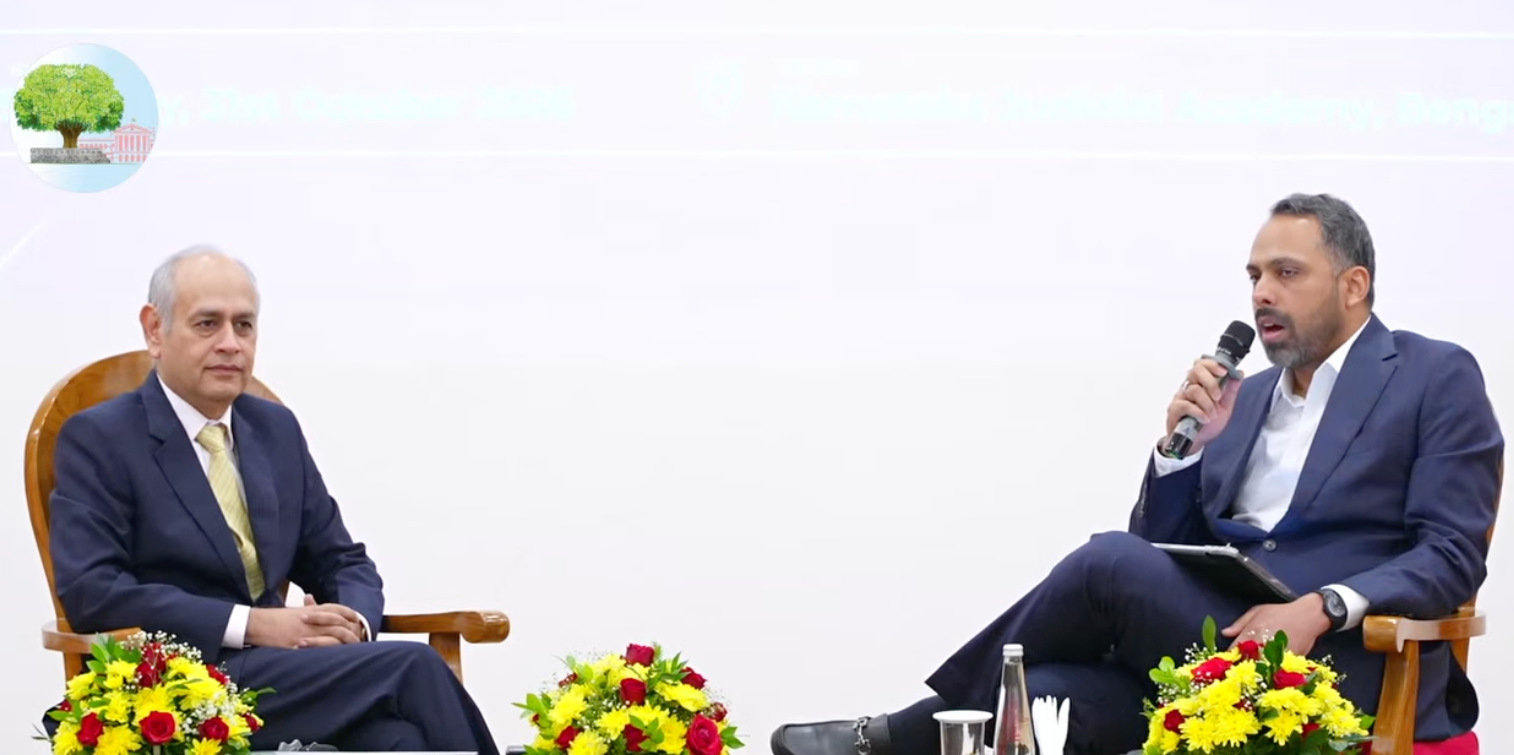
Speaking at a fireside chat with Senior Advocate Shashank Garg, Member of the LCIA Court, at Ethics & Evidence in Arbitration, an event organised by the London Court of International Arbitration (LCIA) and Arbitral Women, hosted by the Arbitration and Conciliation Centre, Karnataka, at the Karnataka Judicial Academy on October 31, 2026, Justice Vibhu Bakhru addressed several pressing questions concerning India’s arbitration framework.
The conversation examined the government’s decision to restrict arbitration in certain public procurement disputes, the independence and appointment of arbitrators, institutional arbitration, diversity in arbitral appointments, the quality of awards, the scope of judicial review under Section 34 of the Arbitration and Conciliation Act, 1996, and emergency arbitration.
“
“You have a good-quality award. You can have a regime in arbitration which says that we are not looking at the merits.”
— Justice Vibhu Bakhru
The discussion repeatedly returned to one central concern: building confidence in arbitration requires improving the quality of the process rather than merely expanding its use.
1. Why are PSUs moving away from arbitration?
Sr Adv Shashank Garg opened the discussion by referring to the Ministry of Finance’s 2024 circular prescribing a ₹1 crore threshold for arbitration in disputes involving government entities and public sector undertakings. He observed that several prominent PSUs, which had historically referred disputes to arbitration, had subsequently begun opting out.
He asked Justice Bakhru why this shift had occurred despite the 2015 and 2019 amendments to the Arbitration Act and continued judicial efforts to strengthen arbitration. He also asked what the arbitration community could do to address the situation.
Justice Bakhru attributed the loss of confidence, in part, to dissatisfaction with the quality of arbitral awards. He observed that some arbitrators and practitioners who had been appointed to conduct arbitrations did not necessarily possess adequate experience in handling arbitral proceedings. While some had considerable expertise in technical fields such as engineering, they sometimes struggled with the procedural and legal requirements of arbitration.
He noted that this had resulted in awards that did not always meet the quality expected of them, thereby affecting confidence in the process.
Justice Bakhru emphasised that the arbitration community should shift its attention from merely advocating greater use of arbitration to examining the quality of awards and the ethical conduct of arbitrators.
He also observed that arbitral awards are generally confidential, making it difficult to have an informed discussion about the principles and standards that arbitrators should follow. He suggested that greater engagement with these issues could help improve the quality of arbitral proceedings and restore confidence in the mechanism.
Taking the discussion on the government’s concerns about arbitrator independence further, Garg referred to the perception that arbitrators may have incentives to favour private parties or law firms that repeatedly appoint them.
He proposed a significant departure from the traditional understanding of party autonomy: while parties could continue to choose the arbitral institution, procedure, number and qualifications of arbitrators, the actual selection of arbitrators should be left entirely to the institution or the appointing court.
He asked whether such a model would undermine party autonomy, which is considered a foundational principle of arbitration, or whether it could provide a more credible appointment mechanism.
Justice Bakhru considered institutional appointment a potentially useful way of addressing concerns about perceived bias. He observed that where parties agree to institutional arbitration and leave the appointment of arbitrators to the institution, it removes, to some extent, the perception that an arbitrator may be beholden to the party that nominated them.
He also pointed out that institutional appointments place greater responsibility on arbitral institutions to ensure the quality and impartiality of the selection process.
However, he was cautious about making such a model compulsory through legislation. In his view, greater institutional participation and wider acceptance among stakeholders could be a more practical way forward.
He further observed that institutional arbitration was gaining traction in India, although more data and experience would be required to assess the extent of this shift.
2. Should parties retain the right to nominate arbitrators, or should institutions make appointments?
Shashank Garg then suggested a possible middle ground between complete party autonomy and exclusive institutional appointment.
Referring to Section 12 of the Arbitration and Conciliation Act, 1996, he pointed out that arbitrators are required to make disclosures concerning circumstances likely to give rise to justifiable doubts about their independence or impartiality.
He observed that, in practice, although courts appoint arbitrators under Section 11, disclosures are often left to the parties to examine. Parties may hesitate to object even where an arbitrator has disclosed a substantial number of ongoing proceedings, fearing that they may have to appear before that arbitrator.
He asked whether courts should examine disclosures before confirming appointments, as had reportedly been followed in certain appointments by the Delhi High Court, and whether such a two-tier process could improve accountability.

Justice Bakhru agreed that the examination of disclosures before appointment had merit. He explained that the appointment process could involve different mechanisms depending on whether the arbitrator was appointed directly by the parties, by an institution or by a court.
He cautioned against treating the number of ongoing arbitrations as the sole indicator of an arbitrator’s availability. Some proceedings may be stayed or inactive, while others may be nearing completion. In a three-member tribunal, the availability of the tribunal as a whole must also be considered, since the schedules of individual members may overlap.
He emphasised that institutions, in particular, have an important role in monitoring disclosures, assessing the availability of prospective arbitrators and determining whether they can deliver awards within the prescribed timelines.
Justice Bakhru agreed that a more careful examination of disclosures before appointment could improve the process.
3. Should courts examine arbitrator disclosures before confirming appointments?
Shashank Garg referred to the establishment of arbitral institutions such as the Delhi International Arbitration Centre (DIAC), the India International Arbitration Centre (IIAC), the Gujarat International Arbitration Centre and the Arbitration and Conciliation Centre, Karnataka.
He asked whether court-connected arbitral institutions, which benefit from the credibility and supervision associated with the judiciary, could provide the foundation for institutional arbitration in India, or whether the country should aspire to establish one prominent institution recognised internationally.
Justice Bakhru acknowledged that court-connected institutions have helped familiarise parties with the benefits of institutional arbitration and have encouraged a shift away from the traditional ad hoc model.
He also highlighted the question of financial sustainability. While court-connected institutions may receive support through court budgets, private institutions must operate independently and sustain themselves through fees and services.
Nevertheless, he saw considerable scope for private arbitral institutions to grow. He observed that institutions offering reliable and efficient services could attract parties willing to pay for quality, particularly when compared with the substantial costs associated with prolonged litigation.
On whether India should aspire to have a single flagship institution, Justice Bakhru indicated that the country’s diversity and the range of disputes arising across sectors made it unnecessary to focus on one overarching institution. Multiple credible institutions could coexist and contribute to the growth of institutional arbitration.
4. What should diversity in arbitral appointments mean beyond gender representation?
Shashank Garg observed that discussions on diversity in arbitration often focus primarily on gender, although diversity could also encompass professional backgrounds, subject-matter expertise and geographical representation.
He asked what institutions could do to make arbitral appointments more diverse and referred to the need for domain experts in technically complex disputes, such as those involving oil and gas, engineering and infrastructure.
He also asked Justice Bakhru about the steps taken during his tenure at DIAC and subsequently in Karnataka to promote broader representation in arbitral appointments.
Justice Bakhru stressed that diversity should not be confined to gender. He emphasised the importance of considering the nature of the dispute and the expertise required to adjudicate it.
He pointed out that technical disputes may require arbitrators with specialised knowledge of the relevant industry. For instance, a dispute involving a defence contract may benefit from the participation of someone with experience in the armed forces, while disputes involving public administration may require a different kind of expertise.
Referring to the experience at DIAC, he explained that its panel included not only lawyers but also domain experts and individuals with backgrounds in administration, security, police services and the armed forces.
He thus advocated a broader understanding of diversity that takes into account the subject matter of the dispute, professional experience and the backgrounds of the disputing parties.
5. Are awards written by technical experts viewed with greater suspicion by courts?
Shashank Garg raised a concern about the perception among parties that courts may examine awards written by engineers or other domain experts with greater suspicion than those authored by former judges or legally trained arbitrators.
He pointed out that even where a dispute is highly technical and would benefit from an engineer or industry expert, parties may hesitate to appoint such individuals if the opposing party has nominated a former judge.
He asked whether this perception was justified and how it could be addressed.
Justice Bakhru disagreed with the suggestion that courts inherently view awards written by technical experts with greater suspicion. He identified the problem as one of communication and the manner in which awards are written.
He explained that former judges and lawyers are accustomed to writing judicial decisions and legal documents. Their awards therefore tend to follow a familiar structure and format, making them easier for courts to read and understand.
By contrast, a technically qualified arbitrator may possess considerable subject-matter expertise but may not necessarily have experience in drafting reasoned awards in a manner that is readily comprehensible to courts.
Justice Bakhru observed that readability is an important component of award quality. An award that is difficult to understand may require considerably more judicial time to examine, irrespective of the merits of the decision.
Shashank Garg then suggested developing a standard operating procedure or short training course on award writing for domain experts who are not legally trained.
Justice Bakhru agreed with the suggestion and referred to an initiative undertaken at DIAC in collaboration with the National Law School and another law university, under which an arbitration course was conducted. The course included sessions on relevant aspects of arbitration, with judges contributing as faculty members. Participants who completed the course could also be recognised for empanelment.
He suggested that similar training could help technical experts develop the skills required to write clear and well-structured arbitral awards.
6. Should Section 34 provide for a full-fledged appeal on merits?
Shashank Garg referred to differing views expressed by judges at the Gujarat Arbitration Week on the scope of judicial review under Section 34 of the Arbitration Act.
He referred to a suggestion by Justice Narban that, given the manner in which challenges to arbitral awards are currently being examined, it might be preferable to provide for a full-fledged appeal under Section 34 and do away with the limited appellate framework under Section 37. He contrasted this with the opposing view expressed by Justice Ravindra Bhat, who had cautioned against introducing a full merits appeal.
Justice Bakhru explained that the suggestion for a full merits appeal stemmed from concerns about the quality of arbitral awards. If awards do not meet the expected standards, courts may find it difficult to maintain a regime of limited judicial intervention.
However, he cautioned that introducing a full-fledged merits review would undermine the very foundation of arbitration. Parties choose arbitration because they want their disputes to be finally decided by the arbitrators they have selected. If courts were to reconsider the merits of every dispute, the fundamental premise of private adjudication would be lost.
He explained the relationship between award quality and judicial intervention as a cycle: good-quality awards make it possible for courts to maintain a limited-review regime, while poor-quality awards risk inviting greater judicial scrutiny.
“
“If you have a good-quality award, you can have a regime in arbitration which says that we are not looking at the merits.”
Justice Bakhru also observed that courts must be able to understand the reasoning and findings contained in an award. The quality of the award is therefore central to ensuring that courts can exercise restraint within the limits prescribed by Section 34.
During the discussion, Sr adv Garg also raised the question of whether courts would require greater domain expertise to deal with challenges involving technically complex disputes, including construction, oil and gas and technology arbitrations.
Justice Bakhru responded that complex commercial disputes are not exclusive to arbitration and are also adjudicated by ordinary courts, where expert evidence can be led and examined. He referred to the historical development of commercial courts and observed that if the volume and complexity of such disputes demand specialised courts, the legislature could consider addressing that need.
7. Should courts relegate parties to emergency arbitration where institutional rules provide for it?
For his final question, Shashank Garg turned to emergency arbitration. He pointed out that several institutional arbitration rules provide for emergency arbitrators, although not all Indian institutions have adopted such mechanisms.
He asked whether, where parties have agreed to institutional rules providing for emergency arbitration, courts should ordinarily direct them to approach the emergency arbitrator rather than entertain applications under Section 9 of the Arbitration Act before the constitution of the arbitral tribunal.
Justice Bakhru observed that the answer would depend on the circumstances of the case and the nature of the relief sought. He referred to the experience of emergency arbitration at DIAC and noted that the existence of an emergency arbitration mechanism does not necessarily exclude the jurisdiction of courts under Section 9.
He indicated that both remedies could operate in appropriate circumstances, depending on the nature of the dispute and the relief required. However, where an effective alternative remedy is available through emergency arbitration, courts would have to take that into consideration while deciding whether to entertain a Section 9 application.
The event, titled Ethics & Evidence in Arbitration, was organised by the LCIA and Arbitral Women at the Karnataka Judicial Academy on October 31, 2026, and hosted by the Arbitration and Conciliation Centre, Karnataka. The programme brought together members of the judiciary and arbitration practitioners to deliberate on ethical standards and evidentiary issues in arbitration.