
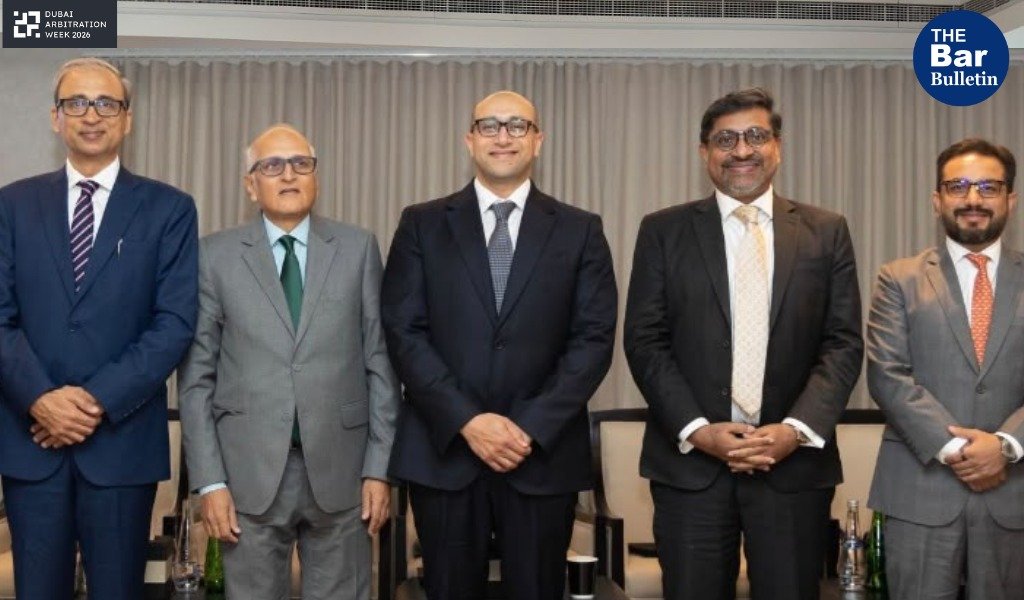

Courts must maintain a balance between minimal judicial intervention and ensuring that arbitration proceedings do not become oppressive, while retaining the authority to determine whether parties have actually consented to arbitration, former Abu Dhabi Courts judge Justice Ahmed Bakry said during Dubai Arbitration Week 2026.
He was speaking at a panel titled “Four Courts, One Award: Judicial Perspectives, Cross-Border Advocacy & The Great Common Law Debate”, held on November 12 at The Ritz-Carlton, DIFC, Dubai. The session was moderated by Dinesh Pardasani, Partner at DSK Legal, and brought together:
● Justice Ahmed Bakry, former Abu Dhabi Courts judge
● Justice S. Ravindra Bhat, former Supreme Court judge
● Abraham Vergis SC, Managing Director of Providence Law Asia, and
● Sidharth Sethi, Partner at JSA.
Responding to a question on whether an arbitration-friendly court should limit its intervention or examine whether the arbitral process had become oppressive for a party, Justice Bakry said both approaches were necessary at different stages of the proceedings.
He referred to a 2025 decision of the Dubai Court of Cassation concerning the appointment of an arbitrator, in which one party argued that the arbitration clause had been terminated by a subsequent settlement. According to Bakry, the court clarified that, at the appointment stage, it would undertake only a prima facie examination of the arbitration agreement, leaving the arbitral tribunal to rule on its own jurisdiction.
Explaining the principle of the tribunal’s chronological priority in deciding its jurisdiction, he said courts would exercise their supervisory role at a later stage, including when an award was challenged or its ratification or enforcement was opposed. Justice Bakry said:
“
“There is one thing that a court must never surrender in the name of friendliness: its role as the ultimate arbiter of jurisdiction and of consent. Calling a court arbitration-friendly cannot mean that it finds an arbitration agreement without really checking what the parties intended. If one party never agreed to arbitrate, sending it to a tribunal is not support for arbitration, it is the opposite.”
He further emphasised the importance of judicial specialisation, saying that the effectiveness of an arbitration-friendly court depended not merely on the establishment of commercial courts but on the expertise of the judges hearing such disputes.
“
“In my experience, specialisation is what allows a court to refuse. But not in the sense we usually mean. Having a commercial court is not by itself specialisation. Specialisation is not a sign on the door. It is the judge behind it. An arbitration-friendly court needs judges who know arbitration from the inside, and where possible, who have sat as arbitrators themselves.”
Justice Ravindra Bhat: Excessive reference to arbitration could slow development of law
Former Supreme Court judge Justice S. Ravindra Bhat said Indian courts had become more restrained in their approach to arbitration over the past decade, with the Supreme Court repeatedly emphasising that judicial interference with arbitral awards must remain limited.
Referring to the evolution of Indian arbitration law, he recalled the confusion surrounding the application of domestic arbitration provisions to foreign awards, which was addressed by the Supreme Court in Bhatia International v. Bulk Trading S.A., (2002) 4 SCC 105 and later overruled in Bharat Aluminium Co. v. Kaiser Aluminium Technical Services Inc. (BALCO), (2012) 9 SCC 552.
Justice Bhat also referred to the Supreme Court’s decision in Amazon.com NV Investment Holdings LLC v. Future Retail Ltd., (2021) 1 SCC 209, which recognised the enforceability of an emergency arbitrator’s award under the Indian arbitration framework. He also elaborated on the circumstances in which Indian courts had granted anti-arbitration injunctions, observing that such intervention was generally reserved for exceptional situations involving serious procedural concerns. On the scope of interference with arbitral awards, he said:
“
“The courts are more constrained now in the sense that unless something is egregious and it appears on the face of the award, the enquiry doesn’t proceed further. Because in judgment after judgment, the Supreme Court has reiterated that the scope of interference is minimal and public policy is not such a stretch that you can include everything.
“But speaking from a slightly different view, sometimes I feel that you do end up having contrary outcomes, and that’s because of this idea that arbitration has to be very arbitration-friendly. If we go down this path, where do we see the growth of law? Common law and law generally evolve through development, robust enquiry and development of law.
“If you leave everything to arbitration, as we all believe that all disputes should be arbitrable, I think there will be a time when the growth of law will be static.”
Justice Bhat clarified that he was not advocating a radical change in the law but said courts needed to consider how emerging legal questions, including those arising from technological developments and evolving concepts of damages, would be addressed.
He also cautioned against comparing India directly with Singapore, pointing to India’s substantially larger judicial system, differing understandings of public policy among courts and the increasing congestion in commercial courts. Nevertheless, he said there had been greater stability in the interpretation of public policy over the last decade.
Abraham Vergis SC: Singapore courts do not entertain disguised merits appeals
Abraham Vergis SC, Managing Director of Providence Law Asia, said Singapore’s reputation as an arbitration-friendly jurisdiction did not mean that arbitral awards were immune from judicial scrutiny.
He explained that arbitration-related applications could be filed before the Singapore International Commercial Court (SICC), which has an international panel of judges. He said the court aimed to process arbitration-related challenges within six to nine months, requiring parties to be prepared for a fast-moving process.
Vergis also explained that awards could be set aside where there were jurisdictional defects, breaches of natural justice, decisions beyond the scope of the tribunal’s reference or failure to address fundamental issues submitted for determination. He said:
“
“There is this misimpression that because Singapore is friendly to arbitration or pro-arbitration, that means virtually no cases get set aside. And actually, that is not true. There are a good number of cases that have been set aside. As far as Singapore is concerned, we are not really concerned about the final outcomes of arbitral awards. The question primarily will be one of jurisdiction. If indeed the tribunal did not have jurisdiction to hear the case, then that is a matter which the Singapore courts need to come in as a seat court to set that right.
“The other broad areas where awards are set aside typically have to do with breaches of natural justice, arbitral decisions exceeding the scope of submission, and the failure of the tribunal to deal with specific or fundamental issues that were put before it for decision-making.
“A lot of challenges to arbitration awards, at least in our experience in our jurisdiction, are really dressed-up complaints that they did not like the merits decision. It is actually a substantive merits appeal, but typically this is being dressed up as some kind of procedural issue or some kind of jurisdictional issue. The Singapore courts pierce through those procedural or jurisdictional complaints to see that the real complaint is that the arbitrator did not decide in your favour substantively. And if that is the reason, then Singapore courts will not entertain that.”
He added that while the majority of arbitral awards were upheld, Singapore courts continued to intervene where the integrity of the arbitral process or the tribunal’s jurisdiction was genuinely in question.
Sidharth Sethi: Counsel Must Tailor Advocacy To The Tribunal’s Procedural Approach
JSA Partner Sidharth Sethi discussed the practical challenges counsel face when conducting international arbitration involving common-law and civil-law legal traditions, particularly in relation to cross-examination and document production.
He explained that common-law systems generally follow a party-driven approach to fact-finding, with parties leading evidence and extensively cross-examining witnesses. Civil-law systems, on the other hand, give judges and tribunals a more active role in examining witnesses and establishing facts. Sidharth Sethi said the differences could create conflicting expectations concerning witness preparation, cross-examination and disclosure of documents. He referred to the IBA Rules on the Taking of Evidence and the Prague Rules as frameworks that seek to accommodate these different approaches.
Sidharth Sethi further stressed that counsel should not assume that extensive cross-examination or broad document production would necessarily be permitted or useful. He advised advocates to understand the procedural framework agreed upon by the parties and the approach preferred by the tribunal.
On cross-examination, he emphasised that counsel should focus on material issues rather than challenge every statement made by a witness. He also cautioned against questioning witnesses on matters already established by documentary evidence. He added:
“
“Counsel must be flexible and adapt their advocacy to the tribunal and the procedural framework. They must not assume that extensive cross-examination or document production will necessarily be permitted or considered useful. Cross-examination should be focused on material issues, rather than testing every statement made by a witness. Never cross-examine on a point that the documents already prove. Know your tribunal before you know your witness. A civil-law chair may prefer a short, surgical cross-examination rather than a three-hour siege.
“Ultimately, international arbitration is not about importing your own legal system into the proceedings. It is about understanding the legal traditions in the room and adapting your advocacy accordingly. The objective is the same across both systems: to assist the tribunal in arriving at the correct facts and, eventually, the correct decision.”
On document production, he said requests should be based on the issues in dispute rather than the volume of material that could be obtained from the opposing party. He highlighted the importance of identifying specific documents, establishing their relevance and materiality, and keeping requests proportionate. He also referred to Redfern Schedules as a useful mechanism for setting out document requests, the justification for them, objections and the tribunal’s decision.