
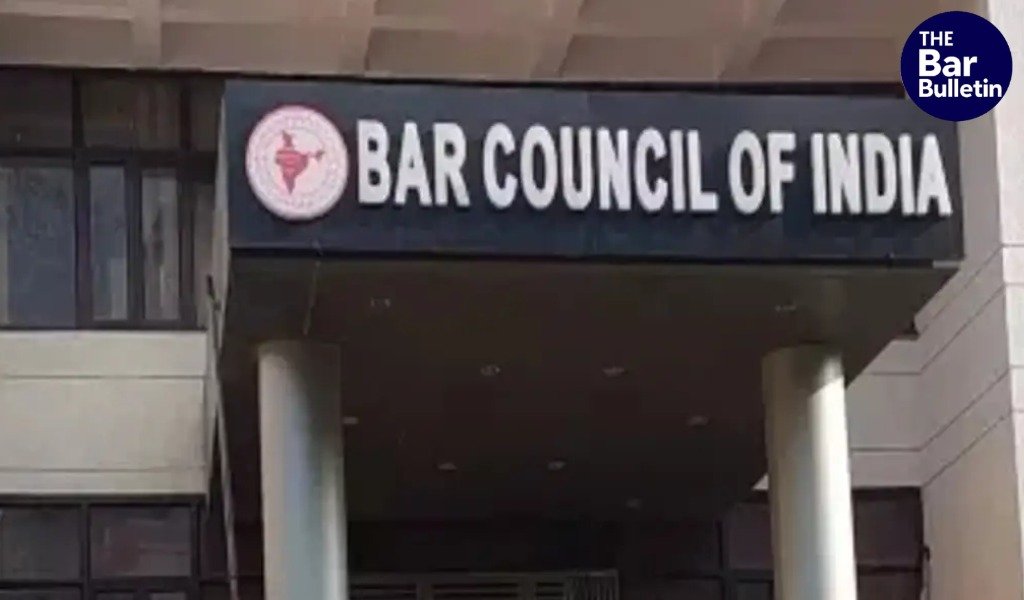

The Bar Council of India (BCI) has directed all State Bar Councils to immediately publish and circulate the Supreme Court’s interim order prohibiting the unauthorised extraction, dissemination and monetisation of audio-video recordings of judicial proceedings, along with the BCI’s earlier circular on digital ethics and social media conduct.
In a communication dated July 28, 2026, addressed to the Chairpersons and Secretaries of all State Bar Councils, the BCI referred to the Supreme Court’s order dated July 24, 2026 in Harshita Grover v. Union of India & Ors. [W.P. (C) No. 751/2026], stating that the Court’s directions reinforce the concerns already addressed in the Council’s circular issued on July 17.
The BCI noted that, by way of an interim measure, the Supreme Court has directed that there shall be no extraction, dissemination, monetisation, posting, re-posting, uploading, transmitting, modification, storing or hosting of audio-video recordings of judicial proceedings on social media or any other digital platform without prior permission from the Secretary General of the Supreme Court or the Registrar General of the jurisdictional High Court. The Court also directed that its order be uploaded on the websites of the Supreme Court and all High Courts for public information.
“
“The subsequent order of the Hon’ble Supreme Court reinforces the concerns and directions already incorporated in the Bar Council of India Circular. It is, therefore, necessary that the order of the Hon’ble Supreme Court and the Circular of the Bar Council of India are published and circulated together, so that Advocates and other stakeholders are made aware of the complete legal and professional framework governing the use of recordings of judicial proceedings and conduct on social media and digital platforms.”
The Council observed that its circular dated July 17 had already clarified that live-streaming of judicial proceedings is intended to promote transparency and legal education, and cannot be treated as a licence to extract, clip, edit, sensationalise, monetise, mock, distort or circulate portions of judicial proceedings with disparaging captions, music, thumbnails, memes or commentary. It also reiterated that prior written authorisation of the concerned court is required before reproducing, transmitting or publishing live-streamed proceedings.
Accordingly, the BCI directed every State Bar Council to prominently display on the homepage of its official website the Supreme Court’s order, the July 17 circular and the implementation directions issued on the same day. The documents are to be placed under a clearly visible heading concerning the prohibition against unauthorised use and circulation of recordings of judicial proceedings and obligations relating to digital ethics and social media conduct.
The Council further instructed State Bar Councils to forward these documents to every recognised Bar Association within their jurisdiction with directions to prominently display them on their official websites and notice boards and circulate them among members through official communication channels. It reminded the State Bar Councils that merely publishing the documents on their websites would not constitute full compliance unless reasonable measures are taken to bring them to the notice of every enrolled advocate and recognised Bar Association.
The communication requires all State Bar Councils to submit a compliance report, including the relevant website links and confirmation of circulation to advocates and Bar Associations, to the Bar Council of India within three working days of receiving the communication.