
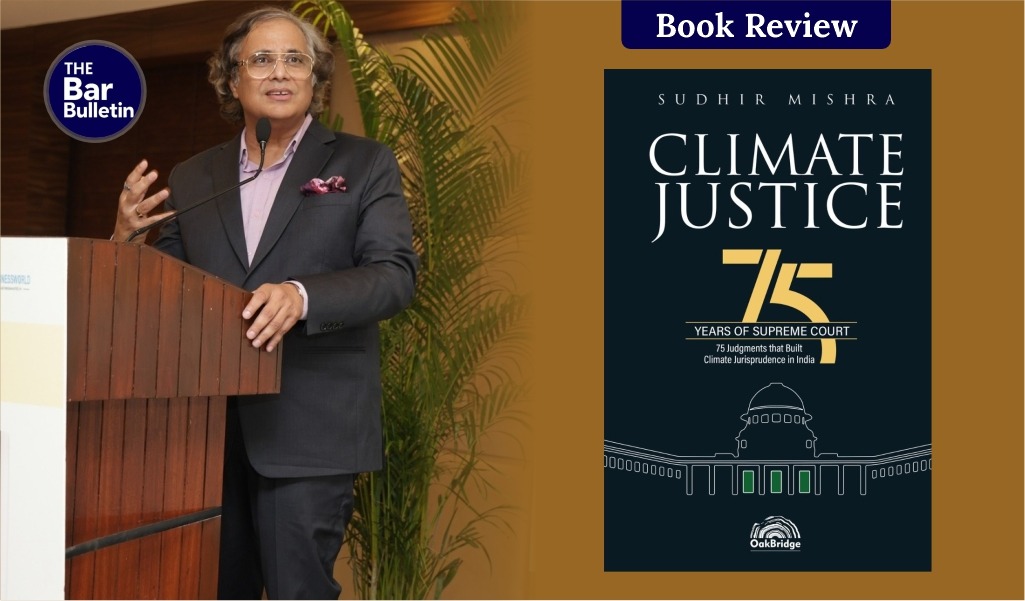

As India confronts the realities of climate change, environmental degradation, and the increasing constitutional significance of sustainable development, understanding the evolution of environmental jurisprudence has become more important than ever. In Climate Justice: 75 Years of Supreme Court – 75 Judgments that Built Climate Jurisprudence in India, Mr. Sudhir Mishra published by Oakbridge undertakes an ambitious and timely exercise by chronicling seventy-five landmark Supreme Court judgments that have shaped India’s environmental and climate law over the past seventy-five years.
This is neither a conventional law textbook nor a compilation of case notes. Instead, it is an engaging narrative that tells the story of environmental jurisprudence through the human stories, constitutional questions, and judicial principles underlying some of India’s most significant decisions.
From State of Rajasthan v. Shri G. Chawla (1958) to M.K. Ranjitsinh v. Union of India (2025), the book traces the Supreme Court’s evolving understanding of environmental protection from questions of public health and municipal regulation to contemporary concerns surrounding biodiversity, climate change, ecological preservation, and sustainable development.
Looking Beyond Conventional Environmental Cases
One of the book’s greatest strengths lies in its decision to begin well before environmental law became a recognised constitutional discipline.
The opening chapter, Religious Freedom Meets Public Peace: The Loudspeaker Wars, revisits State of Rajasthan v. Shri G. Chawla, 1959 AIR 544, a case concerning the regulation of loudspeakers. At first glance, the judgment appears to concern public order rather than environmental law. However, Mr. Mishra convincingly explains how the decision laid the constitutional foundation for recognising the State’s authority to regulate noise in the larger public interest. By connecting public health, public order, and environmental concerns, he demonstrates that environmental jurisprudence often grows from broader constitutional values rather than from specialised environmental legislation alone.
The second chapter, Poison in the Wells: India’s First Environmental Showdown, examines Dhrangadhra Chemical Works Ltd. v. Dhrangadhra Municipality, 1959 AIR 1271. Here, Mr. Mishra presents one of India’s earliest judicial confrontations between industrial development and environmental protection. Rather than merely recounting the litigation, he highlights the importance of procedural fairness, scientific inquiry, and judicial oversight when allegations of environmental harm arise principles that continue to influence environmental adjudication today.
These early chapters are particularly impressive because they resist the temptation to retrospectively overstate the importance of the judgments. Instead, they carefully place them within their historical context and show how seemingly modest constitutional disputes gradually evolved into the foundations of modern environmental jurisprudence.
Landmark Judgments Through Storytelling
Perhaps the book’s most distinctive feature is its storytelling approach.
Each chapter carries a narrative title “The Passport That Changed Everything,” “The Drains Overflowed and Dignity Drowned,” “The Quarry Wars,” “When the Mountains Started to Crumble” before introducing the legal dispute. This transforms judgments that are often remembered only by their citations into compelling constitutional stories.
Mr. Mishra’s treatment of Maneka Gandhi v. Union of India is particularly noteworthy. While the case is traditionally studied as a landmark on personal liberty under Article 21, he explains how its expanded interpretation of life, fairness, and dignity ultimately became the constitutional foundation upon which environmental rights were later recognised. The connection is made naturally, enabling readers to appreciate how constitutional law and environmental law are deeply intertwined.
Equally engaging is the discussion on Municipal Council, Ratlam v. Vardhichand,AIR 1980 SC 1622, where overflowing drains and municipal neglect become the backdrop for recognising environmental dignity as an aspect of the right to life.
The chronological structure of the book significantly enhances its readability.
Rather than grouping cases under thematic headings, Mr. Mishra divides the book into seven historical phases spanning 1950 to 2025. This enables readers to witness the gradual evolution of environmental jurisprudence from municipal sanitation and industrial pollution to wildlife conservation, forest governance, climate litigation, wetlands, mining regulation, biodiversity, and ecological rights.
Bridging History with Contemporary Relevance
Another thoughtful feature is the inclusion of a “Relevance Today” section at the end of every chapter.
Rather than treating each judgment as a historical event, Mr. Mishra explains why the principles laid down decades ago continue to shape contemporary environmental governance and climate policy. This helps bridge the gap between legal precedent and present-day environmental challenges, making the book equally useful for law students, practitioners, researchers, policymakers, and general readers.
Given its broad scope, the book understandably prioritises accessibility over doctrinal depth. Readers looking for detailed statutory analysis or exhaustive discussions of judicial reasoning may find the treatment introductory rather than comprehensive.
At certain places, the ‘Relevance Today’ sections adopt a normative tone that reflects Mr. Mishra’s commitment to environmental protection. While this is consistent with the book’s objective, a slightly greater engagement with competing developmental concerns in some chapters could have enriched the discussion.
These, however, are relatively minor observations in what is clearly intended to be an accessible account of India’s environmental jurisprudence rather than an academic commentary.