
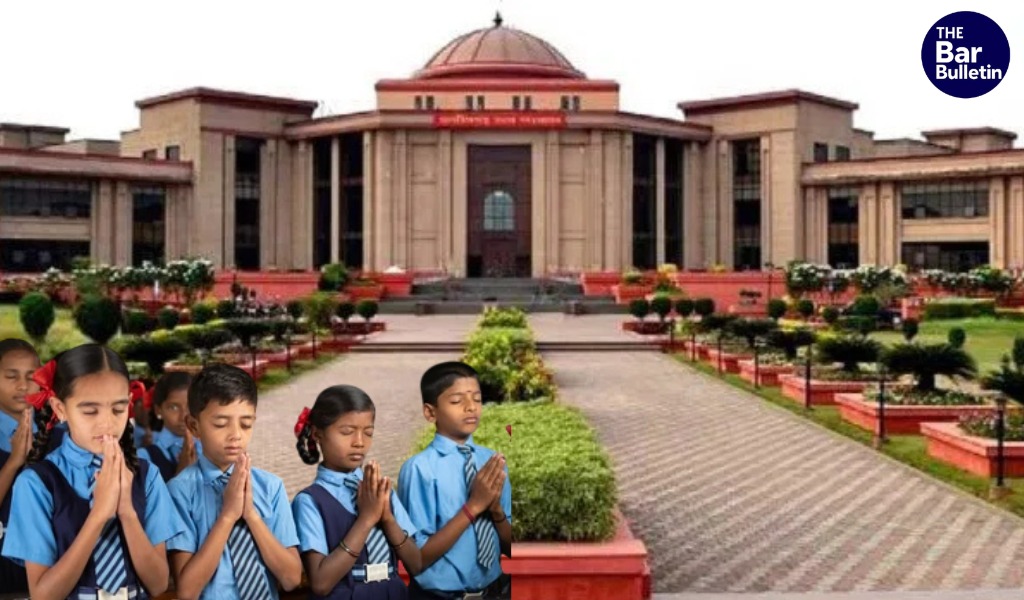

In a writ petition filed before the Chhattisgarh High Court to declare that compulsory recitation of Saraswati Vandana, Guru Mantra, Shanti Mantra, Bhojan Mantra, and similar religious prayers in State funded schools is unconstitutional, a Single Judge Bench of Justice Amitendra Kishore Prasad the petition was dismissed for being premature and based on apprehension rather than any actual grievance.
The petitioners were aggrieved by an order dated 12-06-2026 by the Additional Secretary, School Education Department, Chhattisgarh, which mandated that starting from the academic session 2026-27, students in all schools run by the School Education Department shall be required to recite the National Anthem, National Song, Deep Mantra, Saraswati Vandana, Guru mantra, Shanti mantra and accounts of the live of Mahapurushas at the beginning of the school day and the Rajya geet, Gayatri mantra, and Shanti mantra upon dismissal .
It was asserted by the petitioners that the impugned directions were violative of Articles 14, 21, 25, 28(1), 29, and 30 of the Constitution of India as this creates an impermissible situation for students from minority communities who may feel compelled to participate in religious practices that do not belong to their faith. It was argued that reciting these mantras amounted to promotion of a particular religion in government schools, which is constitutionally barred.
The State argued against the maintainability of the petition while asserting that the impugned direction was in perfect alignment with the National Education Policy, 2020, which mandates integration of the Indian Knowledge Systems to foster cultural awareness. It was mentioned that the State had not received a single complaint from any student, parent, or teacher and that this harmonious implementation meant that the policy had been accepted by the School Community.
The Court perused the impugned order and found that it did not contain any mandatory or coercive direction compelling students to act in a manner contrary to their respective beliefs, conscience, or faith. It was said that the petitioners had completely failed to place any relevant material on record to show violation of any fundamental rights as no individual or direct injury was shown. The Court said that Article 28(1) clarified that the provision does not ban moral instruction, disassociated from any denominational doctrines, which remains an essential part of training in citizenship, maintenance of law and order in the State, and growth of social cohesion.
It was opined that the petition was premature, based on mere apprehension, and that the reliefs sought could not be granted. Thus, the petition was dismissed but liberty was granted to the petitioners to approach the court by way of a fresh petition supported by material, if any exigencies arise in the future.
ALSO READ: Allahabad High Court Quashes FIR Against POCSO Accused Over Marriage and Pregnancy with Minor Victim
