
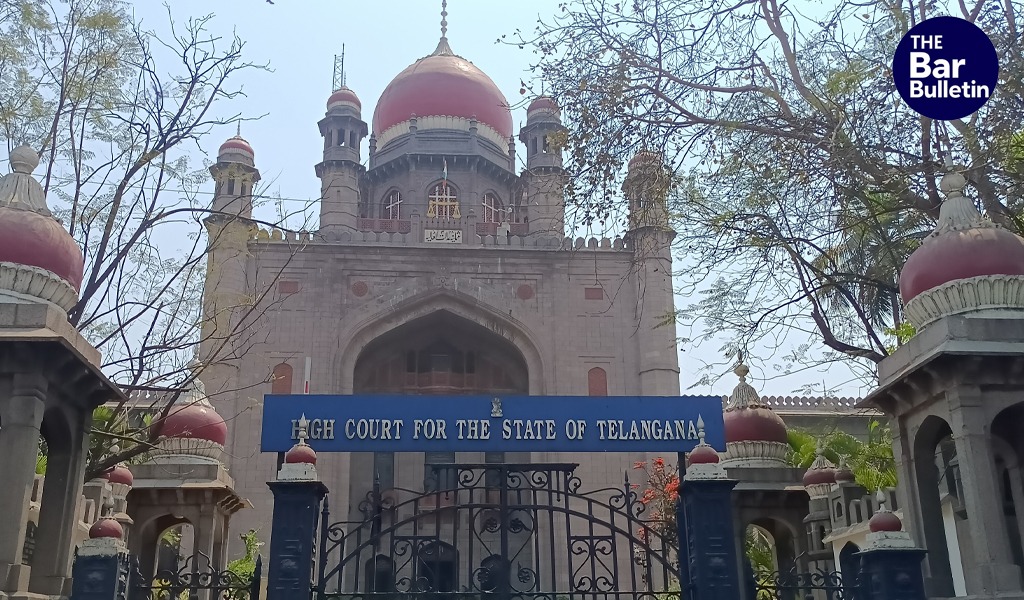

The Hyderabad Bench of the Telangana High Court has held that rent received by a landlord for facilities, furniture, fixtures, kitchen and cafeteria items supplied as part of a composite lease of commercial premises will not amount to a “transfer of the right to use goods” unless the essential legal tests for such transfer are satisfied, particularly identified goods, vesting of legal right, effective control, exclusivity, and inability of the owner to simultaneously extend the same right to others. Where the arrangement only grants a permissive and shared use of amenities under a broader service-oriented lease, it remains a contract of service and is not amenable to tax as a deemed sale under Section 5E of the APGST Act / corresponding VAT provisions.
Applying the said reasoning, the High Court held that the orders of the Assessing Officer, Appellate Deputy Commissioner, Deputy Commissioner and the STAT were unsustainable in law. It ruled that the rent paid by the tenants towards furniture, equipment and other movable items provided in the kitchen and cafeteria was not taxable under the APGST Act because those payments arose out of a contract of service and did not involve any sale, purchase or transfer of the right to use goods.
The Division Bench comprising Justice P. Sam Koshy and Justice Suddala Chalapathi Rao examined the constitutional and statutory scheme, including Article 366(29A)(d), Section 2(q) and Section 5E of the APGST Act, and reiterated that tax can be levied only when there is a transfer of the right to use goods for consideration. The Bench emphasized that unless such transfer is actually established, the transaction cannot be treated as a deemed sale.
The Bench found, on a reading of the lease deeds as a whole, that the petitioners had not parted with possession or effective control of the alleged goods. The tenants were only allowed to use certain facilities and amenities as part of the broader leasing arrangement. The Bench also noted that several of the facilities, including lifts, sewage systems, bathrooms and cafeteria areas, were common facilities shared by more than one tenant, and therefore could not be said to have been exclusively delivered to any one lessee.
Also Read Allahabad High Court Quashes FIR Against POCSO Accused Over Marriage and Pregnancy with Minor Victim
The High Court held that the tax authorities had wrongly presumed a transfer of the right to use goods and had impermissibly bifurcated the composite lease rentals into movable and immovable components. According to the Court, the lease rentals were charged essentially on a per square foot basis and not as a true transfer of identified goods. Therefore, the revisional authority could not break up the contract merely on assumption and subject part of the receipts to sales tax.
The Bench then tested the transaction against the five ingredients laid down in Bharat Sanchar Nigam Limited vs. Union of India [2006 (2) STR 161 (SC)] for a valid transfer of the right to use goods. It held that none of the requirements were satisfied. The goods were not specifically identified for delivery; there was no consensus ad idem as to any identified goods; no legal right to use specific goods was vested in the tenants; the use was not to the exclusion of the landlords; and the same amenities were being used by several IT companies at the same time.
The Bench further observed that the lease conditions themselves showed continuing landlord control. The landlord retained powers regarding suspension or discontinuance of facilities, restrictions on tenant use, prohibition on assignment or subleasing without permission, and rights of inspection and repair. These clauses, in the Court’s view, clearly negatived any case of exclusive possession or transfer of an enforceable right to use goods in favour of the tenants.
Also Read Delhi HC Restrains Sale of Counterfeit ‘Beauty of Joseon’ Products; Orders Amazon to Delist Listings
Briefly, a batch of petitions raised a common legal issue on whether rent received by the assessees from leasing out premises in an industrial technology park, together with amenities such as generators, air-conditioning systems, transformers, lifts, furniture, fit-outs, kitchen and cafeteria items, could be taxed as transfer of the right to use goods under the APVAT Act / APGST Act. The petitioners stated that they had constructed high-rise buildings and leased them to software and IT companies. Under the lease deeds, they provided the demised premises along with facilities such as IPS flooring, centralized air-conditioning, raw power supply, drinking water, electrical sub-station, DG power pack, sewage treatment plant, fully equipped kitchen and cafeteria, furniture and fixtures. Their case was that all of this formed part of a single leasing and service arrangement, and that they had already paid service tax on the entire consideration received from the tenants.
The dispute arose because the tax department treated the rent attributable to fixtures, furniture and certain amenities as consideration for transfer of the right to use goods, and therefore taxable under the APVAT / APGST regime. The department relied on the bifurcation in the agreements between rent for the building and rent for certain fixtures and furniture, and argued that these movable items had been separately let out to the tenants.
The petitioners, however, argued that there was only a permission to use these facilities in the course of leasing the immovable property, and not any transfer of the right to use goods. They stressed that possession and substantial control always remained with the landlords, that many of the facilities were common amenities shared by multiple occupants, and that the contract could not be artificially split up into a taxable goods component and a service component.
