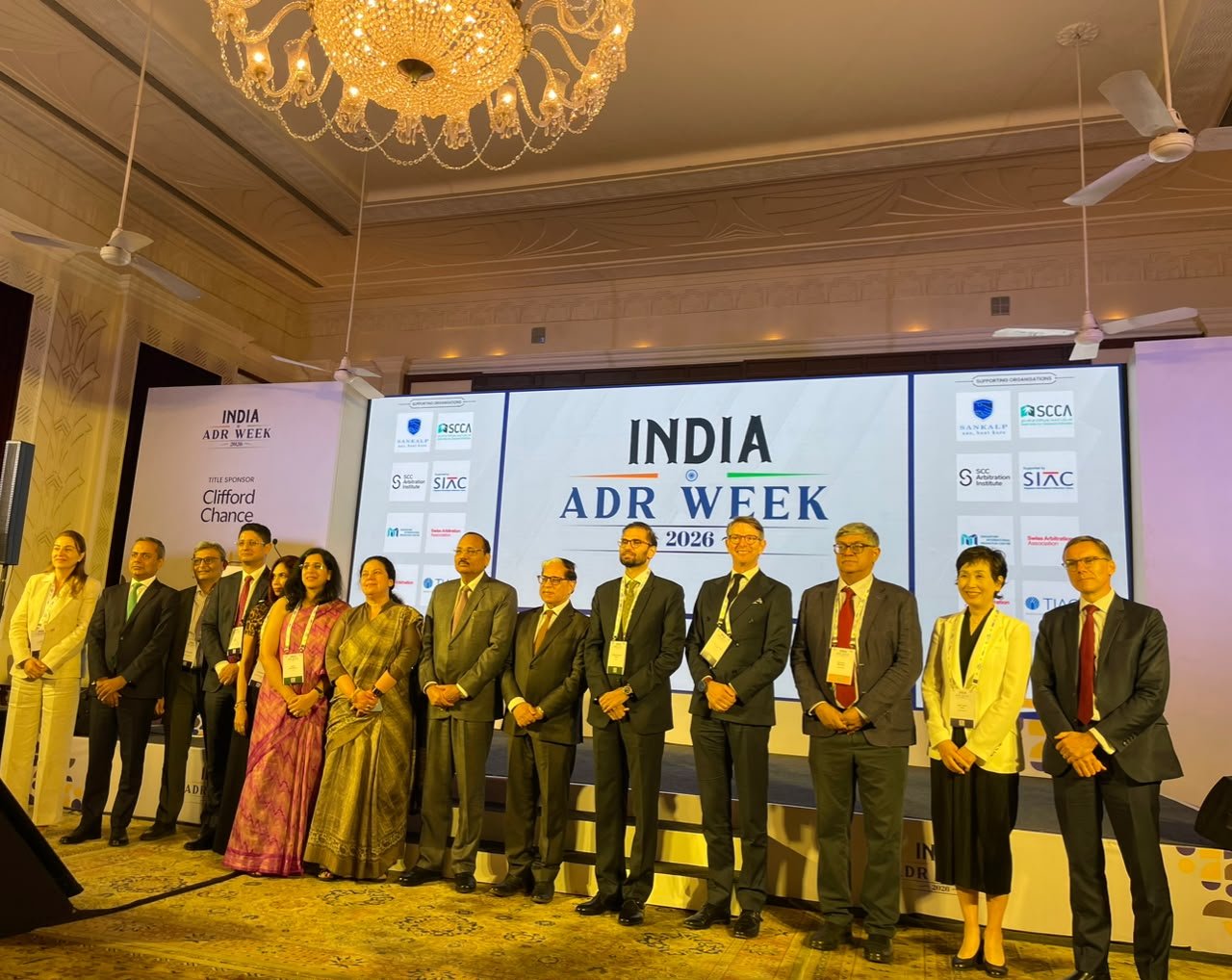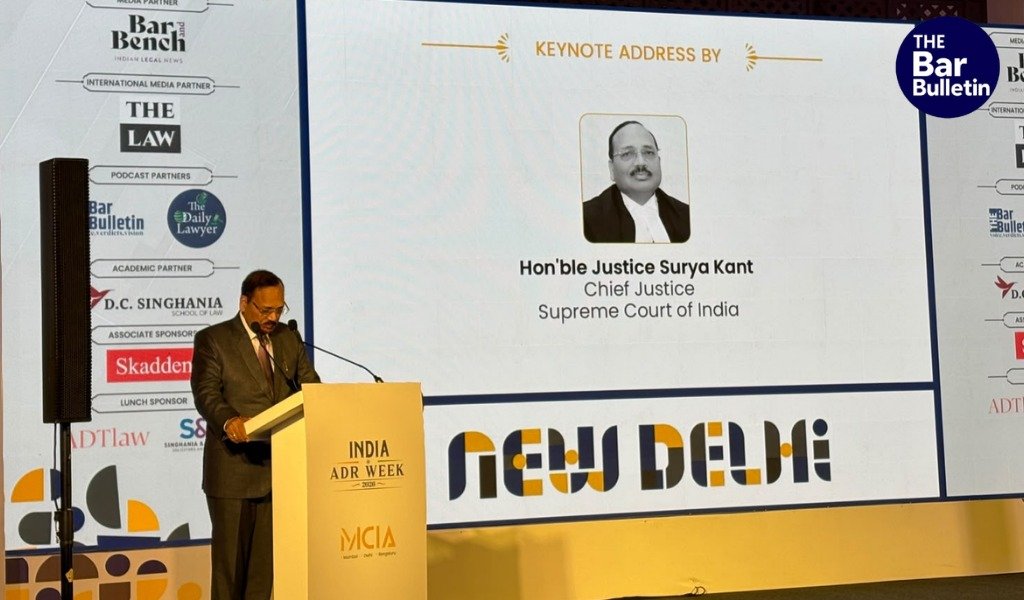

Chief Justice of India Justice Suryakant delivered the keynote address at the concluding session of India ADR Week 2026, organised by the Mumbai Centre for International Arbitration (MCIA) at The Imperial, New Delhi, calling for greater professional accountability, institutional transparency and a stronger focus on efficiency if India is to emerge as a leading international arbitral seat.
Reflecting on the deliberations during the ADR Week, the CJI identified certainty and efficiency as the common thread running through discussions on construction disputes, cross-border arbitration, energy disputes and professional ethics. He observed that parties choosing arbitration do not seek a guaranteed victory, but expect reasonable certainty about the duration of proceedings, the decision-maker and the standards to which the decision-maker will be held.
Also Read Panel Discusses AI, Access And Diversity In Dispute Resolution At MCIA India ADR Week 2026
On the question of regulating arbitrators, Justice Suryakant said the arbitration community should not simply wait for statutory intervention. He suggested the creation of a shared, cross-institutional disclosure register containing information on arbitrators’ conflicts, sitting loads, average time to award and areas of subject-matter expertise. He said greater transparency could allow counsel and parties to make informed appointments based on a visible track record rather than closed professional networks.
He further emphasised that statutory reform could establish the minimum standards, but self-regulation would determine how high the standards ultimately rise. “Statute can only set the floor; the self-regulation I have just proposed will decide how high the ceiling should be,” he said.
Turning to India’s aspirations as an international arbitral seat, the CJI stressed that the country’s legal framework alone would not be sufficient.
“
‘A seat is not chosen on paper alone. It is chosen on experience’,
he said, highlighting the need for India to offer arbitral proceedings that meet global expectations. He also highlighted the importance of efficient interim relief and institutional credibility in determining how international parties perceive an Indian seat.
Justice Suryakant also pointed to the growing significance of energy and technology disputes, noting that rapid regulatory and technological changes are generating contractual, intellectual property, data and regulatory disputes. He called for arbitral panels with genuine sectoral expertise and greater institutional initiative in developing specialised panels and transparent information on arbitrators’ experience.
Concluding on an optimistic note, the CJI said India has the necessary ingredients to become a serious arbitral seat, including disputes, talent and increasingly strong institutions. He called for “confidence and discipline” to bring these strengths together through faster timelines, stronger territorial expertise, greater transparency and institutions willing to measure themselves against the best.
He concluded with a call for the arbitration community to move from discussion to implementation:
“
“Let us meet again next year not merely with more ideas, but with results to show for them.”