
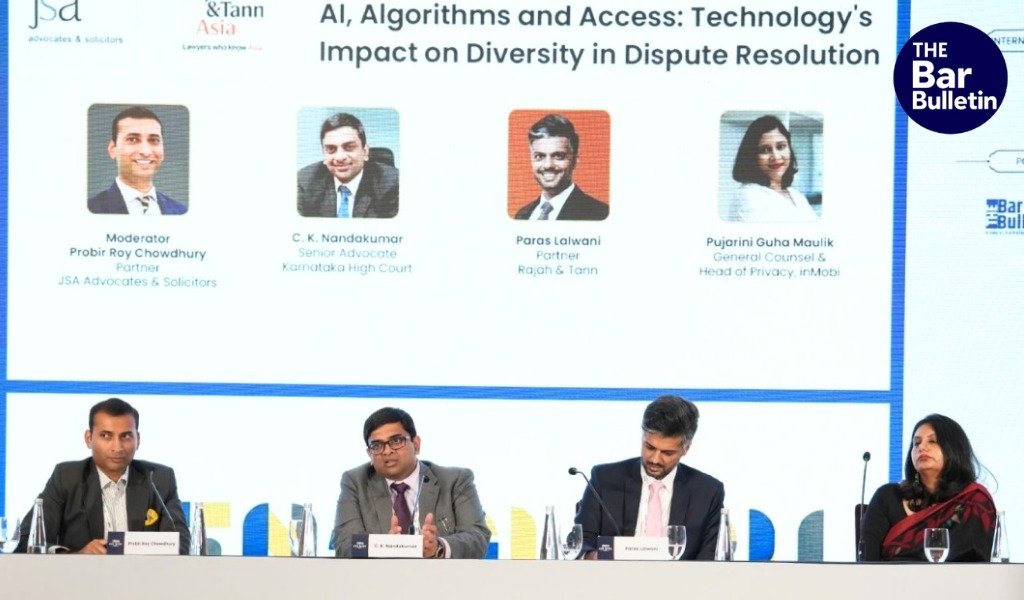

Whether artificial intelligence will make dispute resolution more accessible or instead create a new divide between parties with unequal access to sophisticated technology was among the key questions discussed at the third panel discussion of the Bengaluru leg of India ADR Week 2026, organised by the Mumbai Centre for International Arbitration (MCIA).
The panel, titled “AI, Algorithms and Access: Technology’s Impact on Diversity in Dispute Resolution,” was hosted by JSA and Rajah & Tann Asia and moderated by Probir Roy Chowdhury, Partner, JSA Advocates & Solicitors. It featured
● Senior AdvocateK. Nandakumar,
● Rajah & Tann Partner Paras Lalwani and
● Pooja Yedukumar, Vice-President, Legal and DPO, Glance (InMobi Group).
The Bengaluru programme formed part of India ADR Week 2026, being held across Bengaluru, Mumbai and Delhi from September 7 to 11.
Opening the discussion, Probir Roy Chowdhury said AI could substantially reduce the costs involved in document review, legal research, translation and analysing large datasets, potentially allowing smaller businesses and parties with fewer resources to pursue claims they might otherwise abandon. But he posed the the question: would AI actually level the playing field, or simply replace the question of who has the bigger legal team with who has the better technology?
Can cheaper legal services actually mean greater access?
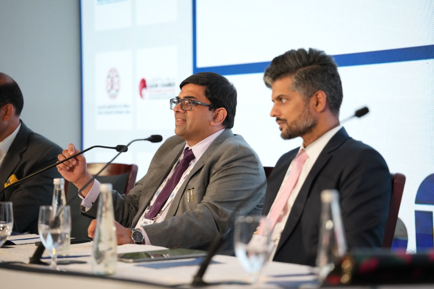
Asked whether reducing the cost of dispute resolution necessarily made it more accessible, and whether unequal access to sophisticated AI tools could create a new divide, CK Nandakumar said the issue needed to be framed differently.
He distinguished access to justice from dispute resolution, stating that arbitration is primarily a mechanism for resolving contractual disputes rather than a traditional justice-delivery mechanism. At the same time, he said AI could promote equal treatment of parties by giving less sophisticated parties access to tools that were previously available mainly to better-resourced opponents.
“
“I think certainly AI can aid equal treatment because it gives everybody a shot at it.”
Nandakumar pointed to international arbitrations where Indian parties historically struggled to match the manpower and resources available to foreign law firms. AI, he said, could help smaller parties process thousands of documents and narrow that gap.
Paras Lalwani, however, offered a more cautious view. Asked the same question, he said access was not merely a question of cost but also depended on the AI tools available, digital literacy and technological infrastructure. He compared the situation to giving two parties cars of vastly different capabilities:
“
“AI helps the smaller parties enter the competition, but it helps the larger party dominate it.”
He said larger parties could deploy enterprise-grade tools that smaller parties may be unable to challenge, while cheaper tools could also create risks of inaccurate output, hallucinations and confidentiality breaches.
Where should the line be drawn between AI assistance and decision-making?
Probir Roy Chowdhury then asked Pooja Yedukumar where judges, courts, litigators and arbitrators should draw the line between AI assisting the dispute-resolution process and AI influencing the outcome.
She said the distinction should turn on the level of risk and the need for human verification. AI could be used more freely for procedural and administrative tasks, such as preparing a first draft or organising information, but higher-risk uses should require human oversight. She identified predicting settlement values or the likely outcome of a specific dispute as an area where AI should not yet be relied upon.
“There is definitely a line… Where to draw the line today is probably, where you do require a human where you probably don’t require a human.”
She added that AI tools needed to be continually tested for accuracy, bias and explainability. The moderator noted that the Supreme Court’s draft AI guidelines specifically prohibit judicial outcome prediction, prompting Lalwani to explain Singapore’s approach. He said Singapore uses a “traffic light” system, with low-risk administrative uses in the green category, applications requiring human oversight in the orange category, and direct judicial decision-making and witness evaluation in the red category.
Can AI selection of arbitrators reproduce existing bias?
The discussion then moved to arbitrator appointments. Chowdhury asked whether an AI system recommending arbitrators based on historical appointment data could genuinely be considered neutral, given that historical appointments themselves may contain structural or unconscious biases.
Nandakumar said India’s largely ad hoc arbitration system created an additional problem because there is no sufficiently comprehensive public database showing arbitrators’ appointments and performance.
Lalwani went further, warning that AI trained on historical data could simply reproduce the existing composition of the arbitration profession.
“If the past is bias, an algorithm will recommend that bias at scale.”
He said AI would tend to recommend the same established arbitrators rather than identify younger or more diverse candidates, potentially entrenching the existing “pale, male and stale” composition of major international arbitration panels.
Nandakumar agreed that increasing diversity would require conscious intervention rather than simply relying on algorithms. He pointed to MCIA’s appointment of younger and women arbitrators and the Karnataka Arbitration Centre’s expansion beyond retired judges as examples of efforts to broaden the pool.
Should AI-generated work be disclosed?
The Moderator then asked how AI models should be trained and whether parties should know what data a model relied upon, whether its results were representative and whether the opposing side could challenge them.
Yedukumar said these questions were fundamental to the development and deployment of any AI tool. She said users needed to know what the tool was being optimised for, how it had been tested, its margin of error and whether contested outputs had resulted in retraining.
She stressed that explainability was essential, drawing on the principle that justice must not only be done but also be seen to be done.
Nandakumar added that confidentiality and data-protection obligations were particularly important in arbitration. He suggested that disclosure of the AI tools and datasets being used could at least allow the other side to understand and respond to their use.
Lalwani similarly warned that an opaque AI-generated output could not simply be presented to a tribunal on a “trust me” basis, arguing that the opposing party must have a meaningful opportunity to understand and challenge it.
AI billing and the future of young lawyers
On an audience question about whether law firms should charge clients an AI surcharge, particularly as firms develop their own AI platforms and reduce reliance on human fee-earners.
Lalwani said the traditional hourly billing model may itself have to change, although firms were still grappling with how to fairly account for AI use while recognising that human lawyers continued to spend time reviewing AI-generated work.
Nandakumar, meanwhile, said AI was likely to increase accountability in legal billing, while Lalwani raised another concern: if clients no longer wanted to pay for junior lawyers’ time, how would the next generation of lawyers learn the profession?
Nandakumar agreed, urging young lawyers to use AI but not allow it to replace the hard work of reading, drafting and applying their own minds.
“
“You can’t delegate document reading to AI, you can’t delegate drafting altogether to AI, you have to do it, you have to learn how to do it and still use AI to be able to do it.”
He stated that lawyers who stopped developing those skills could eventually become irrelevant.
Asked whether AI was creating a new dimension to the traditional imbalance between a large law firm and a sole practitioner, Nandakumar said it was an old problem with a new and potentially more significant dimension because AI could increase the scale of the disparity much faster. Lalwani put it more starkly: “one side has AI, the other side has anxiety.”
The discussion concluded with the panel considering whether the growing cost of AI infrastructure could itself eventually make sophisticated technology accessible only to larger players. Nandakumar said advanced AI tools were likely to become premium products, while Yedukumar suggested that wider access to datasets and potentially government intervention could be necessary to prevent the technology from becoming exclusive.