
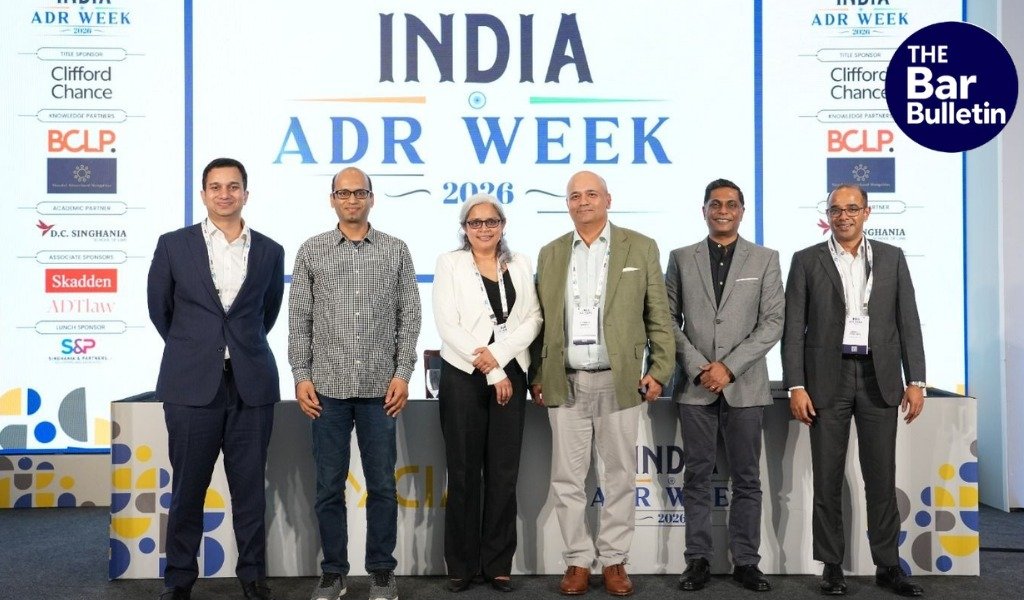

The Bengaluru leg of India ADR Week 2026, organised by the Mumbai Centre for International Arbitration (MCIA) as it marks its 10th year, saw a series of discussions on emerging issues in arbitration. The week-long India ADR Week, being held from September 7 to 11 across Bengaluru, Mumbai and Delhi, features more than 30 partner events and over 160 speakers, with Bengaluru hosting the opening day’s programme at The Oberoi.
The second session of the Bangalore event, titled “Corporate Governance in Conflict: Arbitrability of Investor Rights,” was hosted by Touchstone Partners and moderated by Sandeep Das, Partner, Touchstone Partners. The panel featured:
● Abhishek Goyal, Co-Founder of Tracxn;
● Mamta Sundara, CEO of Daksh;
● Navneet Hrishikesan, Senior Director and General Counsel, Cisco Systems India & South Asia;
● Ramanand Mundkur, Independent Director, Federal Bank; and
● Yashasvi Mohanram, Partner, Touchstone Partners.
Opening the discussion, Sandeep Das described corporate governance and arbitration as increasingly intersecting areas under Indian law, calling the question of whether corporate governance disputes can be arbitrated a “vexed question”.
Opening the discussion, Sandeep Das, Partner at Touchstone Partners and moderator of the session, said corporate governance and arbitration had reached an intersection that raised a “vexed question” under Indian law, whether corporate governance disputes can be arbitrated. He referred to a series of high-profile corporate disputes, including Zee-Sony, IndiGo and Tata-Mistry, while setting out the panel’s task of examining the evolving law on arbitrability.
Navneet Hrishikesan, Senior Director (APJ SP) and General Counsel (India & South Asia) at Cisco Systems, said certainty was one of the key concerns surrounding arbitration in India. On being asked about the uncertainty surrounding arbitrability and the role of courts in determining which disputes can be referred to arbitration, Hrishikesan said:
“
“Now I think one piece that in India creates a little bit of confusion on the certainty part is the fact that the courts keep, I would say changing the mind on what can be arbitrated, what can’t be arbitrated, shareholder disputes is.”
He explained that parties generally turn to arbitration because they want a dispute-resolution mechanism that is quicker and more certain. Referring to Cisco’s large commercial contracts, he said the objective is that if a dispute ultimately reaches a judge or arbitrator, the parties should be able to expect a “fast, quick, certain” process.
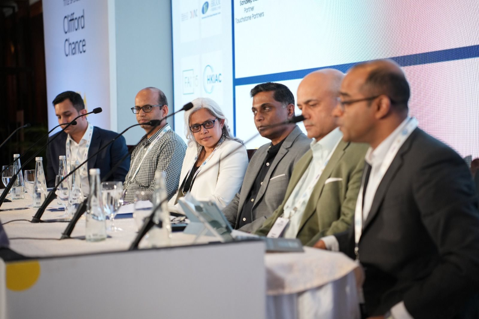
Abhishek Goyal: ‘Biggest issue’ is uncertainty over what can be arbitrated
On a question about whether expanding the scope of arbitration could create a situation where parties with fewer resources are effectively forced into an expensive process, Abhishek Goyal, Co-Founder of Tracxn, said arbitration should not become a deterrent for parties who cannot afford it.
He said that if the scope of arbitration is widened, parties with fewer resources should still have an option to approach courts directly, particularly because arbitration can be expensive. He also stressed that the larger problem was uncertainty over what falls within the non-arbitrable sphere.
On being asked about the limits of arbitrability, he said every country places some restrictions on sovereign functions being subjected to arbitration, but the difficulty arises when the definition itself keeps shifting.
“
“Every country has that requirement well more or less, every country more or less has the thing which says that sovereign functions cannot be arbitrated because this is largely a commercial dispute resolution mechanism. But if you keep changing the definition of what is sovereign and what is not sovereign, it leads to a lack of certainty from a business standpoint. So, I think if you ask me, that is probably the biggest issue… It’s not the institutional arbitration or the fact that that’s actually in many respects the best approach to try and solve disputes in this country.”
He also stated that arbitration could be made optional for weaker parties in investor-founder disputes, particularly where the cost of arbitration itself could become a deterrent
Ramanand Mundkur: India should adopt a less ‘binary’ approach to arbitrability
When asked whether the distinction between in rem and in personam disputes should determine whether an entire dispute is non-arbitrable, Ramanand Mundkur, Independent Director at Federal Bank, suggested a less rigid approach.
He said India was an outlier in the manner in which the distinction was applied. According to him, the fact that an arbitral tribunal may not be able to grant a particular kind of in rem relief should not automatically mean that the entire underlying dispute becomes non-arbitrable.
He advocated a “more flexible, less binary approach”, saying this could provide greater certainty to investors. Mundkur said India was an outlier in the manner in which it approaches the in rem versus in personam distinction. He stated that the fact that an arbitral tribunal cannot grant certain in rem remedies should not automatically render an entire dispute non-arbitrable.
He said greater certainty would benefit both foreign and domestic investors, noting that investors do not necessarily abandon markets because of uncertainty but instead “price in that uncertainty” while making investment decisions.
“
“If we took that more flexible, less binary approach to what is arbitrable and what is not arbitrable, I think it would do a couple of things it would provide far more certainty as far as investors are concerned, because the way investors behave when they see uncertainty is that they… look the market is just too large, the opportunities are just too large. They don’t run away from the market just because there’s uncertainty. But they do price in that uncertainty and their investment decision is therefore, based on that price. So, it would make India more attractive investment decision from that perspective and I’m not just talking about investment decision for foreign investors but for domestic investors as well.”
He also warned that businesses generally cannot afford to litigate merely over matters of principle and argued that a more nuanced approach could allow parties to arbitrate the contractual portions of a dispute even where other remedies remain outside the arbitral process.
On a further question concerning disputes involving multiple stakeholders, including cases such as Byju’s, Mundkur said the answer could depend on the nature of the dispute and the parties involved.
He pointed out that while disputes involving shareholders or creditors could potentially be dealt with through arbitration, a dispute involving students or other persons who had signed up for courses could raise different concerns because of the broader public-interest element.
Navneet Hrishikesan: Arbitration provides a specialised forum, but certainty remains a problem
Cisco’s Navneet Hrishikesan said the choice between litigation and arbitration ultimately depends on what the parties want from dispute resolution. He noted that arbitration can provide a specialised forum for technically complex commercial disputes.
“
“So, first you decide which what do you want out of it, right. The litigation or dispute resolution of any sort should not be based on you know, this guy did wrong to me, so I should get back to them. That’s not the intent here what is it that you want out of this whole thing, right. Once you decide on that then you decide on the mode.”
Hrishikesan said large commercial contracts at Cisco contain arbitration clauses because, if a dispute ultimately reaches a judge or arbitrator, the parties have generally already tried to settle it. What they want at that stage, he said, is a process that is “fast and quick” and provides certainty.
He also pointed to the uncertainty created by judicial changes on the scope of arbitrability, saying arbitration seeks to provide a specialised mechanism but courts continue to retain an important role in determining what can and cannot be arbitrated.
Whether Litigation itself Creates Uncertainty: Mamta Sundara’s Take
When Navneet Hrishikesan said courts appeared willing to let arbitration take on the workload while still retaining a say over what could be arbitrated, Mamta Sundara said the issue was not necessarily about judicial control alone. She pointed to the public-policy considerations that may arise in some disputes and which an arbitrator may not be able to consider.
“
“I think in fairness, there is an element of not necessarily only control, I think a public policy view that a judiciary can hold, which an arbitrator, I do not think will consider. It is not within their remit to consider and they are right in not considering it. But some disputes will have that element.”
Later, when Sandeep Das asked whether the public-policy approach could lead to multiplicity of disputes and litigation, Sundara answered, “Absolutely does.” When the panel was asked how certainty could be achieved if courts continued to take different views on arbitrability, Sundara suggested that Indian courts and practitioners needed to undertake a more serious analysis of Indian and comparative jurisprudence, including approaches followed in jurisdictions such as Singapore and London. Otherwise, she warned, “we will keep flip flopping like this depending on which judge is looking at an issue.”
She also cautioned against judging arbitration only through the relatively narrow debate over investor rights. Responding to the broader discussion on whether arbitration was actually working in India, she noted that a much larger universe of commercial disputes is successfully resolved through arbitration and never reaches the courts.
“
“let’s not forget we are talking about a narrow issue on investor rights arbitrability. There is a larger universe of commercial disputes that are getting arbitrated and are not coming to court every day. So let’s not let’s not forget that actually it is effective, it may not be perfect.”
Yashasvi Mohanram: Investors are already pricing in enforcement risks
Touchstone Partners’ Yashasvi Mohanram discussed the practical difficulties faced while drafting shareholder agreements, particularly for foreign investors seeking returns through put options and other contractual mechanisms.
He said lawyers constantly have to track developments concerning the enforceability of damages and put options and whether particular provisions could be regarded as punitive.
“
“It is always an overhanging risk from an investor perspective and clients, as Ramanand say, said they almost walk into it with their open eyes. But they almost pricing this risk to say that if there were to be a default event and if your nuclear option is that you have an option to sell back to an Indian party, you know that it may not be fully enforceable.”
Mohanram said lawyers consequently try to build alternative structures into transaction documents to address the possibility that an arbitral award may face enforcement difficulties in India.
Towards the end of the session, when asked whether major corporate governance disputes such as Zee-Sony, IndiGo and Tata-Mistry could have been more efficiently resolved through arbitration, Mohanram gave a qualified response:
“
“Given that we’re running out of time, is that if absent fraud or absent a regulatory interface, I think they would, they could be and if there was an underlying agreement they could be, but as Abhishek was saying invariably in all of these cases either fraud is pleaded first or the fraud comes in later.”
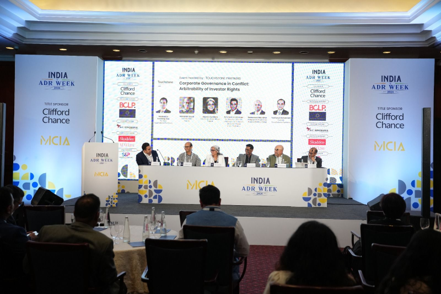
Ramanand Mundkur: ‘We have this habit in India of… continuing to appeal the unappealable’
In the concluding exchange, Mundkur said arbitration’s effectiveness ultimately depends on parties respecting the finality of arbitral awards.
“
“As far as the Parties to the arbitration themselves are concerned, very often we have this habit in India of just not giving up and continuing to appeal the unappealable. And so, that finality of the award never seems to establish itself sufficiently strongly enough and if there were a focus on that side of it, then I think arbitration would become a far more powerful tool in India.”
Sundara, meanwhile, cautioned against viewing the investor-rights debate as representative of arbitration as a whole, pointing out that a much larger universe of commercial disputes is already being arbitrated without regularly reaching courts.
The discussion concluded with the panellists emphasising the need for greater certainty, clearer boundaries of arbitrability and confidence in the finality of arbitral awards, while recognising that not every corporate governance or investor dispute can necessarily be resolved through arbitration.